

Issue #411: Dominant Strains of Thought, 2025's Cinematic Unconscious
I designed this round of Music League to be thought-provoking. The idea was to submit “cancelled” artists, so obviously if you click through to the playlist you are going to see some scary music by some abhorrent people.
Here’s the prompt as I wrote it:
Music by an artist who has either been “cancelled” or has views or addresses topics in their music that are unambiguously offensive to polite society.
Evaluating this prompt, I don’t think it entirely matches the spirit of my intention. I wanted to leave room open to submit songs by artists or bands who have made a home for themselves within offensive subcultures. Their commercial viability and cultural circulation would be limited by their own aspirations as opposed to having been subject to some kind of sudden public scrutiny. The idea of “offensive,” here is far too permissive. If you read it to the letter, and you’re an average person, you might find Cannibal Corpse’s music to be offensive, for instance. But a band like that, which has been highly successful, and is understood as presenting their lyrical subject matter as an artistic choice rather than behavioral prescription, isn’t really what I had in mind.
Almost everybody abided by the prompt as written. When I think about my intention, though, G.I.S.M. falls into that Cannibal Corpse category, where the band is totally beloved because of Sakevi’s reputation rather than in spite of it. It seems to me there were a few other examples here that have objectionable lyrical content but are otherwise upstanding citizens.
Despite all this, the playlist captured the essence of what I imagined it would. Some of these submissions were easy for the submitters and obvious to listeners: R. Kelly, Diddy, Bill Cosby, Inquisition. Horrible people making music ranging from awe-inspiringly good to atrociously bad. All of these songs together pose a question about how we should encounter these works. I am neither in favor of abandoning great art for the sins of its creator nor inflicting oneself with an overriding sense of guilt because of how a work moves us. At the same time, discovering an artist has done something objectionable from an individual or broader point of view will change our relationship to the art. The toughest to listen to for me were the Chuck Berry and Diddy submissions, disgusting and unsettling in equal measure because of what we have come to learn about them.
These sins, such as they are, may be written into the art in ways legible or illegible. Or maybe legible only in retrospect. But this is something we must confront as a fact of artistic production. The most recent favorite artist who did something you find awful won’t be the last. And I don’t want to be prescriptive. Listen to them or don’t. Listen to some and not others. Do what you can live with. But don’t give in to the judgment of a crowd; render your own.
One of the things I think this playlist was a little worse at is denaturalizing the kind of stuff in popular music most have come to accept but perhaps would benefit from more consideration. There are cases if society at large discovers that the artist had done precisely what they say they did in their music, society at large would condemn that artist whose music they so loved — we’ve seen as much with the momentary moral panic toward Cardi B. Fortunately, this one didn’t stick. But it has not been the lesson it should have been: projecting valor onto artists because they are great at making art produces a deeply distorted view of the artist.
Trends in Film: 2025
Every year I try to look back at what’s going on in the year’s movies. I usually have a hard time, but this time was easy. These threads I picked up were not subtle. The relation of these films to one another and among the groups mostly jumped out at me.
Reflecting on the year, I think this was a phenomenal one for film. I regularly had a great time at the theater. Though I am a harsher critic of Sinners and One Battle After Another than most, I liked both. When I think about my top ten, any of them could have been #1 another year. Speaking of which, here’s my in-progress Letterboxd list of favorites from 2025. Below, the strains of thought.
Political Commentary
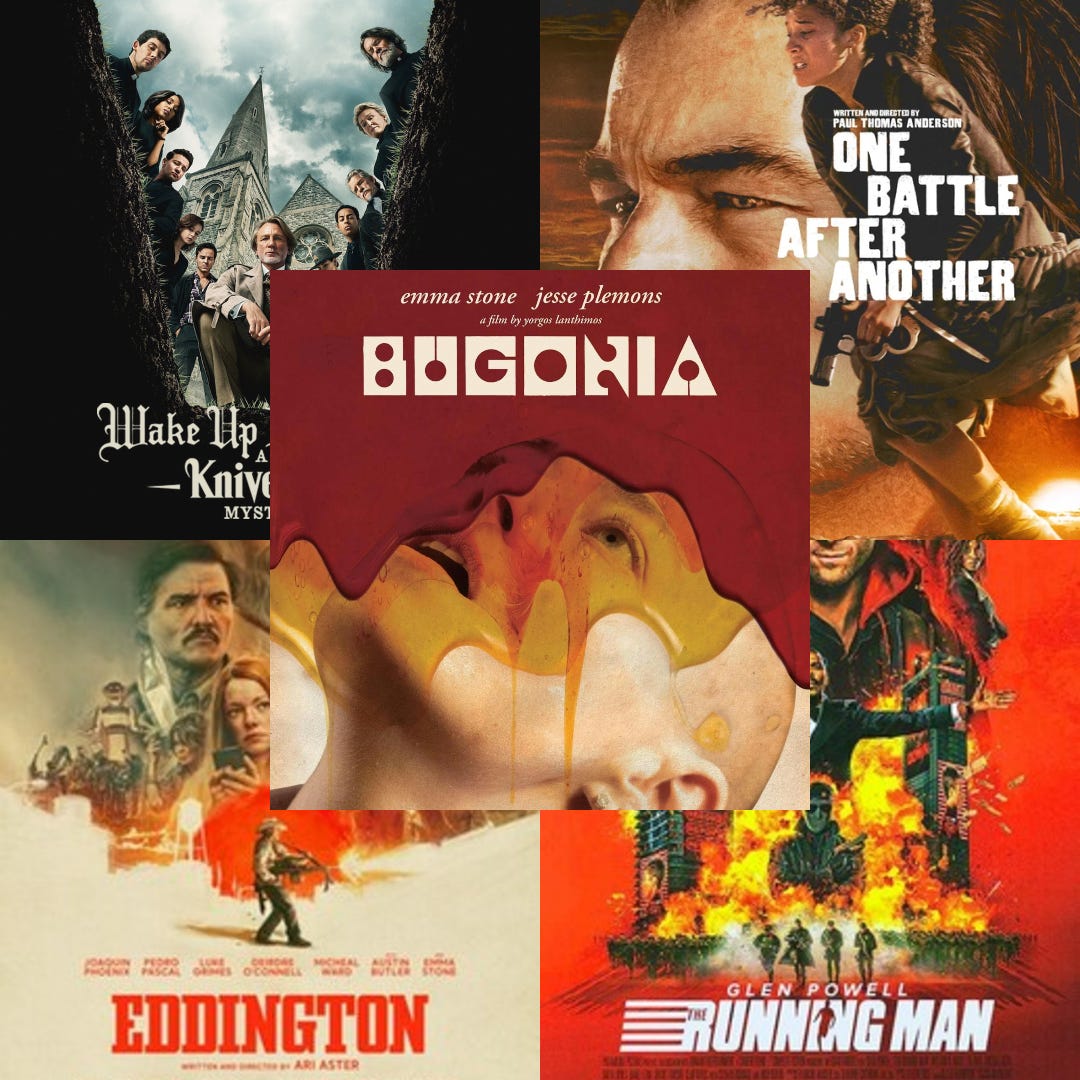
“Art in the Age of Trump” came through in a big way this year. Bugonia, One Battle After Another, and Eddington all presented a satirical view of a distorted, incoherent political world. Even Wake Up Dead Man and The Running Man made pointed critiques of right wing ideology through exaggerated caricature. Among these films, all but Eddington are clearly progressive in their orientation. But it is a question as to what degree these films achieved their ostensible aims.
Wake Up Dead Man oriented all of its characters around a conservative ideologue, Monsignor Jefferson Wicks (Josh Brolin), who cultivated his flock through sewing division and fear. Though he is clearly Trumpian, the even more absurdly presented Cy Draven (Daryl McCormack) is more interesting to me. Draven captures the essence of what disjoins the order of politics at the level of normative ethical frameworks. What Draven evaluates as good or bad is totally distinct from Jud Duplenticy (Josh O’Connor), making it impossible for them to find common ground. They don’t even understand where — to continue the metaphor — each is situated on the map. Ultimately, and like The Running Man, Wake Up Dead Man has the smug, self-congratulatory, condescending quality characteristic of a 2008-era politics that takes the “right side” as a given.
By contrast, Bugonia, One Battle After Another, and even Eddington (which I despised) all deserve credit for being movies of our time that properly reflect the polarized, unpredictable, and downright bizarre nature of the U.S. political landscape. In each film, what hides beneath the veneer of a political position is never what one expects. One Battle After Another is undone by exactly this imperative, presenting Steven Lockjaw (Sean Penn) as the most psychologically and ideologically complex character in its nexus of would-be revolutionaries and Christmas Adventurers.
A similar but more effective subversion is the essence of Bugonia and its plot. The movies that have explicitly intervened in the global political landscape are best when they show how the conventional wisdom of political understanding has fallen away. While Mickey 17 and No Other Choice could also be considered along with these films, I think they are a bit more reflective of their respective directors’ overriding investments as opposed to part of any cresting aesthetic trend.
Absent Fathers
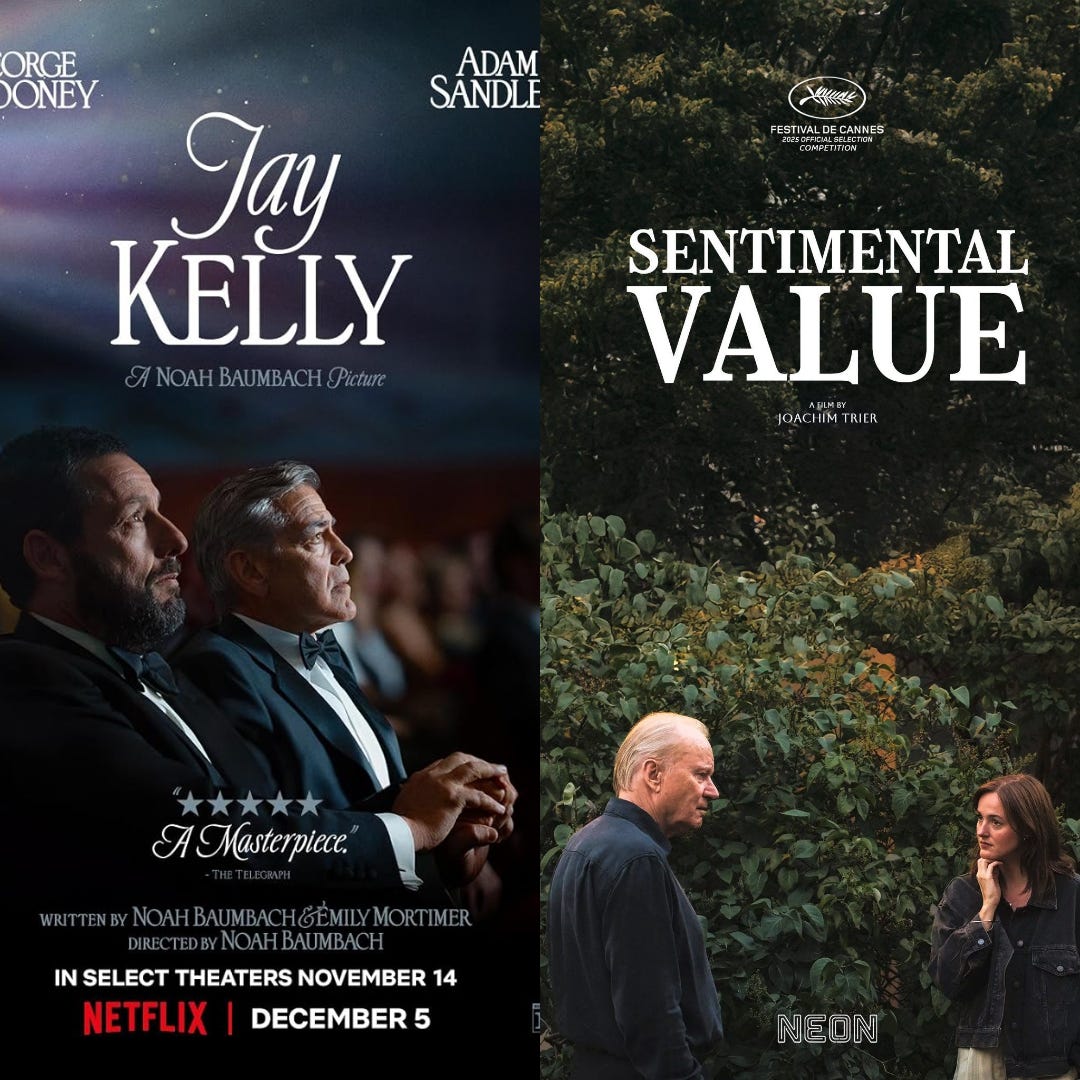
When Nietzsche declared the death of God, he meant the death of sense. The end of a guarantor to authorize knowledge, morality, and social life. In Jay Kelly and Sentimental Value, the god (the father) is not dead, but he is absent. Coincidentally, doing the same thing, pursuing his dreams in the world of cinema and ascending to the height of the medium in different categories.
This is a shorter list, but it really felt like there was something in the air. What Jessica Kelly (Riley Keough) puts at the feet of her father (George Clooney) is a simple but resonant view from the vantage point of a child examining a parent’s priorities. “Do you know how I know that you didn’t want to spend time with me? Because you didn’t spend time with me.”
Along with these two, it is worth mentioning The Surfer (2024) which is also about absent fathers. It was first released in theaters in 2025 after a 2024 festival premiere. I consider it a 2025 movie, but I’m being restrictive in these groups.
Josh O’Connor
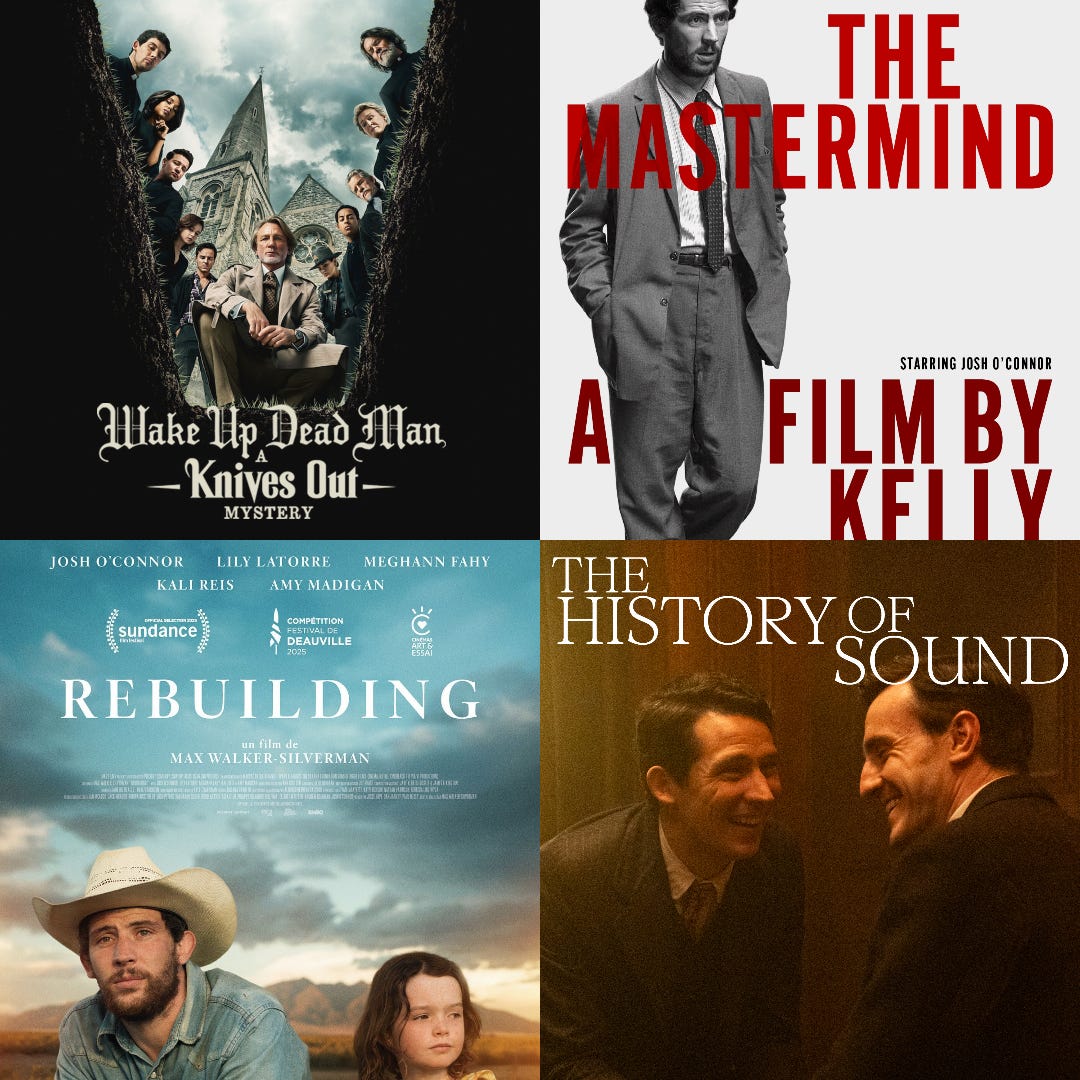
What a year this guy has had. Four huge roles in four critically acclaimed movies. There’s nothing to do here but marvel.
Biopics
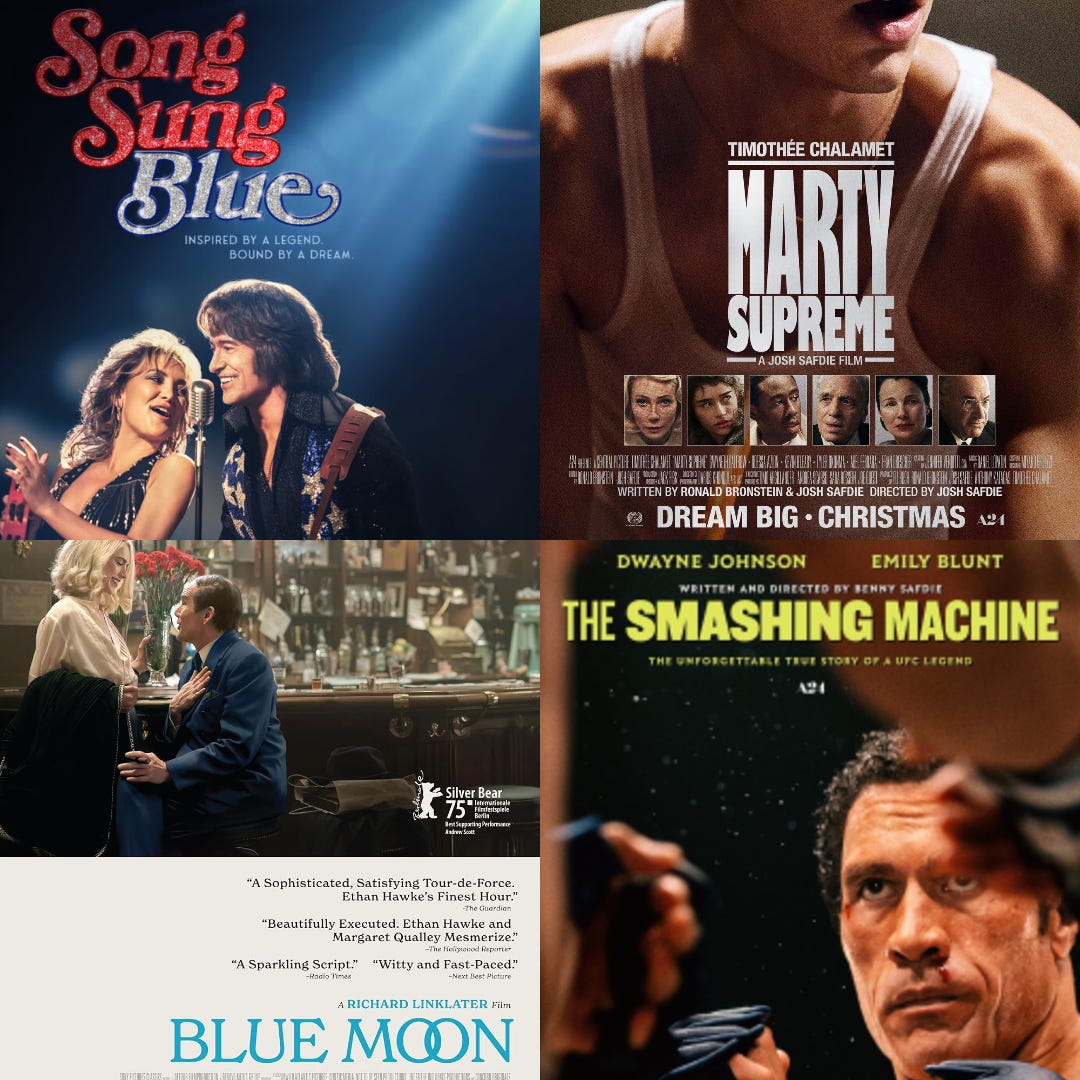
If I were making sub-lists I would do one for Safdie directed niche sports biopics. Something must be wrong with those guys. Come to think of it, between Marty Supreme and If I Had Legs I’d Kick You, maybe the Bronsteins deserve their own heading on the list. Their kind of abrasive, confrontational, anxiety-inducing screenwriting is having a moment.
More than anything, these movies indicate we might be running out of interesting people to make movies about.
Fan Culture
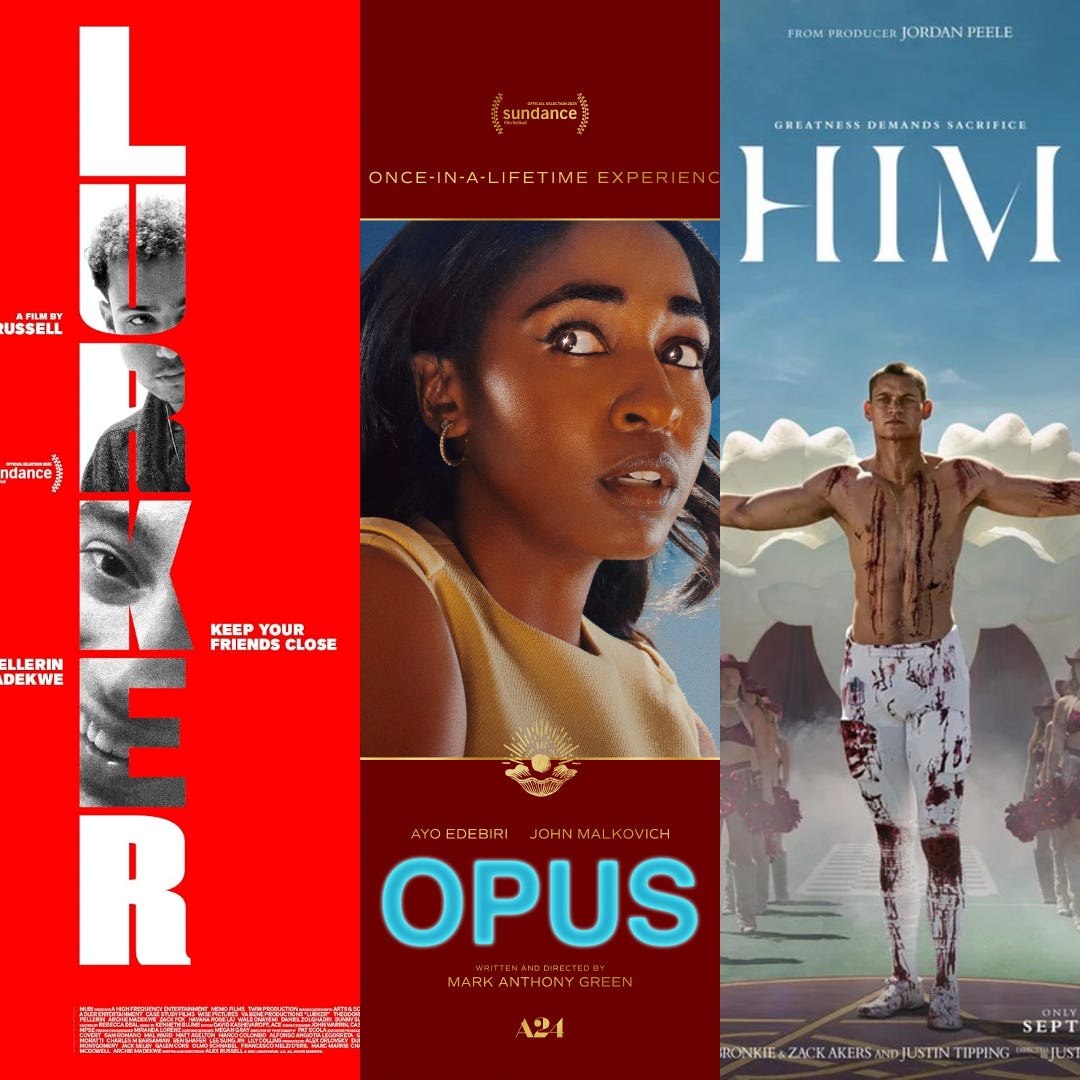
Stan power is unmistakable. Even as twitter’s social significance wanes, fear of offending the rabid groups of anonymous online fans is palpable. Five Nights at Freddy’s 2 demonstrated this as Owen Gleiberman farmed fan discontent for clicks in his review for Variety. Lurker, Opus, and Him, to varying degrees, take what is old (Spree [2020]) or older (Audition [1999] and Misery [1990]) and make it new again. Lurker is the standout among these, but Him has been unfairly maligned. It is quite good. What is perverse and harmful to both the fan and the subject of fandom is what these films ask their audience to confront. The Rebrand also touched these themes, but it was much more focused on examining the influencer as opposed to the fan.
Horror
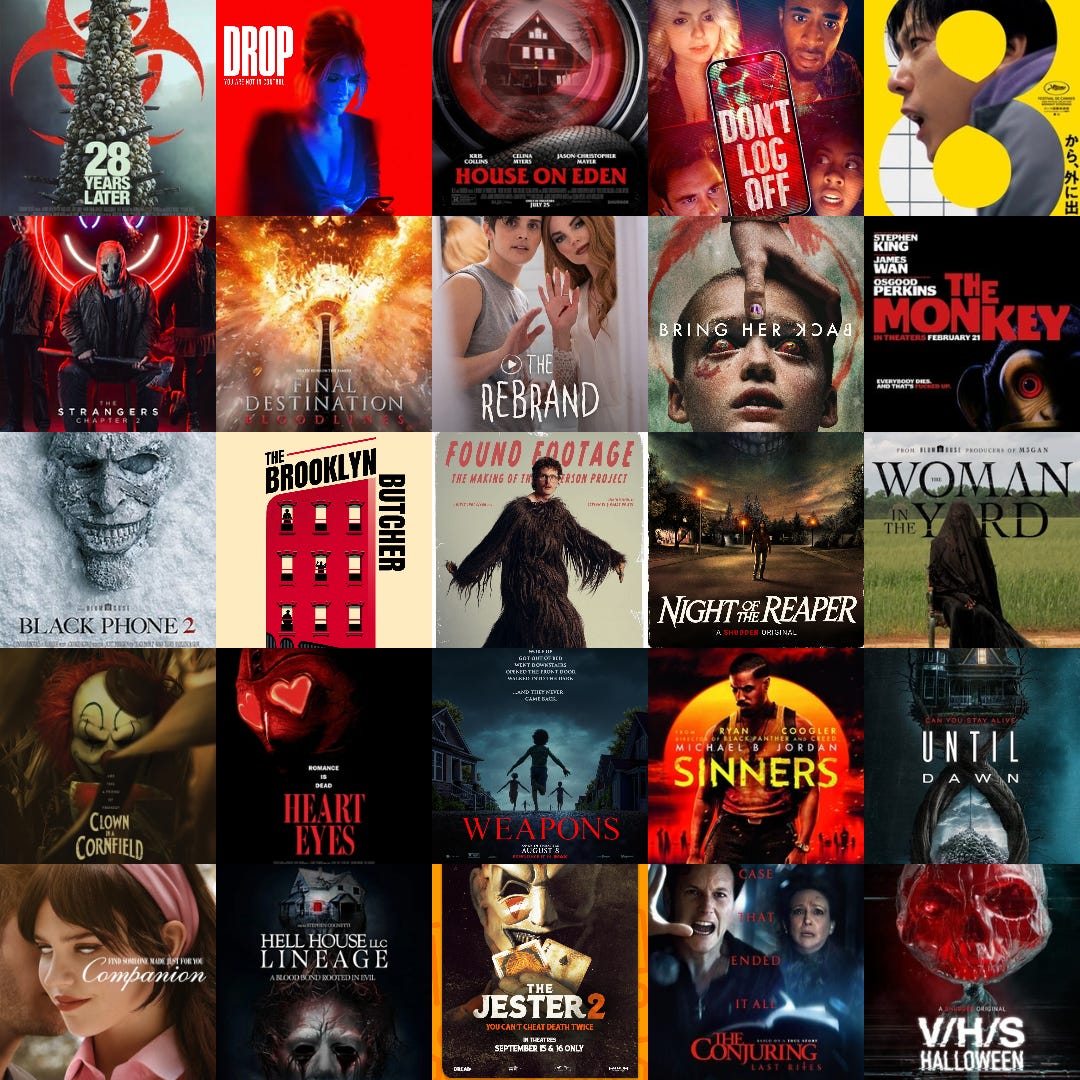
By my count, I watched a staggering thirty-two horror movies released in 2025. Notice the comical dimensions of the collage which is not even exhaustive. There are others — exceptionally good ones — that don’t fit according to their listed release year but do according to my logic. Shelby Oaks, Strange Harvest, Cloud (if you count this, which I think is debatable), Presence, and The Shrouds all had festival releases in 2024 but weren’t available in theaters in the United States until this year. That is, all told, thirty-seven horror movies. All but one, Exit 8, were distributed or independently released in the U.S. The message is clear: the horror audience endures. And its formal strictures have become the playground for independent filmmakers like Max Tzannes, Kaye Adelaide, and Brandon Christensen. It’s also big business for production houses like Blumhouse, attached to many of the films I saw.
Two films regarded as among the best this year fit, to some degree, into the genre. Weapons and Sinners both enjoyed enormous critical acclaim. Weapons, especially, marks an important switch point for the genre’s critical reception. There is no debate Zach Cregger, like Jordan Peele, makes horror films with the pulpy irreverence that is conventional for the genre. Cregger has also proven himself as a beloved auteur without the normal stripped-down, quiet-voiced, vaguely plotted trappings of the impressionistic “elevated horror” that plagued screens thanks to Ari Aster and Robert Eggers.
I’m not a box office returns guy, but a few notable (financial) flops like Him, The Strangers: Chapter 2, Megan 2.0, and Woman in the Yard did not slow the snowball of, apparently, record-breaking profits for the genre.
As a fan, I’m always open to more, and more varied, horror films. I missed some truly great films, like Shelby Oaks and Strange Harvest, in theaters, but I think that has more to do with their limited theatrical windows and poor promotion as opposed to an overstuffed release year. All the indices by one can predict future film releases point to more major and minor horror films in the coming years. Bring it on.
Weekly Reading List
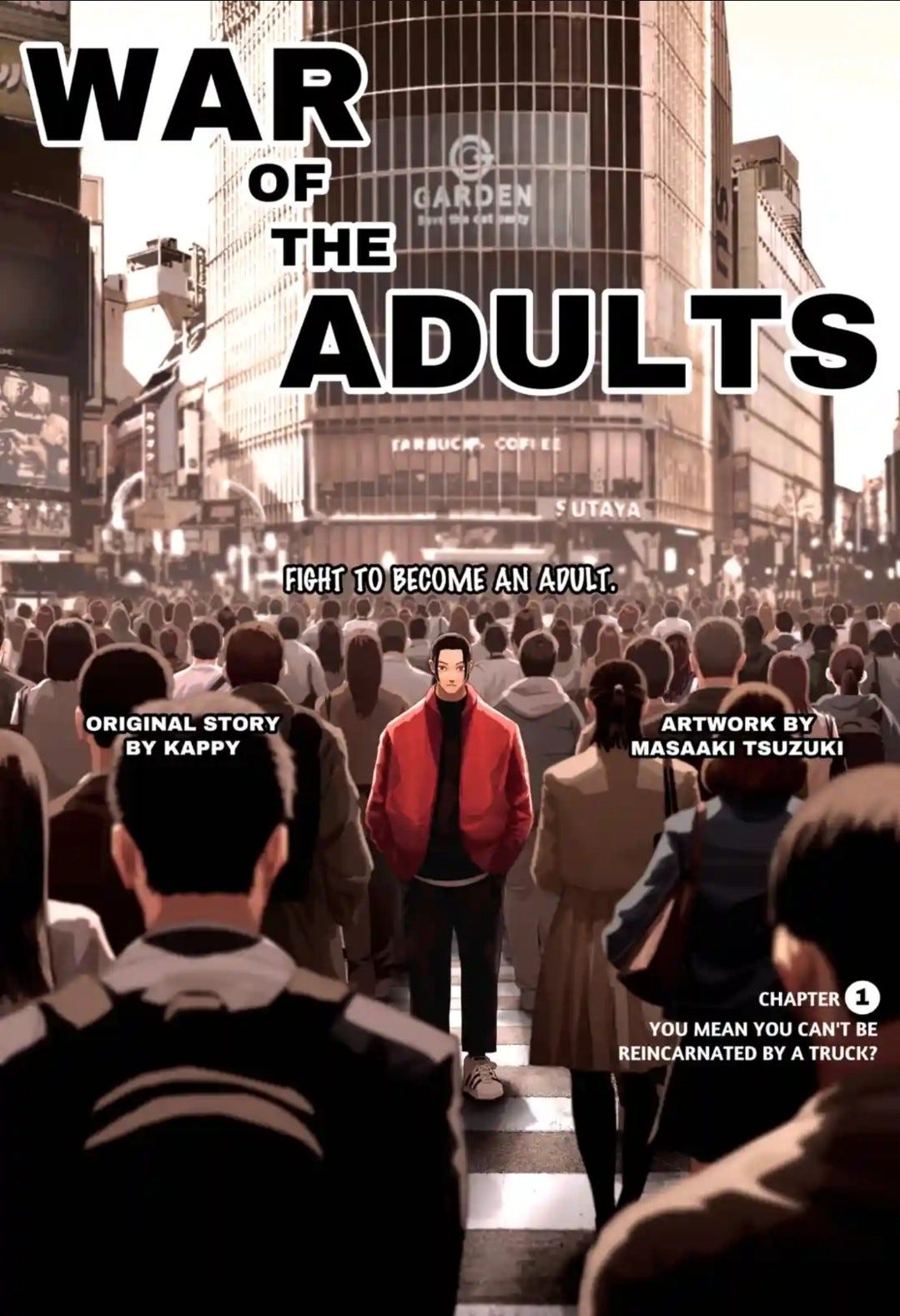
https://mangaplus.shueisha.co.jp/titles/100479 — Kappy’s War of the Adults (2025) is an unusual manga that just began serialization this past April. I shouldn’t say too much about the premise. The manga introduces it as a twist during the first chapter. It’s worth a read. I’m sure I’ll write about it as I get caught up to the current chapter.
Pretty impressive selection here from Vince Staples. He’s right, we should say Robert Towsend’s name more. I say it fairly often myself.

A nice reunion of the Jakarta youth crew legends Raincoat.
This is big.
Event Calendar: Kubrick Comes to Harvard
I had the pleasure of seeing The Shining (1980) in IMAX last week. If you missed it, thankfully, those local to the Boston area will have another opportunity as part of the Harvard Film Archive’s The Complete Stanley Kubrick program. Yes, they are screening everything. And on film. Do not miss it.
Until next time.