

Issue #417: Keisuke Itagaki's Lesson on Passion
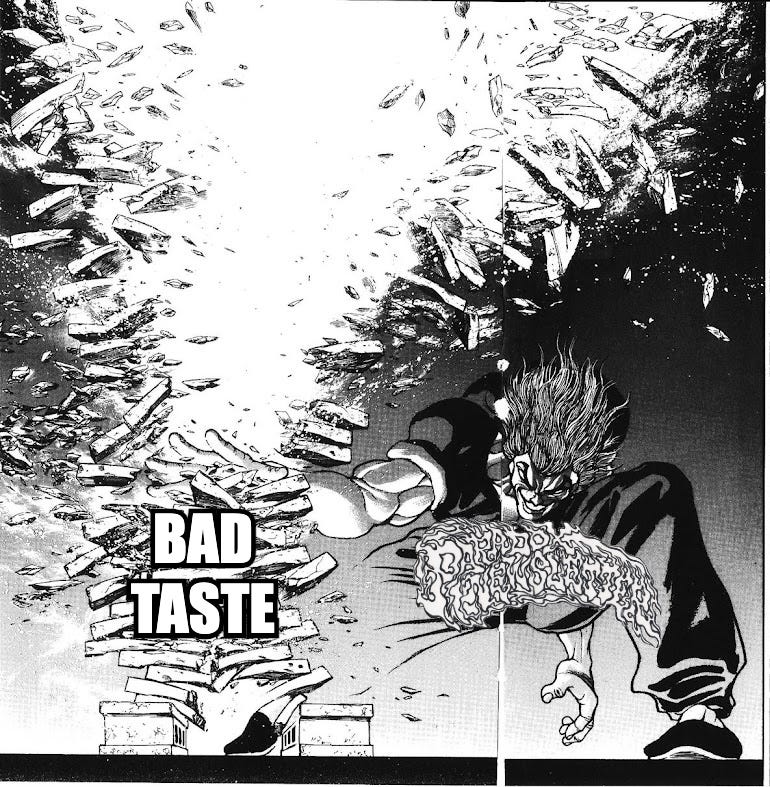
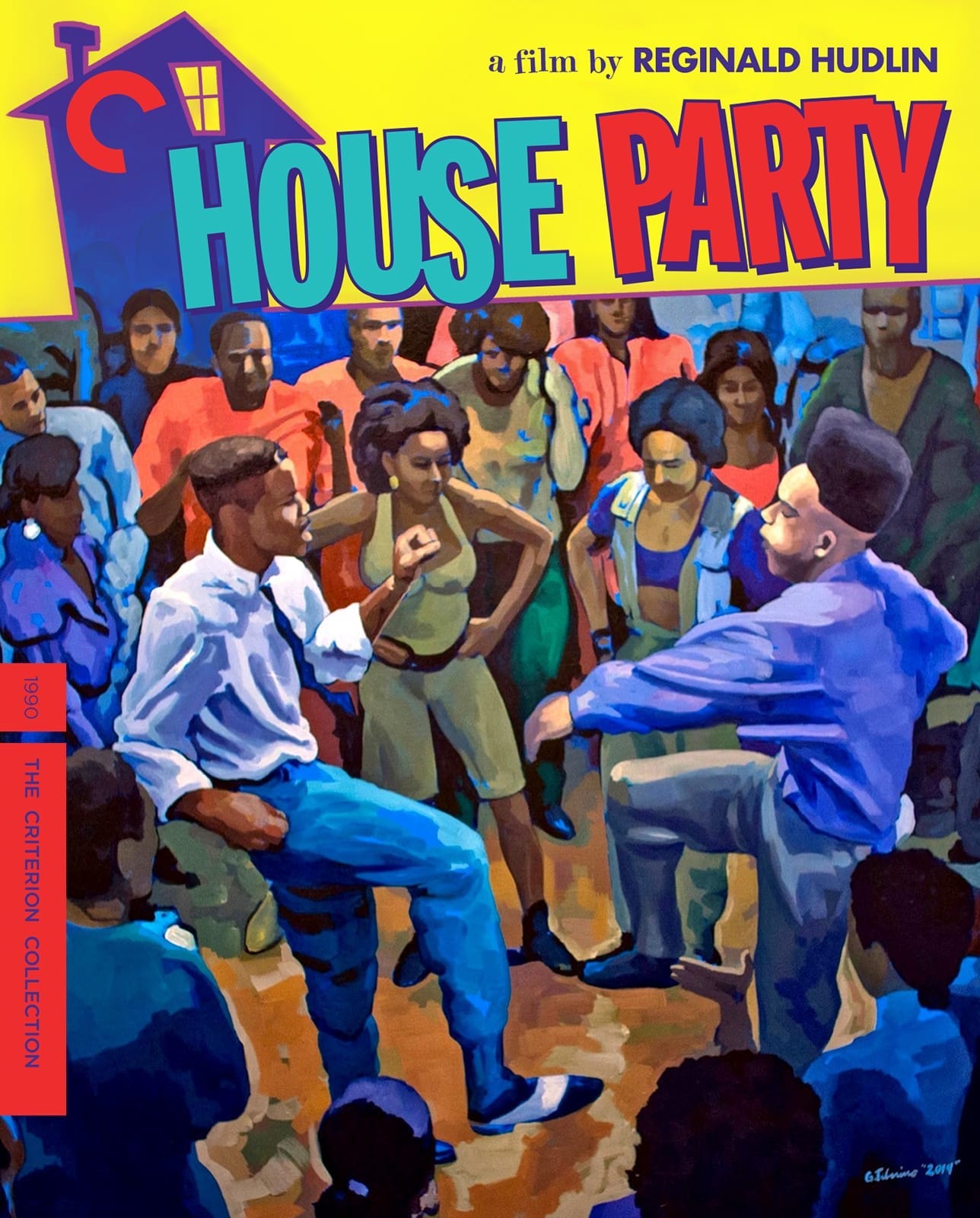
House Party (1990) has made it into the Criterion Collection.
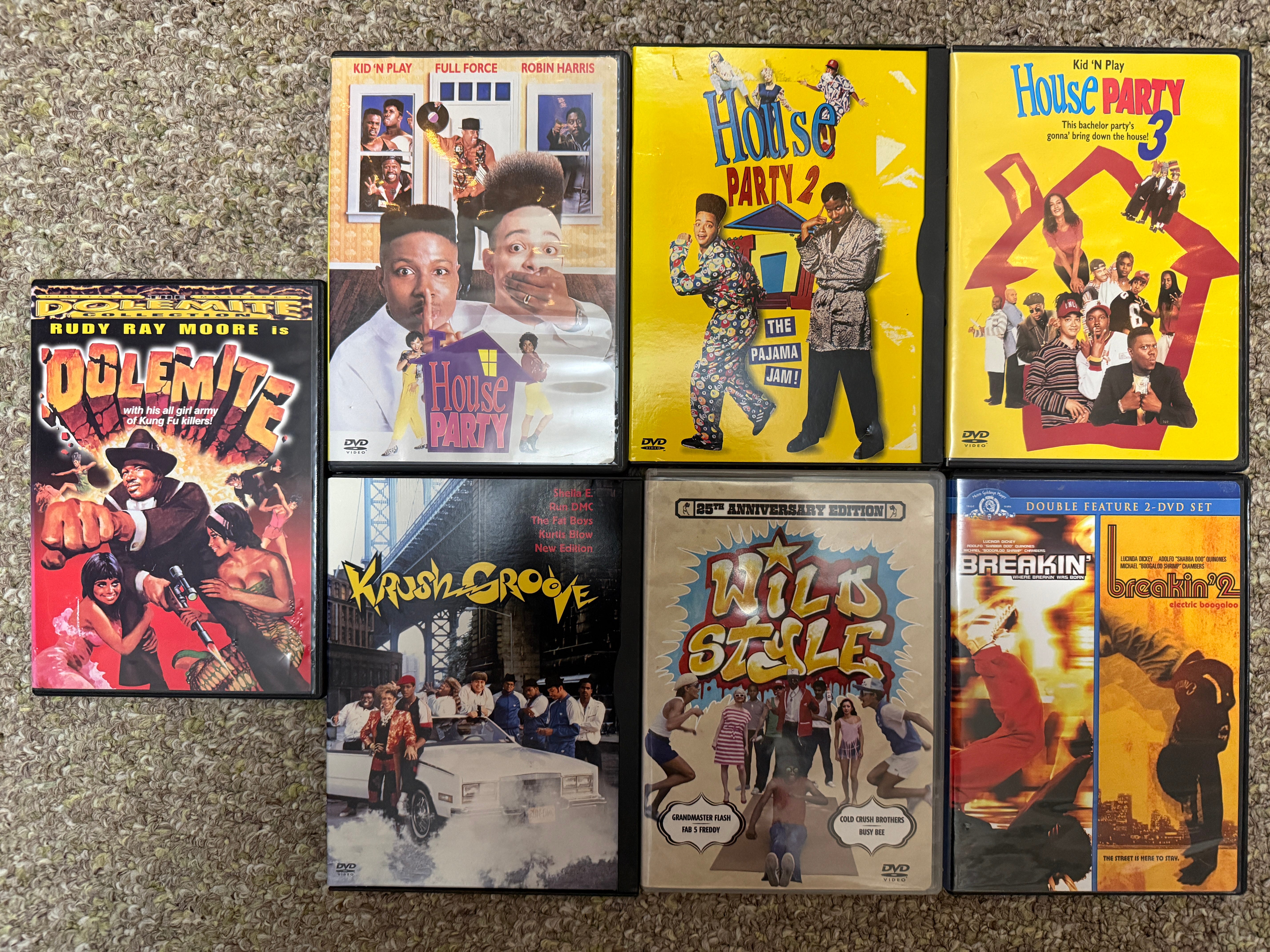
There are few movies, in my view, more deserving. House Party is the greatest (non-action) comedy ever made. Christopher “Kid” Reid and Christopher “Play” Martin defined ‘cool’ for me as a young person. What I value in a work of art, especially a modern one, is the ability to be both outstanding but also serve as a repository for cultural knowledge. Through House Party, I learned about Breakin’ (1984), Krush Groove (1985), Wild Style (1983), and Dolemite (1975). Extremely improbably, all of these films, along with every installment of House Party, were sold at my local Wal-Mart at around the same time in the early 2000s. I still own all the DVD copies I bought back then, too.
This new Criterion version of the film is fantastic. Unfortunately, the two House Party sequels are not very good. The differentiator is Reginald Hudlin, who wrote and directed only the first film and has a tremendous commentary track for the Criterion release. Hudlin elaborates on the casting process (Will Smith was in contention) and some of the running gags, like the reference to comedian Dick Gregory’s health food shake.

Some of House Party’s humor hasn’t aged well, but I embrace these imperfections. It is a must-see.
The Martial Arts Manga Against Which All Can Be Measured
Keisuke Itagaki’s Baki is a fairly common recurring topic for the newsletter. Comprising six serializations — Baki the Grappler (1991), Baki (1999), Baki Hanma (2005), Baki-dou (2014), Bakidou (2018), and Baki Rahen (2023) — the most recent of which is still ongoing, it is a martial arts epic of unprecedented scale. In the past, I’ve discussed Itagaki’s tendency to illustrate real-life sneakers, an enduring element of Baki that remains one of my favorites:
Baki also includes one of the coolest manga characters ever, Kaoru Hanayama:

But Baki is a work for all seasons.
Though the premise transforms, it has a Shakespearean, or Freudian, undercurrent that sets the protagonist Baki against his father, Yujiro Hanma. Yujiro is a monstrous figure who has made Baki’s life hell in service of trying to make Baki the ultimate fighter. He hopes to pay back his father in kind, usurping “the strongest living creature on Earth.”


Even as Itagaki duplicates sneaker silhouettes with extreme detail, his vision of the human body is much less naturalistic. There’s a gruesome, repulsive quality to the muscled figures he illustrates. At times, the bodies are ugly enough to be Cronenberg-esque.
In the first manga, Baki the Grappler, Baki faces an unexpected obstacle: his illegitimate brother Jack. He has neither the preternatural gifts of Baki nor the abusive training at the hands of Yujiro. Instead, he is a distorted Captain America figure, who uses performance-enhancing drugs to become a physically imposing fighter.
After losing to Baki (of course), Jack abandons drugs and instead undergoes surgery to extend his arms and legs.
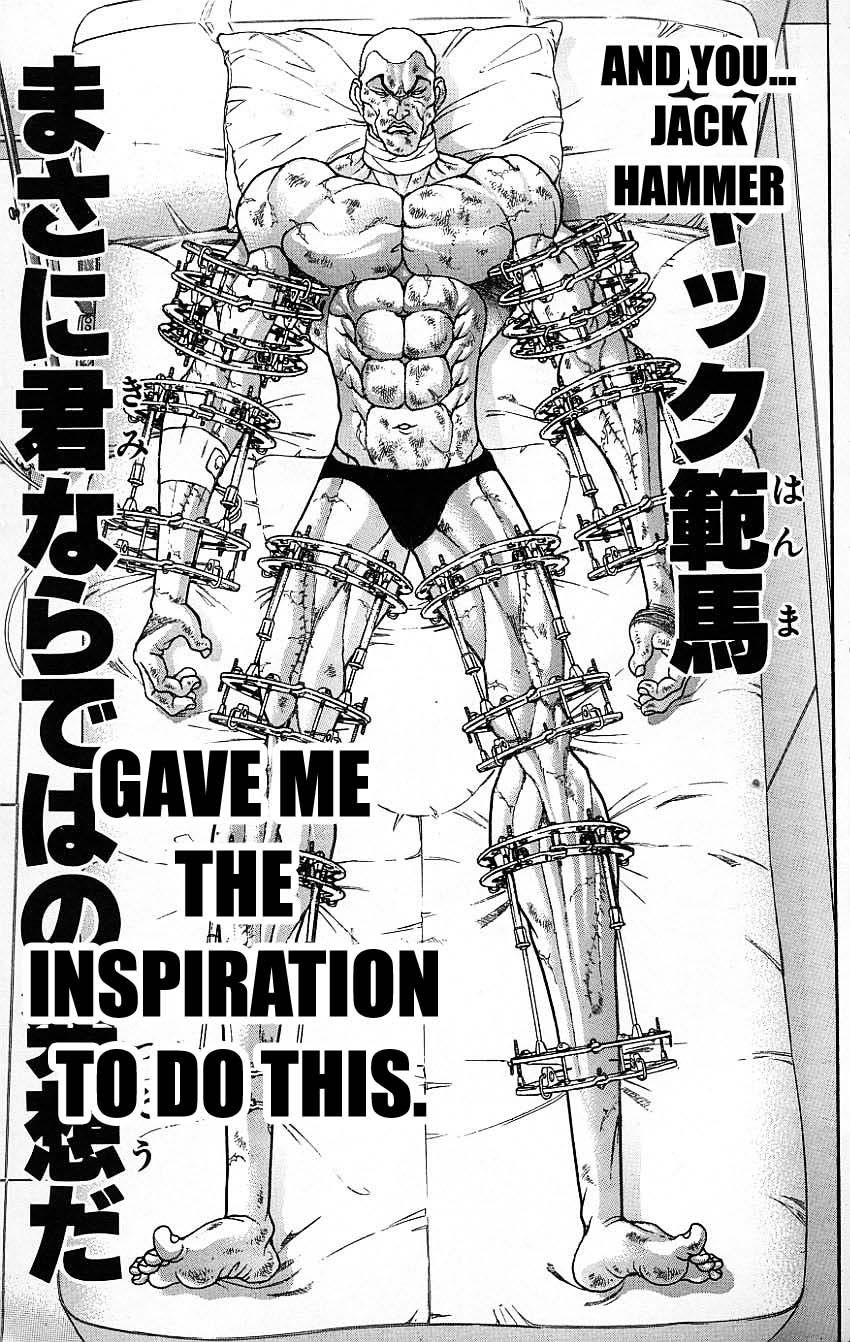
Re-reading these pages now, I can’t help but think of the guy who claimed to have had his legs lengthened on Everybody’s Live with John Mulaney (2025).
Jack’s reliance on medical treatment to elevate his combat prowess makes him an important figure in Baki. Itagaki’s world treats Jack’s choices as shortcuts, subversions of the hard work and dedication that make many of the manga’s other characters strong. Thus, Jack often falls short — though he also gets his due from time to time, simply because recurring characters in martial arts manga have to win sometimes.
It is impossible for me to escape the gravity of the “Most Evil Death Row Convicts Saga,” the opening arc of the Baki manga (the second serialization) and the 2018 Baki TV series. I re-read it often. The story takes place after Baki is victorious — beating Jack — in an underground martial arts tournament that establishes Baki as the greatest fighter in Japan (except for Yujiro). Baki, like many other works in its genre, dedicates a great deal of time considering the difference between fighting for sport and fighting for survival. Underground, illegal combat tournaments tend to be closer to the latter. There is something limiting, in Itagaki’s view, about fighting for people’s entertainment as a public athlete. The self-serving motivation is counter to what Itagaki seems to value about any practice.
Still, if Baki is implicitly greater than all of Japan’s public martial artists, and has ascended to the top of the hierarchy of underground martial arts, Itagaki must figure out a way to raise the stakes and bring his narrative closer to the unrestricted fight for survival that martial arts helps one survive. Thus, the conceit for this “saga” involves, as the title suggests, the escape of five death row inmates from various prisons around the globe who all travel to Japan to “taste defeat.”
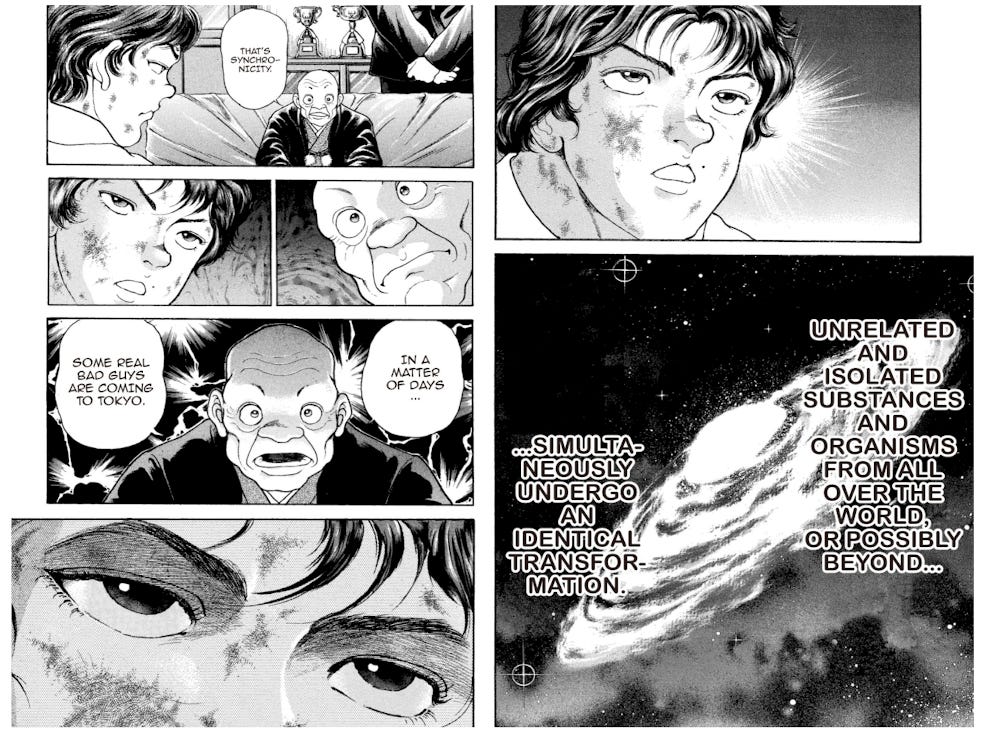
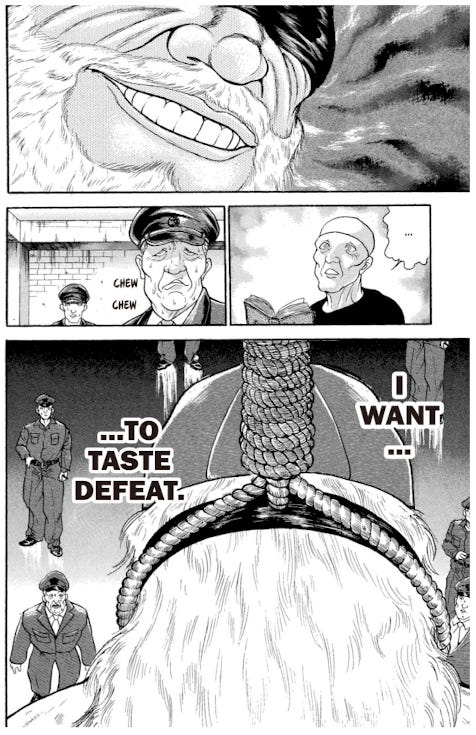
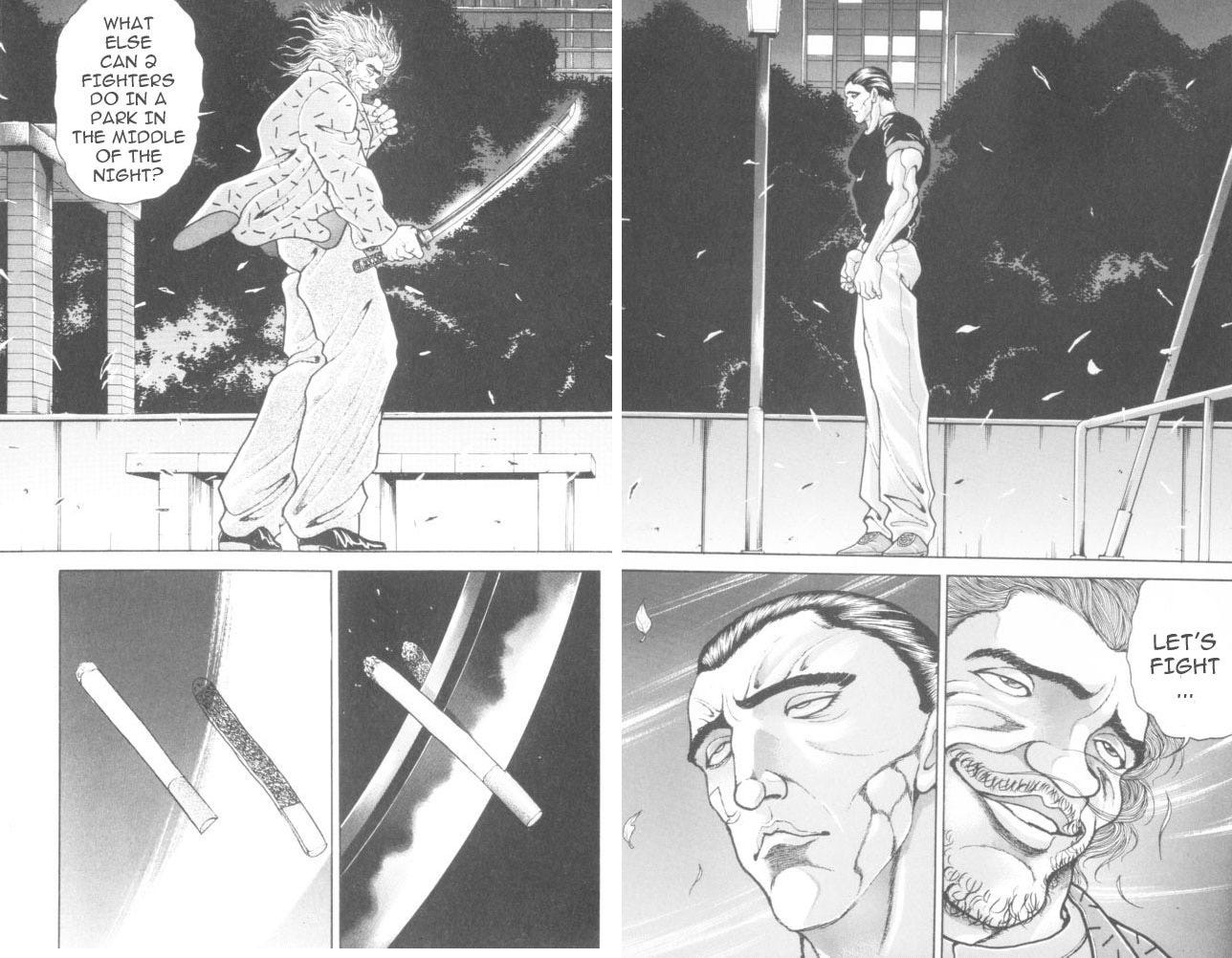
These extra-legal combatants are in a further state of exception relative to underground fighters. And, indeed, the five death row inmates hunt competition in the course of normal life. The fights in this part of the manga are on the street, at the park, on top of a roller coaster. Only rarely do they make their way to an arena. It is Hobbesian. Like the fighters themselves, Itagaki hunts for a fictional setup that will put his characters’ lives on the line.
The villains of this arc fall short for the same reason as Jack. They are not committed. Their power pales in comparison to the practitioners of martial arts or strength training who push themselves in the course of daily training.
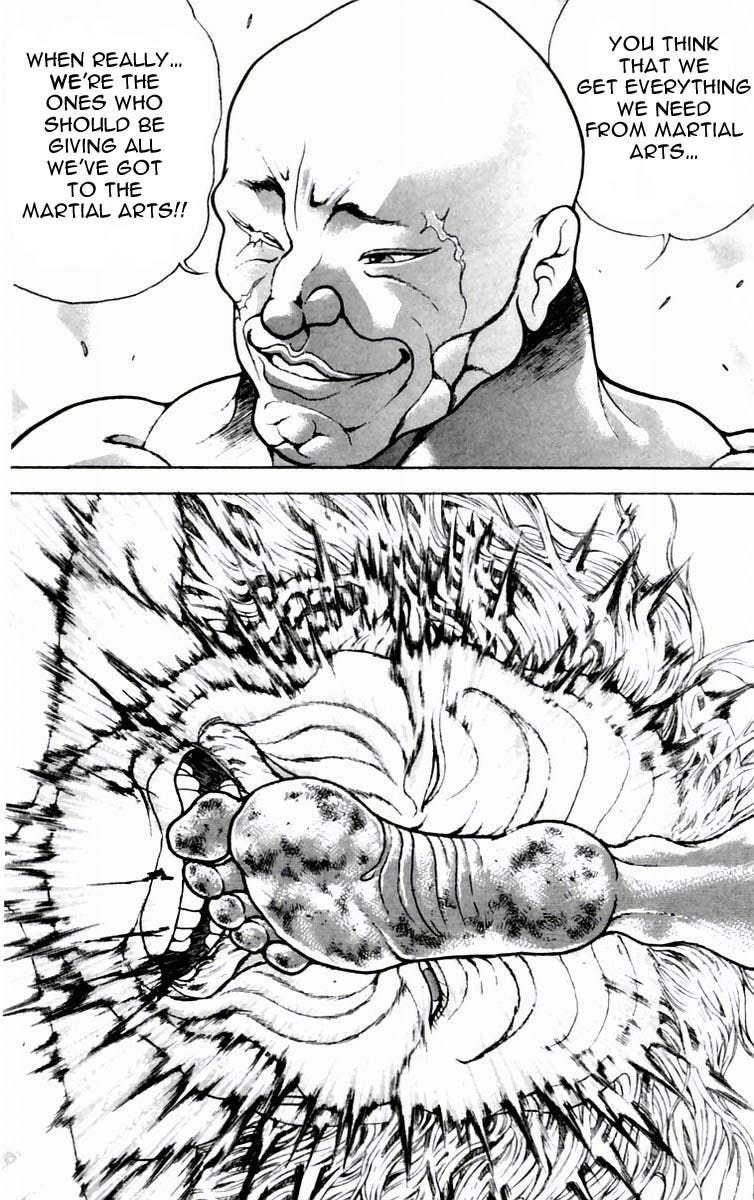
Itagaki’s message above all else seems to be this: having a passion does not enrich you. It asks everything of you and offers nothing in return. It’s only through this dedication someone might find anything worth having. The uncomfortable truth of this idea is why Baki endures.
Weekly Reading List
It is an extremely good and cool idea to sample a marching band for your rap song.
Kai Budde is the Michael Jordan of Magic
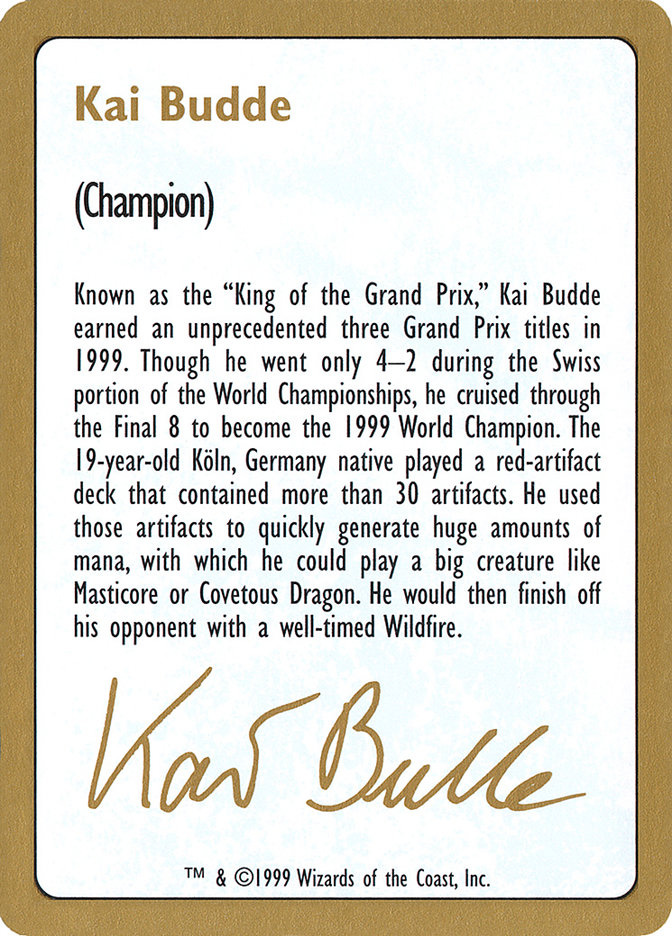
Kai Budde’s death was announced on January 29th, the day before this past weekend’s Pro Tour. We knew it was coming. Martin Jůza called the cancer that killed him “the only opponent [Kai] cannot defeat,” and Budde himself referred to it as “very likely lethal” in both of the videos below. Kai’s life is inextricable from Magic, as you’ll hear in Marshall Sutcliffe’s (and WOTC’s) moving tribute below:
I wrote about Kai in the newsletter a lot, most after I learned about his illness in July of 2024. He has been the imposing god of competitive Magic since I first learned of his exploits leading up to my tenure as a competitive player back in 2004. In the letter, though, I was happy to write about Kai’s stunning performance in 2019’s Mythic Championship III.
But I discussed Kai at the greatest length after he announced to the world he was sick, along with the reveal of Magic naming one of its preeminent honors — Player of the Year — after him.

Along with the Sutcliffe-narrated memorial video, WOTC also prepared a video that is mostly Kai talking about himself:
Even though I followed his career closely for many years, I didn’t know Kai. His passing is an occasion to reflect upon what it means to be great. And upon what we, as in everyone, lose when someone who is great dies far too soon. Reid Duke, another Magic pro, says about Kai in the video above:
Kai shows how we can use competition to bring out the best in ourselves. So, for me, Kai stands for hard work, integrity, respect, honesty, fair play.
These retroactively filmed and retrospectively poised reflections are something Kai got to see. Jůza said about Kai, at his side very close to his death, “[h]e is still thinking about Magic and enjoys the stories and kind words people are posting about him.”
Kai gave everything to this game. He played at the highest possible level of competition until it was physically impossible for him to do so. A commitment like that deserves more than 46 years of life. I wanted Kai to play more and win more. All I can do now is look upon his legacy with awe.
Event Calendar: Boston Sci-Fi Film Festival
Added a few dates for the Boston Sci-Fi Film Festival. Check it out.
Until next time.