

Issue #424: Boston Underground Film Festival Premieres the Greatest Action Film of the Last Decade

Some may not appreciate the attempted humor of my header images, but I am proud to spend 10 minutes in my web-based image editor of choice cobbling these together.
No, “Verts” are not coming to Paradox Newsletter. How quickly we forget the sins we visited upon ourselves with Quibi.
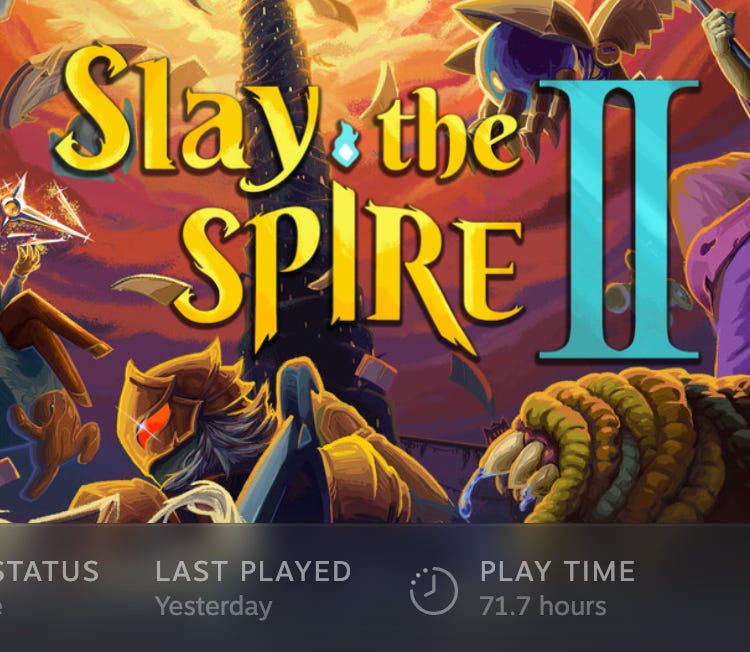
Final housekeeping announcement: Music League is coming back.
Final date TBD but keep an eye out here next week or the week after to join Paradox Newsletter Music League Season 3.
I’ve been getting a lot of requests about this from friends who have been participating. So, we’re coming back.
The Furious Closes BUFF
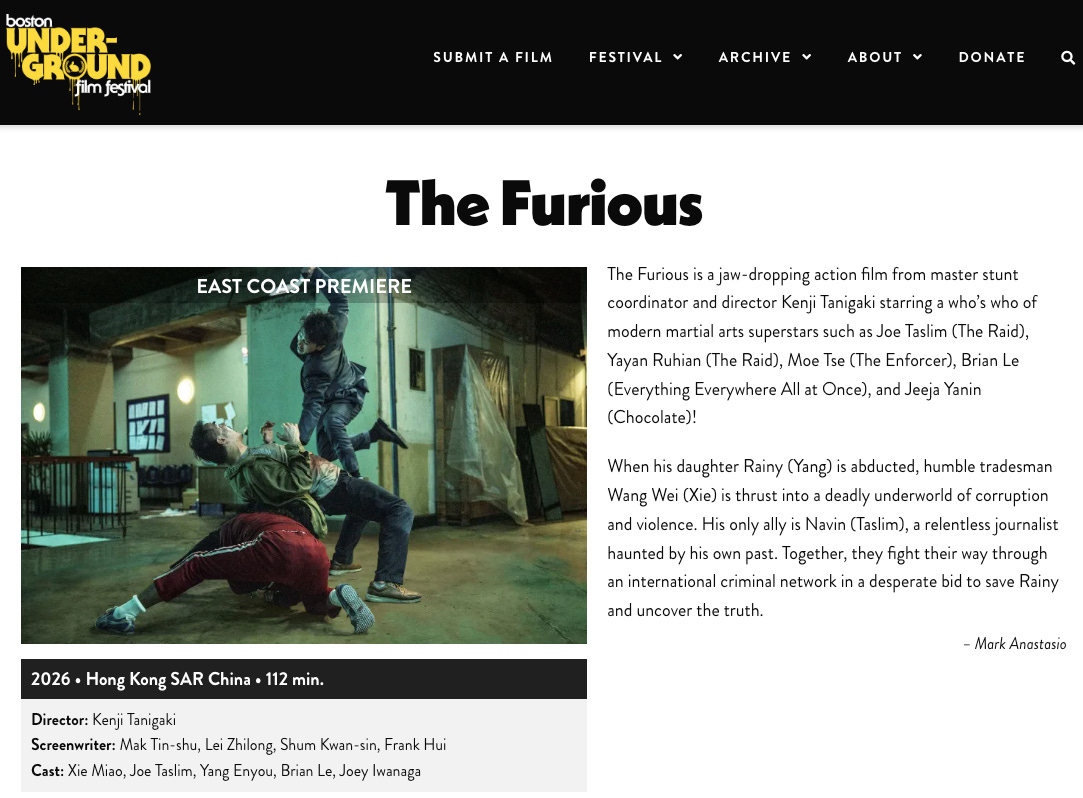
I wasn’t lucky enough to catch much at Boston Underground Film Festival this year. But I was seated for their closing film: The Furious (2026), a new action film from Kenji Tanigaki. Tanigaki created the mold Chad Stahelski has come to live in as a stunt performer/coordinator-turned-director. However, Tanigaki hasn’t quite found the same success behind the camera. He has directed only zero-budget DTV features until Enter the Fat Dragon (2020), which he co-directed with Aman Chang Man. The Furious is his first solo directed feature to make it to theaters at all.
When it comes to stunts, however, he is tremendously acclaimed. He served as a stunt coordinator for SPL (2005), Flash Point (2007), Raging Fire (2021), and Twilight of the Warriors: Walled In (2024). His action directing secured him a Golden Horse Award for Hidden Man (2018), a Japan Action Award for Rurouni Kenshin: Kyoto Inferno and The Legend Ends (2014). All of the work has paid off. The Furious is the real thing.
My Letterboxd review was effusive, but I don’t mind recapping it. For a Hong Kong action movie, what Tanigaki stages is simply not normal. Most action moves use space and keep some distance between the combatants. This usually makes for a more clear, legible visual language compared to the alternative. It’s easier to tell who is who when they’re not on top of each other. The Furious’s action is totally different, though no less clear. For the first third of the film, people are smashed together and nobody is waiting their turn to get in on a fight. Unlike a conventional HK flick, it’s like Moe Tse has a magnet on him.
There’s also props; ladders, pallets, bike pedals with which to bludgeon. The inter-fight cuts are precisely time matched to keep the continuity and moment of a scene.
A little over a third into the film, Wang Wei (Mo Tse) looks over at Navin (Joe Taslim) and writes emphatically: “feint east, attack west.” Wei is quoting from the Thirty-Six Stratagems, a 6th century treatise on military strategy. In Verstappen’s English edition, entitled The Thirty Six Strategies, he also translates strategy six a little differently: “clamor in the east, attack in the west.” Verstappen quotes Sun Tzu:
The spot where we intend to fight must not be made known, for then the enemy will have to prepare against a possible attack at different points and his forces will be spread out too thin. For, if the enemy should strengthen his van, he will weaken his rare. Should he strengthen his rear, he will weaken his van. (29)
The irony of Wei’s evocation of this hallowed military document is that he is acting quickly, without concern, and refusing to plan his attack because of the urgency of saving his kidnapped daughter. Tanigaki, on the other hand, must be a student of the Stratagems. There is no way to defend one’s sense of enjoyment from the shocking action he brings to the screen. Feint east, attack west.
Weekly Reading List
For all the versions of Alexey Pajitnov’s beautifully designed game, Tetris (1988), one stands above the rest: Arika’s Tetris: The Grand Master (1998). The competition-inducing arcade Tetris has only just recently been made easily available for home consoles. The story of TGM is also enough for this five hour documentary for Demonin. Wow.
This is a great, if slightly self-congratulatory discussion about Survivor (2000) featuring the man himself, Jeff Probst.
A low-budget mini-series from the cast and crew of Nihon Toitsu (2013) may be the best adaptation of the Yakuza (2005) video game ever. Yasukaze Motomiya is a fantastic Kiryu.


And already in the first episode they begin to set up the tension between the ‘organized’ logic of so-called organized crime and the irrationality of life that rejects conventional social norms.


But Kiryu is unyielding.


I can’t wait to keep watching.
Presented without comment.
Event Calendar: Shinoda Masahiro at the HFA
From Chris Fujiwara for the Harvard Film Archive:
Throughout a career spanning a wide range of styles and subjects, Shinoda Masahiro (1931-2025) reinvented himself several times, sometimes as often as from one film to the next. A will to innovation unifies his work, which is also marked by a sympathy for rebellion and a taste for secrecy and conspiracy. The loosely connected group of films from Dry Lake (1960) to Double Suicide (1969) is central to Shinoda’s filmography. In addition to two of his best-known films, Pale Flower (1964) and Double Suicide, this group includes several others in which the director’s penchant for visual abstraction matches up with an abrasive and bleak sensibility, breaking open the narrative forms he has inherited.
Pale Flower and Samurai Spy (1965) are among my favorite movies ever. If you get the chance, this is must-see programming.
Until next time.