

Issue #425: Cinema is Nothing Without Masahiro Shinoda
OpenAI’s video generation tool, Sora, is dead.
“Dead” is, perhaps, a poor choice of words. It is too evocative of what LLM AI isn’t: life, consciousness, etc. Sora, however, didn’t pretend to be conscious. It didn’t pretend to be anything except for your friends stealing GPUs from Target. Tech journalist Casey Newton and, to a lesser extent, podcast host PJ Vogt were optimistic about Sora back in October. Newton said to PJ in an episode of Search Engine:
I’ll tell you the prediction that I have that I am confident about and that I think I might differ from my peers on. I think this feature that they’re calling cameos, which is the ability to take your friends’ likenesses and your own likeness and put it in whatever situation you can dream up that the content guidelines will allow, I think that’s here to stay. I think people are really going to like that.
Even without the benefit of hindsight, this was a stupid prediction. I didn’t go on record in the newsletter with my view, but there are plenty of iMessage chat logs from October of last year where I said Sora is no better than JibJab.
Now, Sora is shuttered, only after losing OpenAI an exorbitant, unimaginable amount of money. OpenAI is pivoting to the areas where Anthropic is having success: enterprise products, complex coding tools, and productivity automations. Sora was an embarrassingly bad bet for a company that is routinely humiliated in the public sphere. Cheers to you, Sam Altman. What you don’t understand about people could fill a book.
Shinoda’s 1960s Biting Satire Could’ve Been Made Yesterday
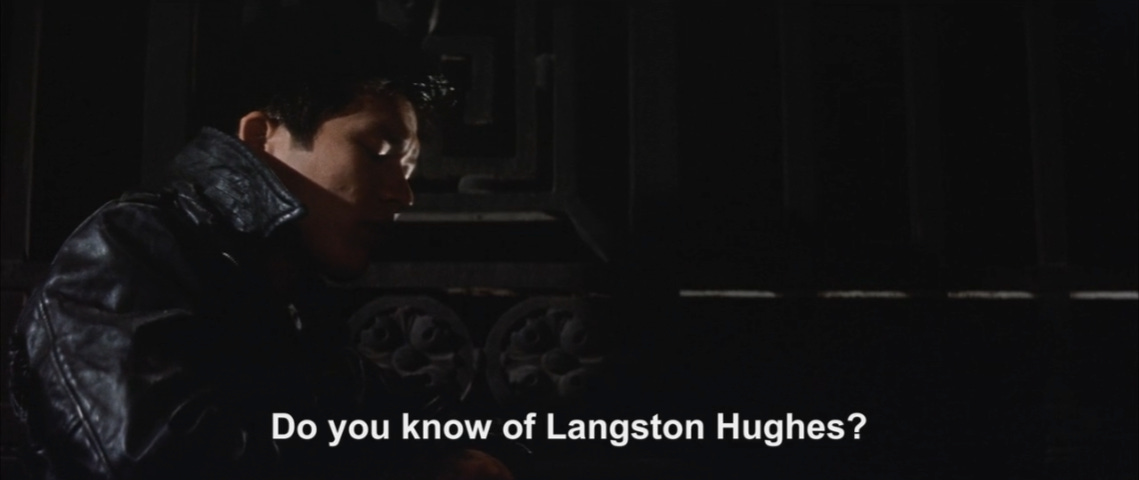
Kawaita mizuumi (1960) has been localized with the title Youth in Fury and Dry Lake, although the latter is the trans-literation. An early film of the Japanese New Wave director Masahiro Shinoda, Dry Lake is an electric masterpiece that set the stage for Panic in High School (1978), Robinson’s Garden (1987), School Daze (1988), and even Happyend (2025). Written by avant-garde playwright Shūji Terayama, Dry Lake is uncompromising and caustic. The teenagers that Shinoda takes as his subjects are mostly repugnant, unsympathetic characters, particularly the two leads: Takuya Shimojô (Shin’ichirô Mikami) and Michihiko Kihara (Junichiro Yamashita). Shimojô is a budding political activist fascinated with leaders of all stripes, from democratic to totalitarian. He sleeps under posts of FDR, Che Guevara, and Hitler. His political consciousness is at odds with that of his peers. He objects to symbolic protests and is desperate for ‘real,’ violent usurpation of the status quo. As he moves through his school life, he is cruel, routinely humiliating his peers, imperiling the women around him, and carrying on a sexually and financially exploitative relationship with an older bartender.
Kihara is a wealthy nihilist and shares a kinship with Shimojô through their cruelty. But for as bad as Shimojô is, Kihara is much worse, staging bizarre torments for everyone around him using money as an incentive and repeatedly attempting to sexually assault girlfriends and classmates. Rather than being a referendum on youthful (im)morality or a condemnation of campus political activity, the work of Shinoda’s film is to spotlight that which is unsightly. He does not gloss over the dimensions of humanity that films preceding it — especially those produced and distributed by the studio Shochiku — would usually ignore.
Shimojô and Kihara both behave abhorrently, but there is no equivalence between them. Kihara is a proto-Patrick Bateman, totally isolated from any possibility of human connection by his obscene wealth. Shimojô, on the other hand, is also isolated because of his delusions of grandeur.
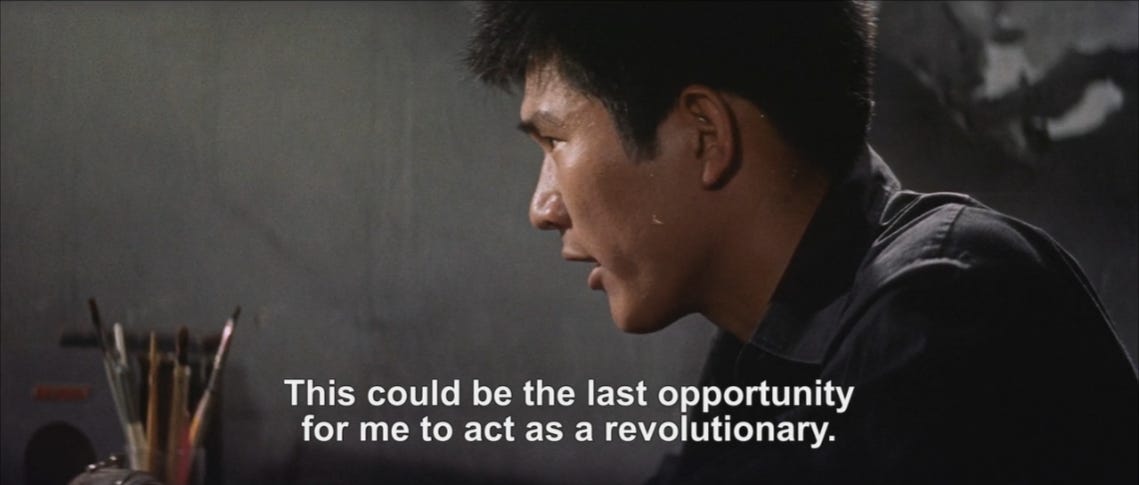
However, his annihilative impulses are the product of a confrontation with imposing political machinery. Shimojô shudders at what he sees as a grim truth, nothing ever happens.
There is an incisiveness Shinoda can bring to bear precisely because his characters are so remarkably wicked. Part of the film’s ugliness is a mockery of the sentimental films that came before it, but Shinoda also makes it clear that individualism is the enemy of the leftist revolution — toward which he himself may have been ambivalent. But Dry Lake is not a film where its characters individuate themselves out of an avowed demand to be somebody. Instead, their social position which marginalizes and alienates them produces the subjectivity. Despite the persistent heinousness of Shimojô and Kihara, the pathos of their representation is not saccharine. It is evident only in Shinoda’s sharp illustration of the political situation in which most are ultimately self-interested.
Shimojô is an aspiring revolutionary (or extremist) in contrast to Kihara because there are some human connections he can imagine, even if he cannot enact them. He quotes a stanza from Langston Hughes’ “Consider Me,” awkwardly and incorrectly rendered in the film’s Japanese subtitles. The actual Hughes lines that grip Shimojô are about a child laborer:
Consider me,
Colored boy,
Downtown at eight,
Sometimes working late,
Overtime pay
To sport away,
Or Save,
Or give my Sugar
For the things
She needs.
…
Consider me,
On Friday the eagle flies.
Saturday laughter, a bar, a bed.
Sunday prayers syncopate glory.
Monday comes,
To work at eight,
Late,
Maybe.
Consider me,
Descended also
From the
Mystery.
It’s no accident this is the piece, and the section, Terayama puts in the mouth of Shimojô. It serves to illustrate some level of global class consciousness. Shimojô sees a continuity between the Black American liberatory struggle and his own political dissatisfaction. At the same time, Shimojô recounts the poem, about a girlfriend, to impress a girl — a shallow gesture following his Don Juan archetype to the letter.
The most remarkable aspect of Dry Lake is the prescience of the political world and personalities it represents. The movie feels new, and perhaps a better reflection of our political situation than One Battle After Another (2025) or Eddington (2025). Shinoda’s gaze, salacious as the world is under it, is a masterful one. He surveys the worst tendencies of humanity. But what he understands, and also shows in his work, is the conditions that produce those tendencies. The world without guarantees makes films without limit in the milieu of the Japanese nouvelle vague.
Life is But a Dream in the Ending of Chainsaw Man
Rapping “It was all a dream, I used to read Word Up! magazine,” The Notorious B.I.G. is reflecting on his childhood aspirations on “Juicy.” It is one of the most iconic rap lyrics of all time, but those specific five words: ‘it was all a dream,’ have structured the way pop culture expresses their ideas about dreams. Biggie doesn’t mean literal dreaming, as in the ones that visit during slumber. Despite this, there’s an echoing reverberation of the nursery rhyme “Row, Row, Row Your Boat,” “life is but a dream,” and even of Shakespeare’s The Tempest (1611), “We are such stuff as dreams are made on.” It is in Hamlet (1623) where Shakespeare gives a more psychoanalytic gloss of dreams, “To die, to sleep — to sleep, perchance to dream — Ay, there’s the rub, for in that sleep of death what dreams may come.”
Freud, for all his critical intertextuality with Hamlet, defines the intrigue of the dream as it is expressed in art. Žižek writes:
the ‘secret’ to be unveiled through analysis is not the content hidden by the form (the form of commodities, the form of dreams) but, on the contrary, the ‘secret’ of this form itself. The theoretical intelligence of the form of dreams does not consist in penetrating from the manifest content to its ‘hidden kernel’, to the latent dream-thoughts; it consists in the answer to the question: why have the latent dream-thoughts assumed such a form, why were they transposed into the form of the dream? (The Sublime Object of Ideology [1989] 3)
The why of this transformation is never a what; never a rote explanation like that of Scrooge in A Christmas Carol (1843), “an undigested bit of beef, a blot of mustard, a crumb of cheese, a fragment of an underdone potato.” And the why is most interesting when the text can illustrate a relationship between the dream and waking life. One of the more conventional methods for this, especially when a work’s diegesis is mostly dream, is the pre-dream or post-awakening montage that recontextualizes all the dream’s characters. The great children’s film Little Nemo: Adventures in Slumberland (1989) uses this structure to great effect. It also maintains that ambiguous sense that the dream may be more real than it seems. The film leaves open the interpretation that the many people Nemo (Gabriel Damon) meets in the dream are in fact the actual circus performers he watches during the day.
Spoilers for Chainsaw Man (2018) follow
Tatsuki Fujimoto’s Chainsaw Man, which ended with chapter 232 last week, will not be remembered as a tasteful exemplar of this dreaming protagonist trope. Like Little Nemo, Fujimoto creates a complex plot justification that distances the sequence of events ever so slightly from a dream. Following the plot logic, Denji awakens in a world where Pochita, and thus his own demonic powers, never existed.


The narrative effect, however, is totally indistinguishable from Denji awakening from a dream.
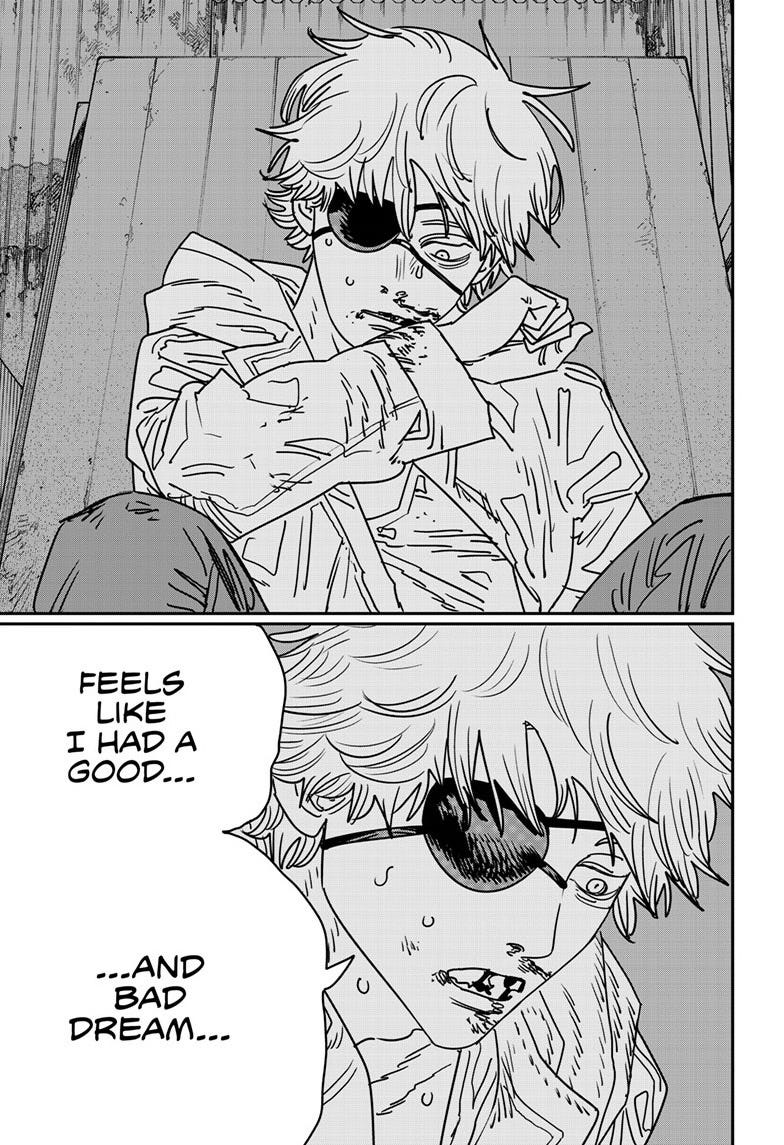
What follows is the structural reversal of Little Nemo. Denji meets all of the people whose lives are irrevocably altered because of the non-existence of Pochita. Or, interpreting to serve the analogy, like The Wizard of Oz (1939), he meets all the people who influenced his long dream chronicled in 231 manga chapters.
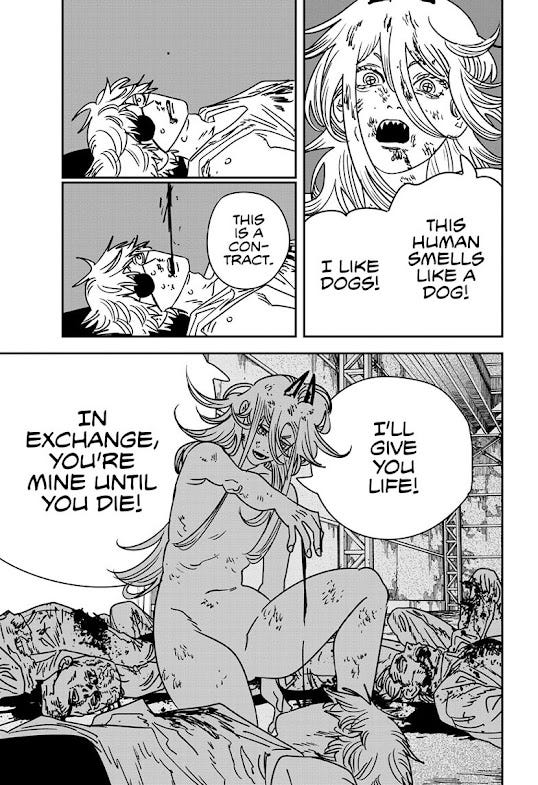
Fujimoto’s ending is the confession of a dour view. Denji’s life as Chainsaw Man, as a supernatural hero, as a manga protagonist with all its vicissitudes, is worse than his life as a demon slaying debtor and yakuza organ theft repository. The author couldn’t find an ending that is satisfactory for the manga’s miserable subject without totally overturning the narrative logic. Why end Chainsaw Man here and in this way?
For those who believe Chainsaw Man jumped the shark, its significant drop in quality happened way before this ending. The manga has been borderline incoherent for months. Even as Fujimoto tried to embrace a new protagonist, Asa, Denji has too much of a grip on Fujimoto’s imagination. Much of Chainsaw Man’s “Part 2,” initially the “School Arc,” has been disjointed and non-committal. Major characters die off screen. ‘World building’ is machine gun fired to the audience through protracted exposition. I prefer interpreting to analyzing creative foibles, it seems a bit too obvious that Fujimoto lost track of his plot and could not figure out how to get to an ending that made sense within the narrative he created. Thus, the world of the manga ends before it concludes.
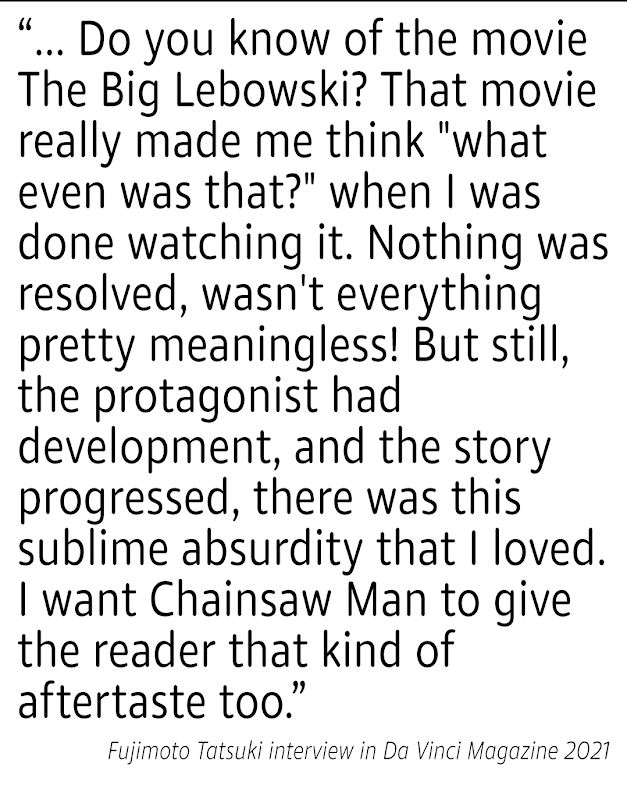
Some have returned to a quotation from Fujimoto stating his admiration of The Big Lebowski and his ambition to emulate it in Chainsaw Man. It’s ending, though, is a bit more similar to Hideaki Anno’s revision of Neon Genesis Evangelion with his Rebuild film series. Denji, Power, and Asa exist in a similar triangulation to Shinji, Asuka, and Mari, but Denji and Shinji end up with the structurally “opposite” romantic partner. The quiet, late entry to the mythology is supplanted by the “tsundere” woman with the earlier claim to the protagonist’s attention.
It is somewhat fitting that an allusive writer like Fujimoto would deliver an ending that can only be understood in relation to its many explicit and implicit intertexts. The ending does not easily make available a reading that takes it on its own merits. This was a desperation move for a guy out of ideas and tired of writing chapters every week. Fujimoto hit the escape button, but we could’ve seen it coming.
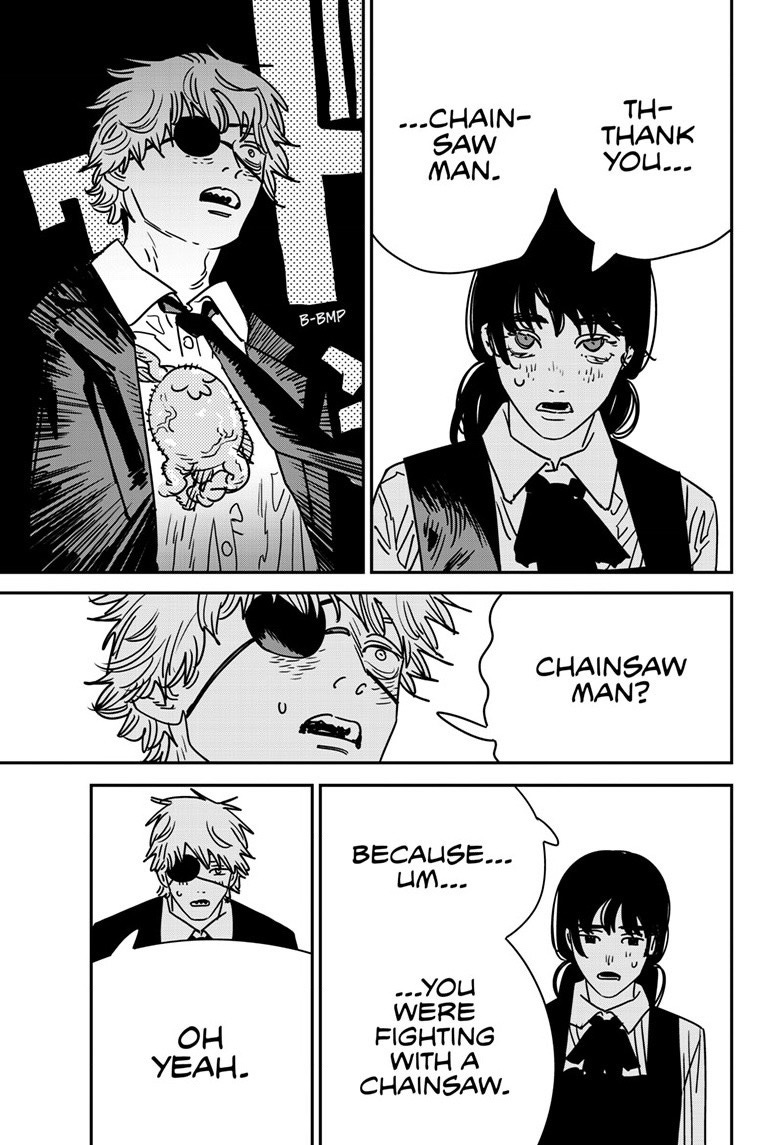
The ending that we have for Chainsaw Man is not the worst one I could imagine, although it is a shame for a storied manga to go out like this. But this second part of the manga always paled in comparison to the first. Perhaps hindsight might soften the attitudes toward the manga’s final, unexpected turn. But, I doubt it.
Weekly Reading List
Somehow I’ve never heard this cover of one of my all-time favorite songs by one of my all-time favorite groups. Although I’m actually not really a fan of this rendition, but I figured I’d share it anyway. Kinda sets the stage.
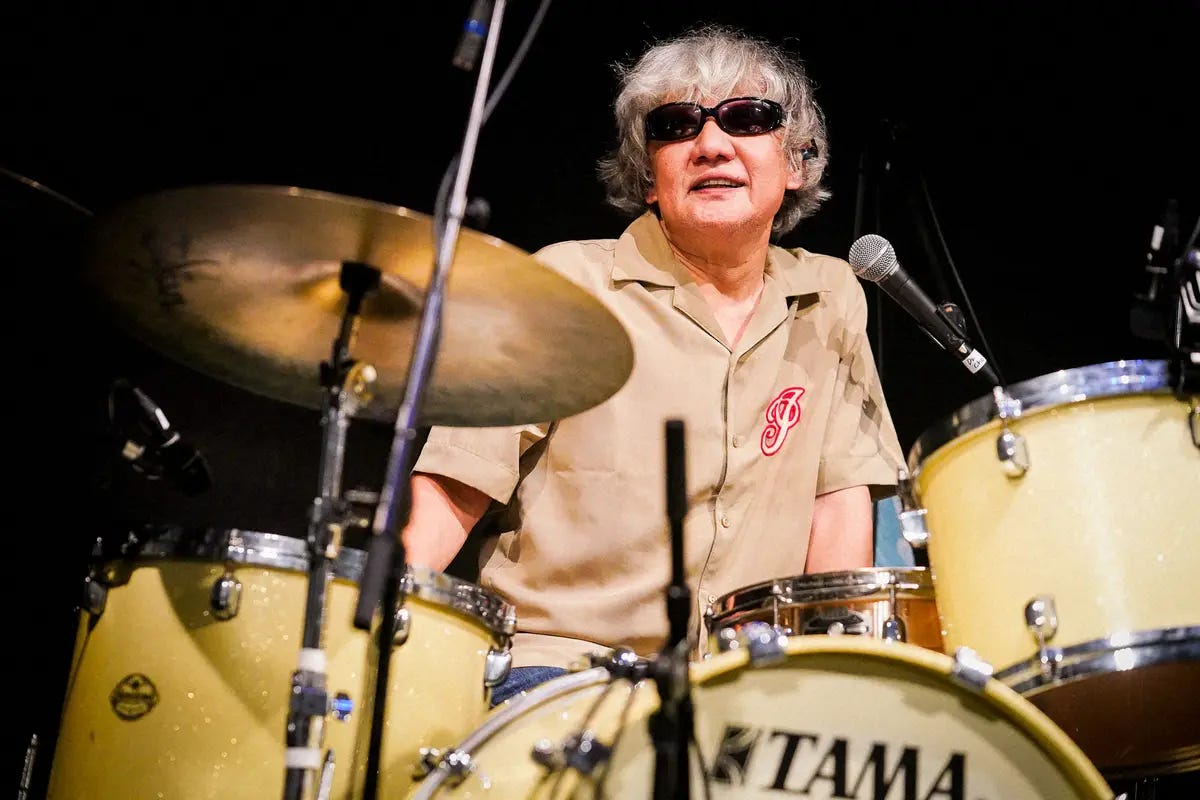
https://www.tokyohive.com/article/2026/03/former-the-pillows-drummer-shinichiro-sato-dies-at-61 — Man, I can’t even say anything about this one. Call it “alternative rock” or “indie rock,” The Pillows are among the best who have ever done it. Shinichiro Sato was playing with the band until just last year. RIP.
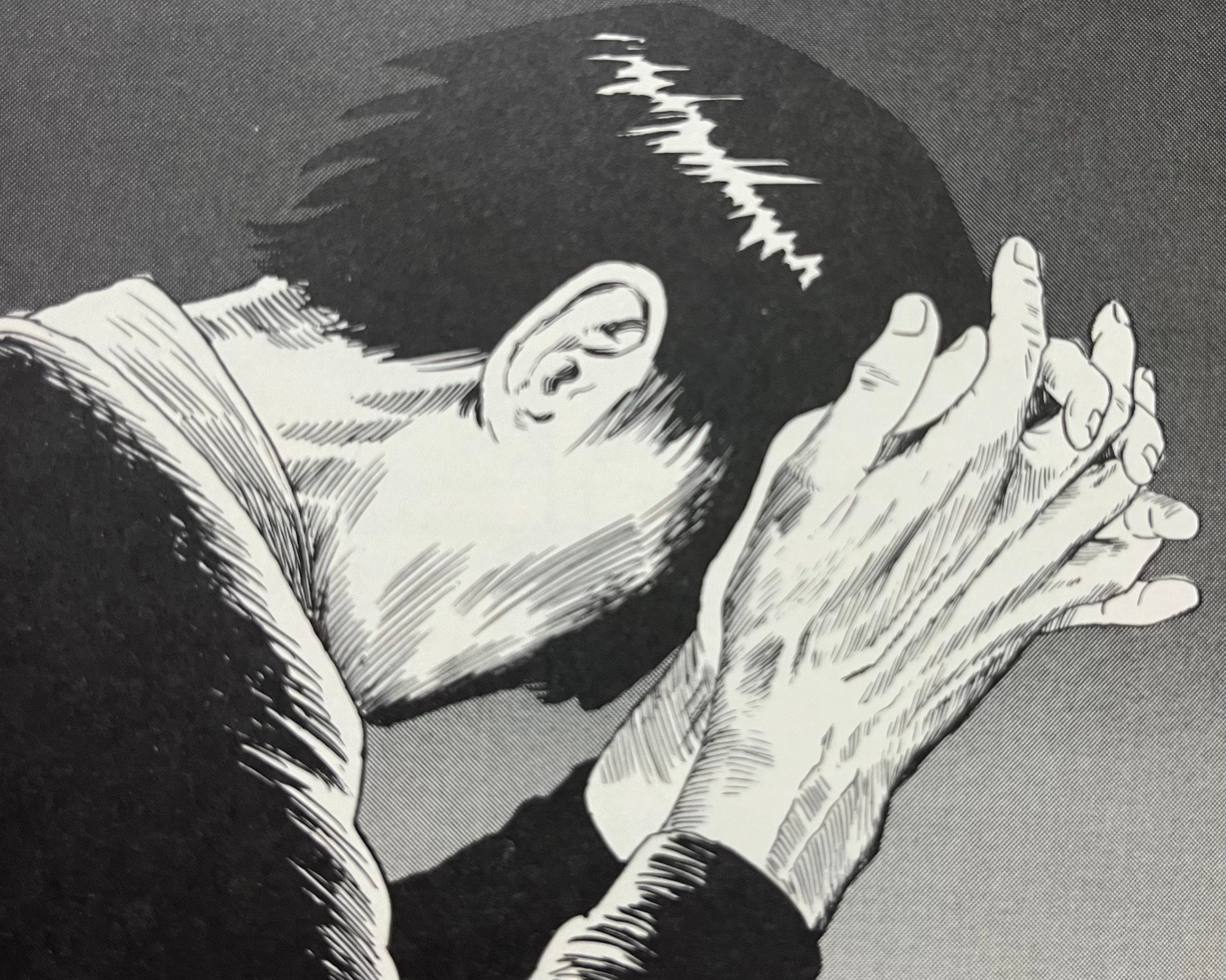
https://www.tcj.com/rip-yoshiharu-tsuge/ — Another absolutely gutting loss.
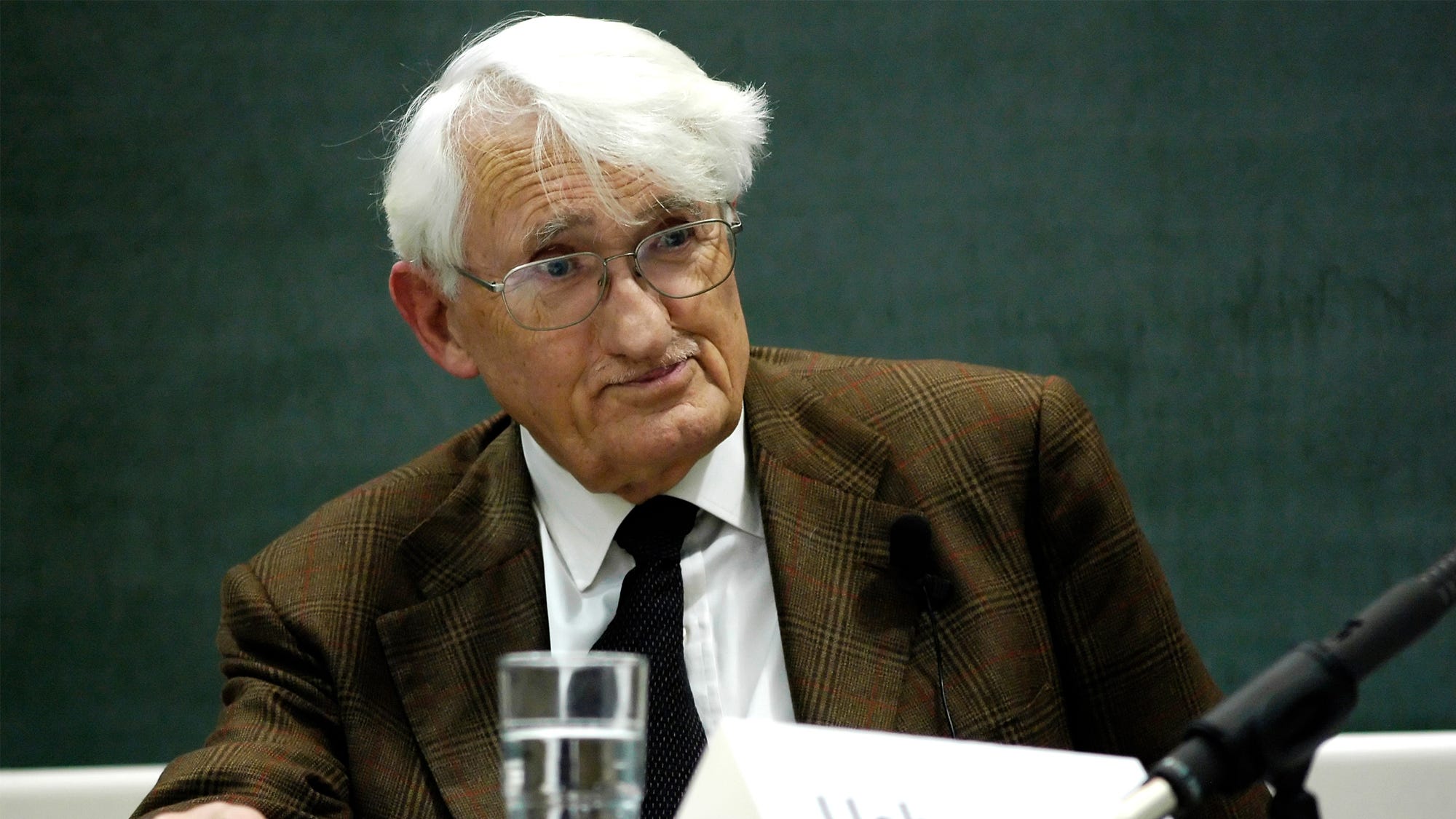
https://www.lrb.co.uk/blog/2026/march/after-habermas — The newsletter may need an in memoriam section at this point.
Event Calendar: HFA Delivers with Decision to Leave
One of my favorite recent films, and perhaps among my all time favorites, Decision to Leave, will screen at the Harvard Film Archive mid-April.
Issue #248: Decisions, Decisions

This week, I wrote about the movie of the year with the greatest film protagonist of all time, Park Hae-il’s Jang Hae-joon. Why is Hae-joon so great? Well, just examine his footwear.
It’s a bit difficult to fully grasp the fact that I wrote my essay about the sneakers in Park Chan-wook’s incredible Vertigo (1958) pastiche nearly four years ago.
Until next time.