

Issue #428: Beginning Endings Strong in The Boys
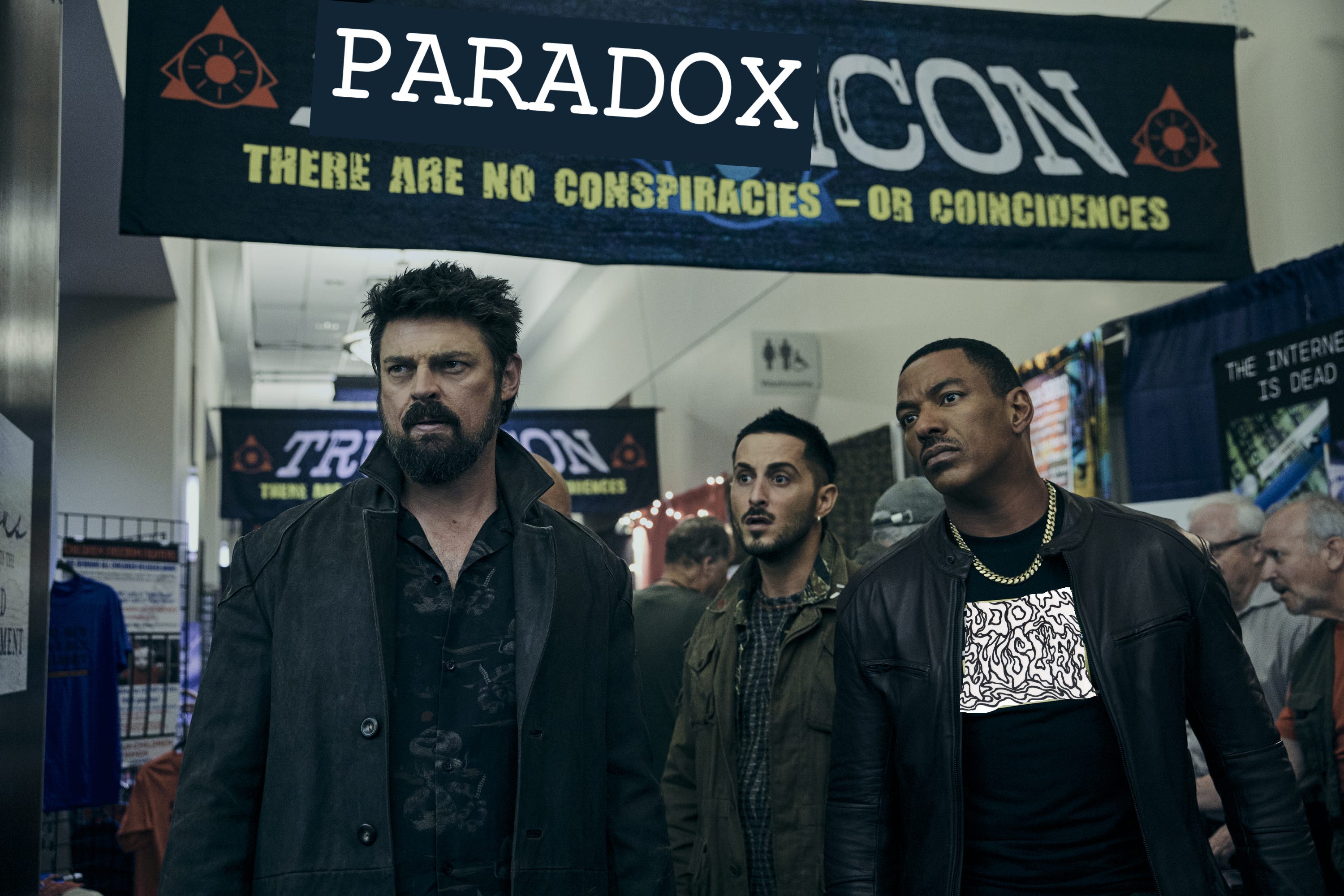
Raffle is done, and we have a winner. Thanks to all who participated. I’m hoping to do more things like this in the future. I am aiming to continue developing the paid subscription this year. You can always get in early.
Playoff basketball is underway. It’s a great time to be a basketball fan and a better time to be a Celtics fan.
This week, I’m tackling where prestige meets superheroes.
“Who says I want to change?”: Ending at the Beginning of Eric Kripke’s The Boys
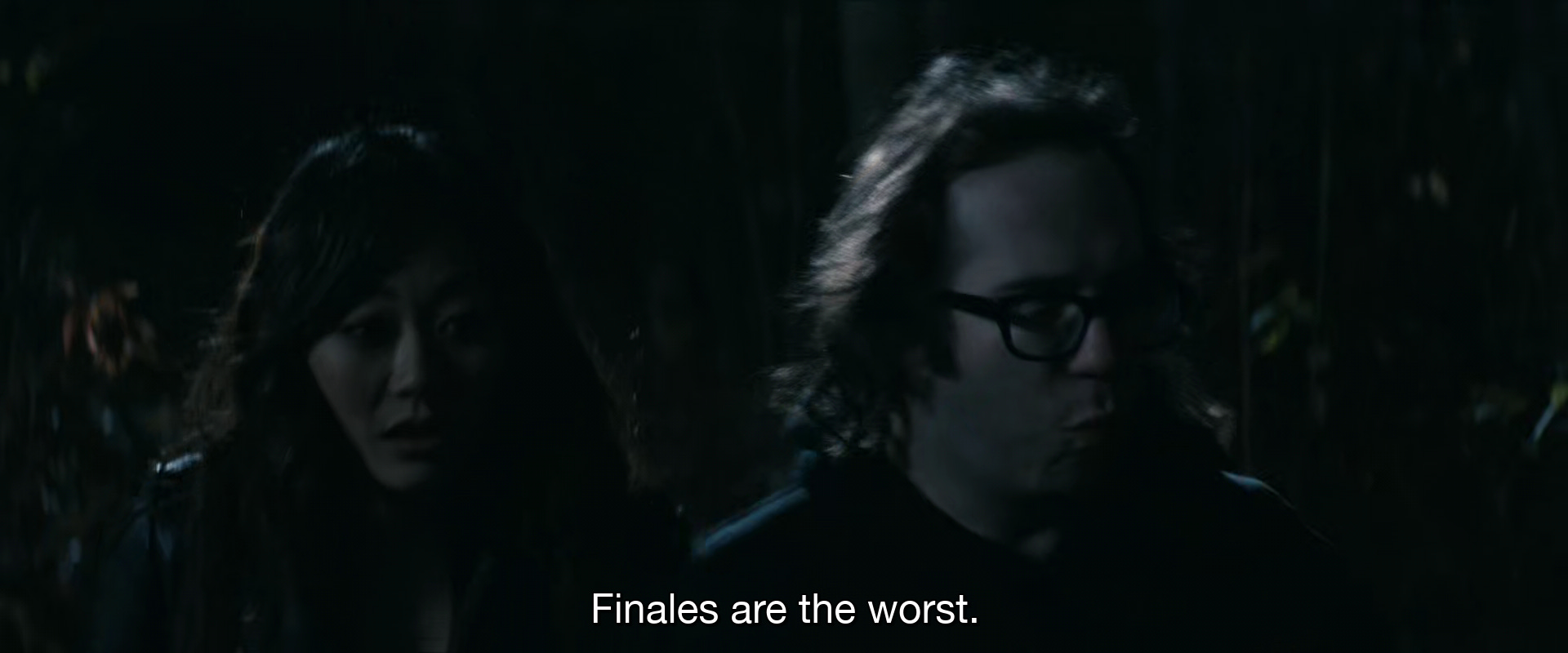
This section includes spoilers for the season premiere of The Boys’ fifth season.
What is wrong with The Boys (2019)? According to Eric Kripke, it is the problem of all satire or political commentary. His show is too prescient. The year plus of production time before airing has rendered his send-up of Trumpian politics too similar to reality. In conversation with Collider this week:
[Collider:] I interviewed Jack [Quaid] ... and one of the things I asked Jack is, do you ever watch the news? And I’m going to ask you the same thing. Do you ever watch the news and just think, “Oh, shit, we just filmed something like this last year and now I’m seeing it happen in real life”?
KRIPKE: It happens all the time. And, you know, tomorrow’s episode is a perfect example. The talk about attacking the pope and presenting yourself as a God as we’re about to release an episode where Homelander thinks he’s God. I don’t know what to say about it. It’s upsetting. You know, I was sending a text, and someone last night who works on the show sent me the image. And my reply is about how I feel, which is like I just texted back: Sigh. Hard, sad, sigh. And I say that’s what I’ll say to you: hard, sad, sigh.
Similar to Dario Scardapane’s commentary on Daredevil: Born Again (2025), Kripke discusses using historical antecedents to structure The Boys’ plot and determine what he will satirize. However, unlike Scardapane, Kripke is earnest about his efforts to mock Trump. The rapid conflation of fantastical satire and what one might see on an evening newscast is problematic for all satire. It loses both its intensity and interest if it simply reproduces everyday life. The fact that the world moves “too fast” for satirists to sufficiently capture in the production timeline of television is a challenging obstacle, but not an insurmountable one.


I have never found The Boys to be particularly incisive when it comes to political satire, although it has its moments. In addition to the comedic dimension of the show, The Boys is often an edgy soap opera focused on internecine personal conflict among allied characters. Now in its fifth season, the fourth of eight episodes airing this week, The Boys remains more soap opera than satire. “Fifteen Inches of Sheer Dynamite,” the fifth season premiere, bucked the prevailing trend with some fascinating television.
Of course, a showrunner with the aesthetic sensibilities of Hot Topic, Invader Zim (2001), and Deadpool comics can’t help but be too cute. When screenwriter Paul Grellong has The Worm (Ely Henry) deliver a meta-monologue on final seasons, I had to laugh. His complaints as an in-show writer of a Reacher spec script (the real show Reacher, like The Boys, is an Amazon Prime exclusive streaming series) are both astute and funny:
It [is] impossible to, like, tick every box and tie up every little storyline. I mean, just try making everybody happy. You can’t do it. Finales are the worst.
The Worm, and the show, are unmistakably right. Finales for long-running shows are difficult to execute. They are often misevaluated because if a show is sufficiently successful, a large portion of its fanbase simply does not want it to end. No ending could possibly be good enough.
The Boys, from my perspective, is headed to a reasonably satisfying conclusion even as the second and third episodes have dragged. Kripke knows where the real interest of the show is: the triangulation of William Butcher (Karl Urban), Hughie Campbell (Jack Quaid), and Homelander (Antony Starr). Aside from self-reflective commentary, the trio are the focus of “Fifteen Inches of Sheer Dynamite.”
Butcher’s world tour of recruiting displaced characters also brings him to his abusive father Sam (John Noble). It is in conversation with Sam that the show communicates Butcher’s arrested development, stuck because of his father’s abuse. Characters like Campbell, A-Train (Jessie T. Usher), Starlight (Erin Moriarty), and Kimiko (Karen Fukuhara) are dynamic. Butcher and Homelander, by contrast, cannot change. It is both because of their inextricable antagonism and their traumatic childhoods. After interrogating Homelander’s childhood in the previous season (particularly “Wisdom of the Ages”), Butcher and Sam’s last caress lays plainly that Butcher will end the show in the same place he begins it: “Who says I want to change?”


But Butcher has changed, though in a relatively superficial fashion: he has become a ‘Supe.’ After an injection of Compound V in an attempt to stave off a fatal tumor, Butcher showcases some gruesome superpowers in season four and five. It is this change that Homelander observes in their season premiere face off


Homelander laments being the man on top, now pairing his unimaginable physical strength with unilateral executive power over the United States. As any good Lacanian would predict, he is unsatisfied.


He attributes his dissatisfaction not to the perpetual metonymy of desire, but to a lack of “devotion.” The masses fear, rather than revere him.
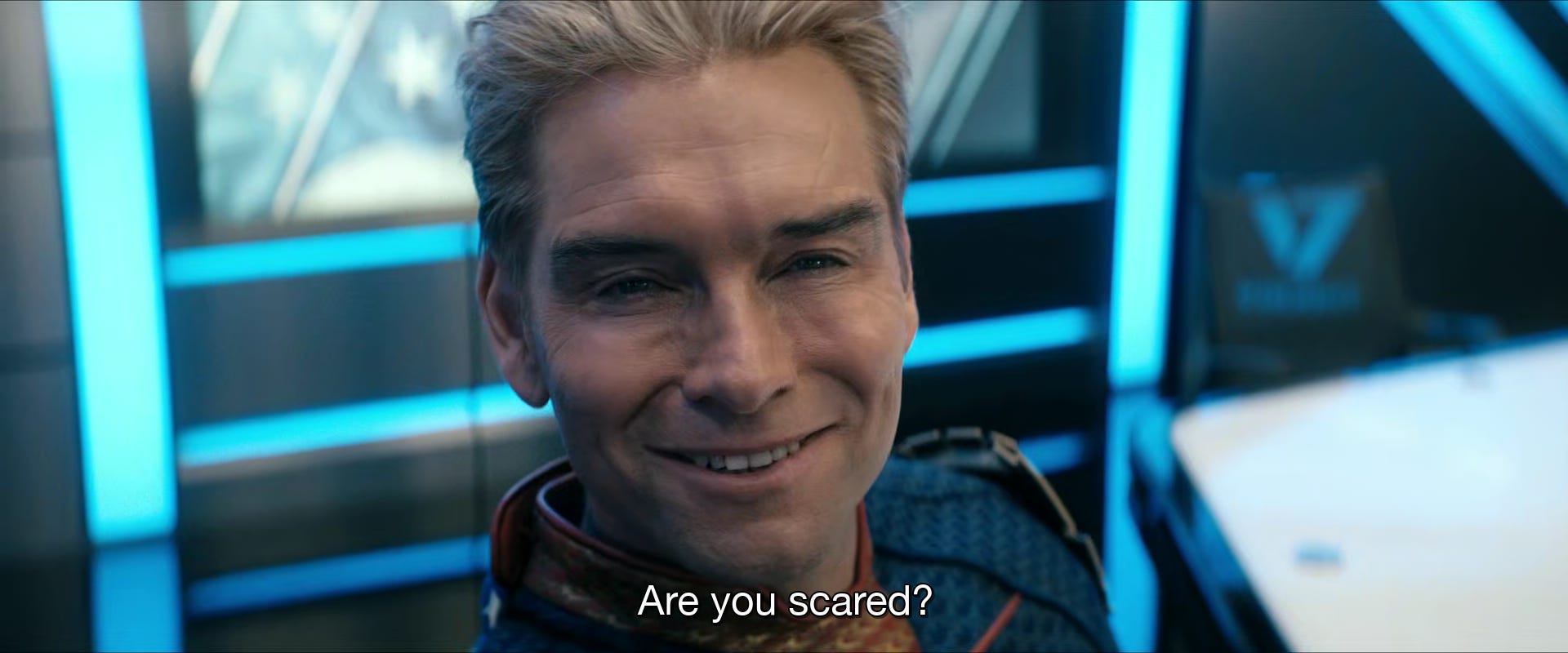
This positions him awkwardly, relative to Butcher. Though Butcher does not revere him, he also does not fear him. And the devotion that Homelander identifies in him is a devotion to attempting to annihilate his arch nemesis. Cue Heath Ledger’s Joker, “you complete me.”
Hughie Campbell, then, presents another antagonism for Homelander. Campbell spends much of his screen time consoling other prisoners in the “freedom camps,” the avatar of earnest hope characteristic of more conventional superhero stories.


Campbell has neither the superpowers of Homelander nor the grit of Butcher. He is entirely without particularity, representing the everyman. For Homelander, this is unthinkable. Commenting on Campbell’s romance with Starlight and friendship with Victoria Neuman (Claudia Doumit), Homelander asks, “why are they so hopelessly devoted to such staggering mediocrity? Why would Starlight and Butcher piss away their lives to try and rescue you?” Campbell replies, Quaid showing some remarkable acting chops here in a reflexive moment of thought before he delivers the line, “Because I’d do it for them.” This mutual benevolence, this sense that the rising tide lifts all boats, is the essence of the everyman that Kripke sets against Homelander’s, and Butcher’s, exceptionalism.
What Homelander struggles to confront in this episode is that his exceptionality may be entirely accidental. This is most evident in his confrontation with A-Train, a fight that concludes A-Train’s arc most spectacularly. Though Homelander kills A-Train, A-Train dies laughing. He tells Homelander (in a series best performance from Usher):
What was I so afraid of? You are fucking nothing. You’re just an empty fucking suit. Take away these powers and what are you? A pathetic, weak, sniveling fucking loser.
These words cut deep not because they happen to be true, but because Homelander is obsessed with what others think about him. And it is this obsession that will undo Homelander as the series progresses, maybe waylaid by Butcher who despises him, but most likely to be defeated by those who don’t think about him at all.
Weekly Reading List
I posted a Caleb Gannon Gaming video last week, but this is a little different. He regularly records straight forward play throughs of Slay the Spire 2 (2026) with thoughtful commentary that will help viewers make better decisions as players.
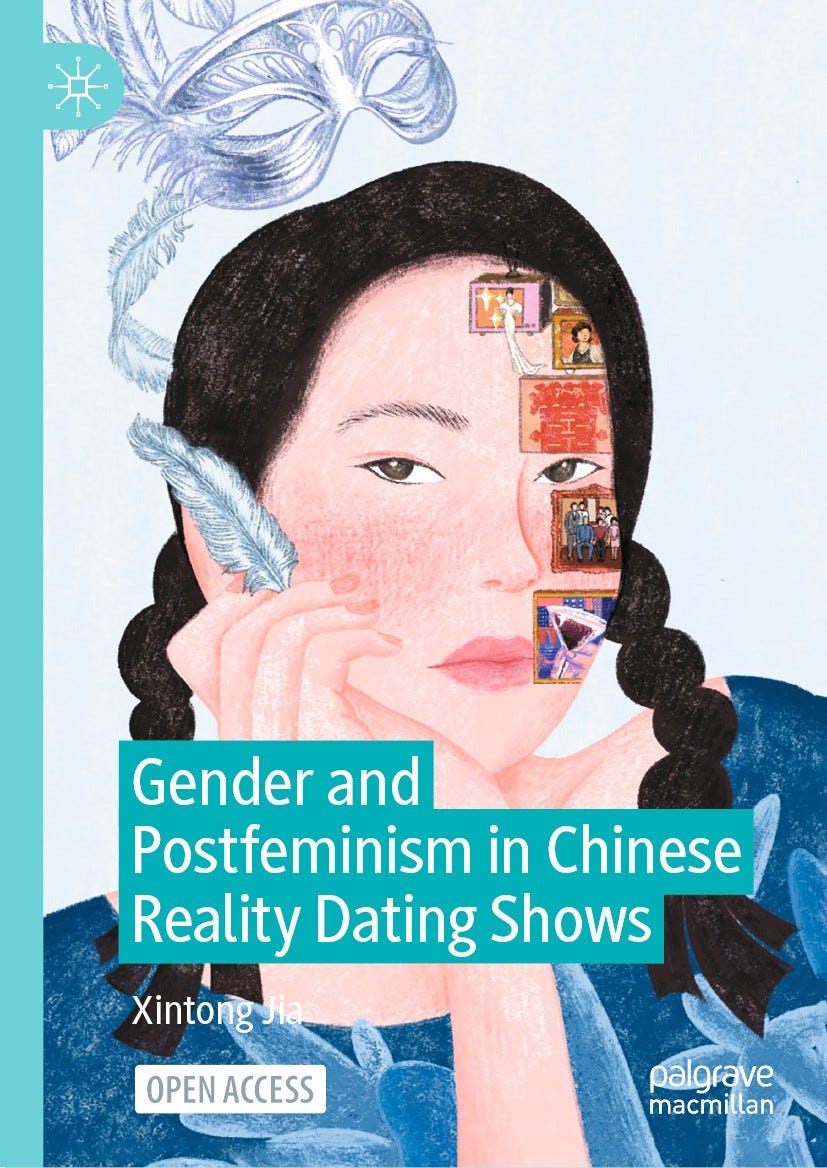
https://link.springer.com/book/10.1007/978-3-032-18396-5 — Xintong Jia’s Gender and Postfeminism in Chinese Reality Dating Shows (2026) is available in open access. Niche subject matter, but fitting for the part of my audience that has read me scrutinizing The Bachelorette (2003) using Lacanian theory.
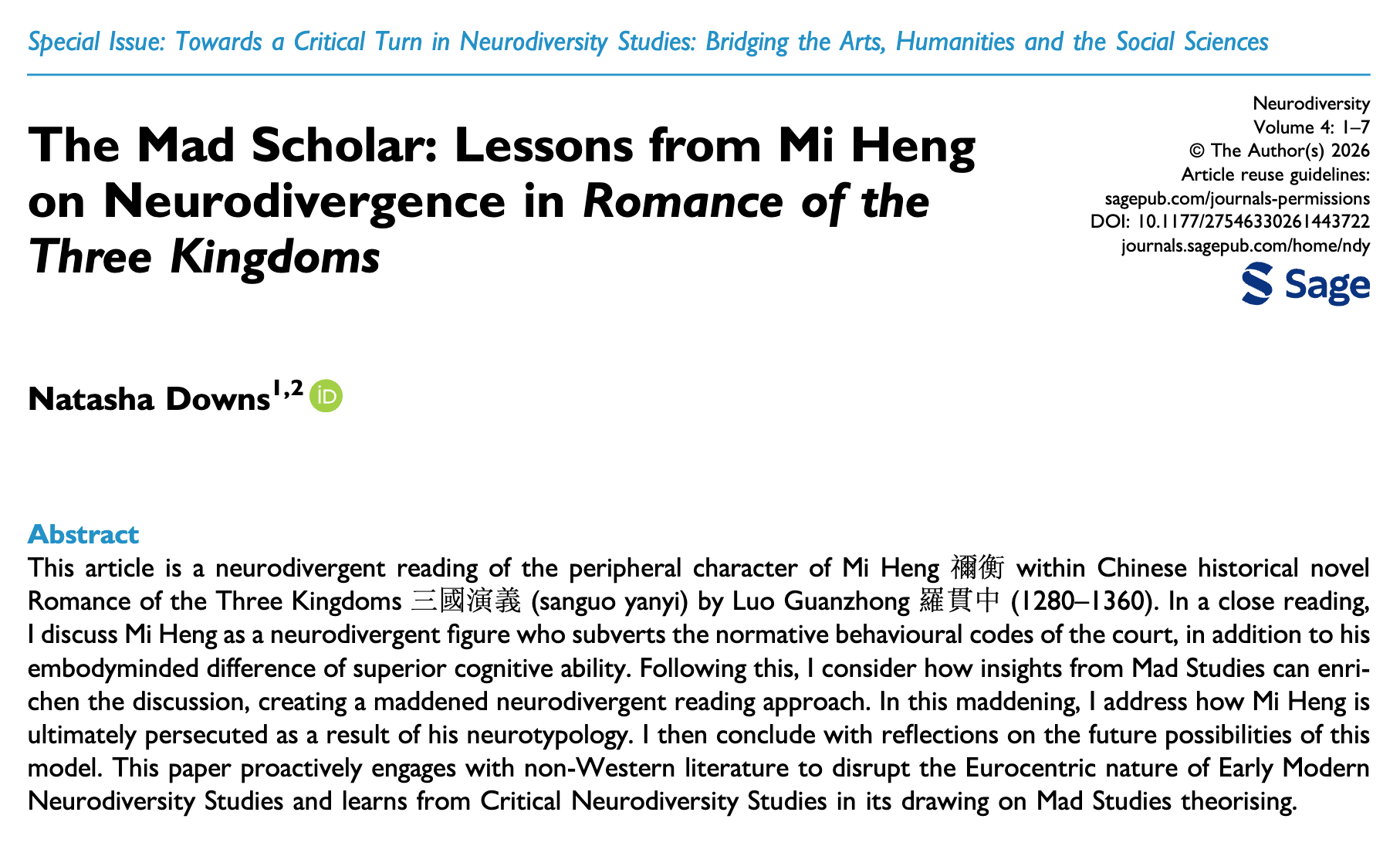
https://journals.sagepub.com/doi/full/10.1177/27546330261443722 — Another open access academic work, this time a journal article, I’m willing to read just about any contemporary academic treatment of Romance of the Three Kingdoms (1522).
Event Calendar: Repertory Potpourri
This week I added a some Coolidge After Midnite programming, a few screenings of 2025’s Resurrection, and a screening of Vertigo (1958) that really snuck up on me. If you’re reading this on Monday, it’s tomorrow.
Until next time.