

I love an issue that calls for me to bury the audience in footnotes. They snowball out of control. Once I start leaving footnotes, I start aspiring to the full-page Fanon footnotes about Lacan in Black Skin, White Masks (1952). My copious footnoting is not occasioned by Music League.
This past round was dedicated to songs under two minutes. The resulting playlist is necessarily, mercifully short. It is not exactly a fun listen. The first song is an exceptionally bizarre acapella about domestic violence. I submitted VaVa. Otherwise, there wasn’t much for me here outside of the stuff I listen to already — Playboi Carti, Dicks (shout out killfromtheheart.com), Stalag 13. Maybe you will find something more your speed.
“The power to soothe savage men”: The Spectral Women of Yoshiyuki Tomino and Earl Lovelace
Lalah Sune. Reccoa Londe. Quess Paraya. What can possibly explain the bizarre behavior, treatment, and positioning of women in the work of Gundam auteur Yoshiyuki Tomino? Reccoa is a particularly interesting example, a character in Mobile Suit Zeta Gundam (1985) who works with the protagonist Kamille Bidan but betrays him for her love of the antagonist Paptimus Scirocco. This puts her opposite a former comrade, Emma Sheen, who stays committed to the AEUG cause. Reccoa and Emma kill each other toward the end of Zeta. During the final confrontation, Emma tells Reccoa, “You’re being too much of a woman.” Reccoa replies:
That’s right! I’m a woman! That’s why I’m here, and now I’m your enemy! That’s why I fight. Each person lives life differently. I don’t want interference with mine. … Men think of nothing but fighting and can only think of how to use women as tools. Or if anything else, how to humiliate a woman.
In an interview soon after Zeta concluded its TV run for the Mobile Suit Z Gundam Encyclopedia (1986), Tomino tries to explain the relationship between the two:
When it comes down to it, the two of them are talking about an identity that represents the idyllic image that men hold of women. To sum up why this is, Reccoa is a good example. She never makes the attempt to take a stand for herself even after how she was treated at Jaburo, and she maintains a state of denial by making excuses like “I’m looking for the man who will fulfill me”, and she ultimately ends up looking for a way to become dependent on a man. As a man, this is extremely gratifying to see. Emma is extremely similar to Reccoa, and I believe that the two characters are fundamentally the same in this sense.
Even with Tomino’s explanation, Reccoa’s character turn and later actions are hard to reconcile with how she’s depicted in the first half of the show. Nearly a decade later, Tomino would reflect back on the women in his work in conversation with Hideaki Anno, Yūichiro Oguro,1 Shinichirō Inoue,2 and Bii Ogawa for a Mobile Suit Gundam: Char’s Counterattack (1988) fan magazine Anno released in 1993. Inoue asks Tomino whether the trope of women betraying their allies comes from Tomino’s difficult professional relationship with Yoshikazu Yasuhiko3 and Mamoru Nagano.4 Tomino dances around the question, but Anno puts a finer point on it, “it’s generally women who are doing the betraying.”
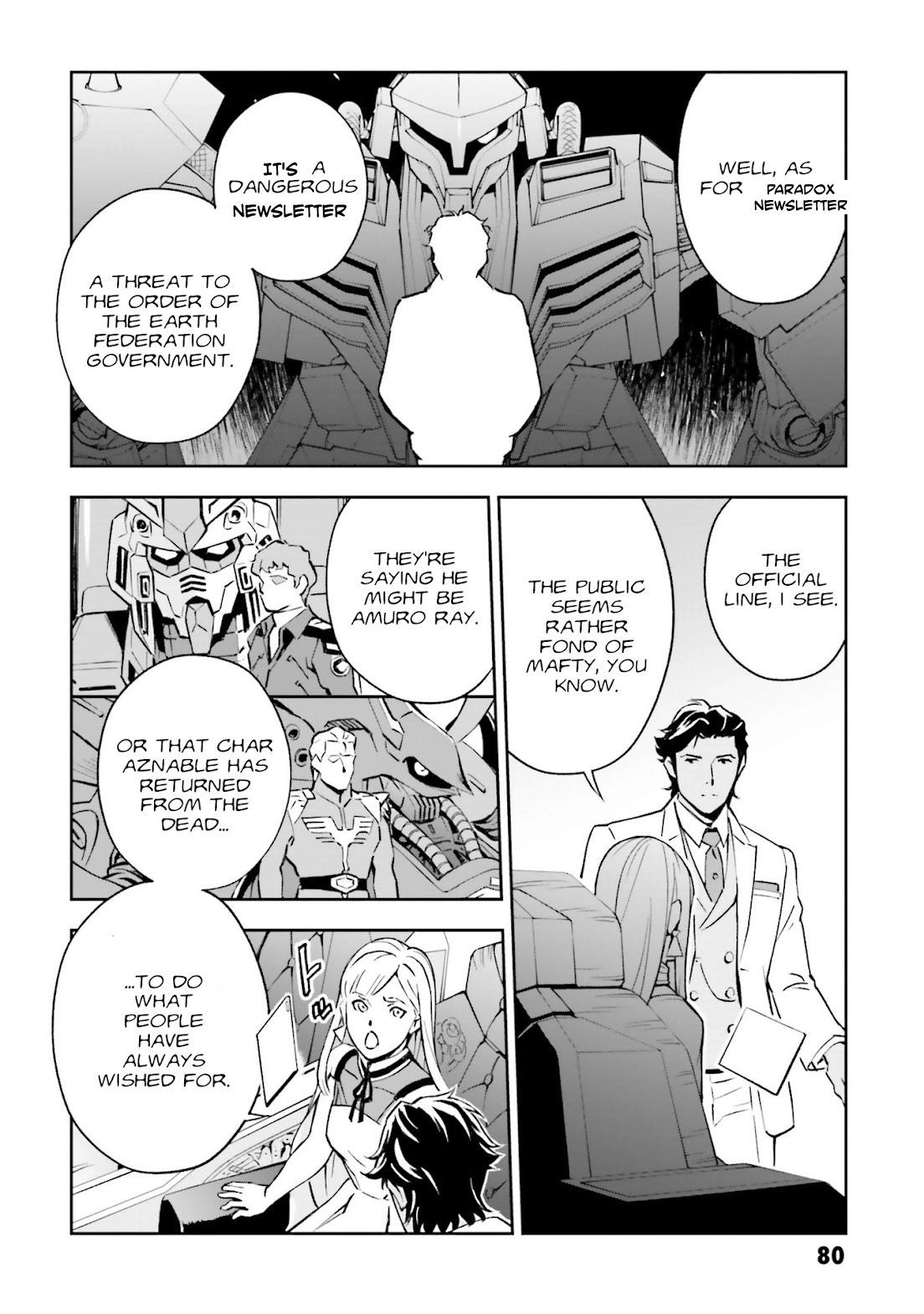
Like Reccoa, Quess betrays her allies in Char’s Counterattack and defects to Neo-Zeon to become a mobile armor pilot. Tomino explains her character’s function:
I thought, “A character like that would be good for setting things in motion.” That’s her true value. The thing that decided it was, it got me thinking, well then, in that case it doesn’t necessarily have to be a girl like Quess, right?
Even if Quess is a plot device, the form she takes on and the actions she takes aren’t accidental — even if they might be ‘unintended’ as Tomino is conceptualizing the script and story sequence of Char’s Counterattack. Quess and her betrayal loom large over the latest Gundam work, Mobile Suit Gundam Hathaway: The Sorcery of Nymph Circe (2026). Shūkō Murase directs this second of a planned trilogy adapted from Yoshiyuki Tomino’s original novel, Mobile Suit Gundam: Hathaway’s Flash (1989). Like Quess, Hathaway features a woman with shifting allegiances, Gigi Andalucia (Reina Ueda/Megan Shipman). And, like Lalah from the original Mobile Suit Gundam (1979), Gigi is a sex worker.
These echoes make Gigi a confusing and somewhat unsatisfying character. Tomino is an archetypal storyteller. He has character personalities, relationships, and plot structures that he reuses over and over. And, indeed, he has a view of women that endorses misogynistic tropes but explains them through the imposition of systemic misogyny:
I think the reason [women] leave like that is basically due to a self-preservation instinct. “There’s a part of a woman that can’t survive without someone else to depend on.” That’s actually just an epistemology instilled in them by men. And so they’ve gotten used to that[.]
This is obvious in the case of Reccoa, who names men as responsible for her ‘humiliation,’ which, in turn, drives her to betray. Tomino clearly learned something from film noir, too.
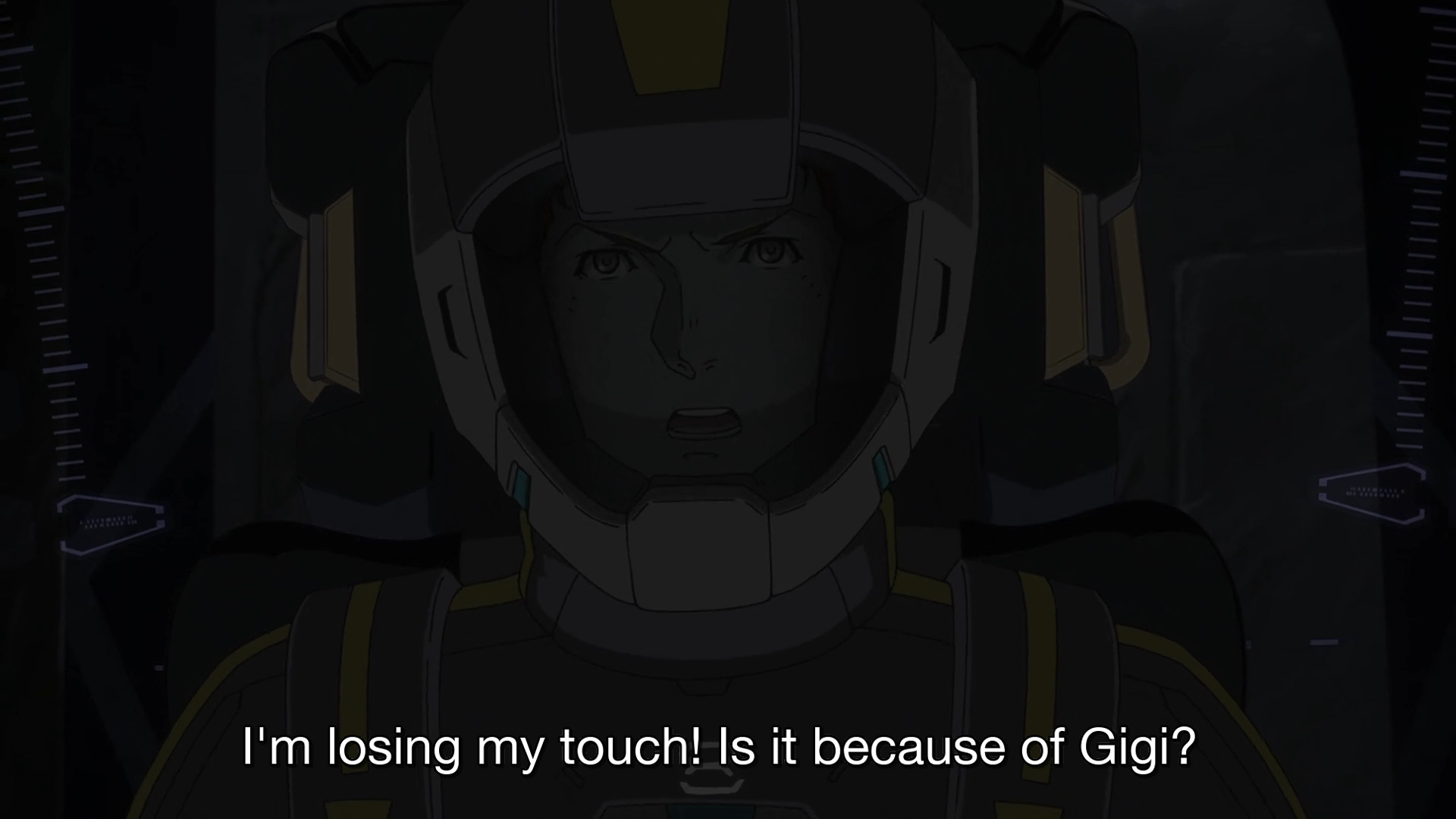
Gigi is a little different. In The Sorcery of Nymph Circe, Federation Captain Kenneth Sleg (Junichi Suwabe/Aaron Phillips) pursues her while she pursues terrorist figurehead Hathaway Noa (Kensho Ono/Caleb Yen), also known as Mafty. Gigi ingratiates herself with Kenneth, she works to keep Hathaway aware of the Federation’s designs on him. Gigi’s loyalties are earnestly divided. Though she supports the Mafty political program, she tells Hathaway in the first Mobile Suit Gundam: Hathaway (2021) film, “the way Mafty does things isn’t right.” In Nymph Circe, she interrupts Hathaway’s frenzied reminiscence of the events of Char’s Counterattack which casts young pilot Lane Aim (Soma Saito/Kieran Walton) as Amuro Ray (Tōru Furuya/Lucien Dodge).
Tomino treats Gigi like Quess, both of them functioning as plot devices. The film makes no attempt to cover this over. In Hathaway, Kenneth tells her, “It always seemed to me like you have the power to soothe savage men.” Because they are fulcrums for the plot, and regardless of their critical symbolic meaning, there is something unsatisfying about their psychological and dramatic substance as characters. There is less to them than Amuro, Char Aznable, or Hathaway. Gigi and Lalah are particularly of apiece because of their shared origin as sex workers. Sex work or sexual economy, in the literal sense of economic fungibility, is often connected with the kind of mystical, illusory quality of women characters.
Earl Lovelace, the author of Trinidadian Carnival fable The Dragon Can’t Dance (1979), confronts these same issues with his heroine Sylvia. Despite her age, seventeen, he describes her in a remarkably sexual fashion, which immediately raises alarm for contemporary readers.5 He also emphasizes this otherworldly quality that Gigi and Lalah seem to share:
She had watched, felt, the whole performance as if she wasn’t there, from a distance, was already engaged in the apprenticeship of being the whore, the virgin fucked but untouched. Already she had outgrown these boys that never sliced her virginity. She had grown away from them, and, even before them, the men watching her, so that now she could look at all of them with a kind of amusement, wonder, really, watching to see what they would try next. (25)
Given this description, readers should be unsurprised when Lovelace describes her entry into the aforementioned sexual economy:
instinctive knowing refined by seventeen years on this hill, that between this man, the rent collector, and her mother, a woman with seven children and no man either, she was the gift arranged even before she knew it, even without the encouragement or connivance of her mother. (25)
On the one hand, one can see how the denigration and precarity of a woman’s life in Cavalry Hill, the setting of The Dragon Can’t Dance, is ultimately because of masculinist hegemony and economic power. On the other, and not to scold Lovelace, but to read him, the potential romance between Sylvia and the age-inappropriate partner Aldrick suggests Lovelace is not fully equipped to deconstruct the tropes he deploys here. Sylvia and Aldrick fall into the archetype of heroine and hero, destined to be lovers, despite the way in which it naturalizes Sylvia’s treatment as a sexual object. Such treatment is always cause for objection, but it is particularly objectionable because she is a child. Though Tomino is unlikely to have ever read the English-language work of a novelist from Trinidad, he addresses this point explicitly in the context of the common visual gag of showing a young woman’s underwear in Japanese animation:
What I mean is, you see white pair of panties, and in that glimpse you see that the artist or director is only showing them furtively or knowingly. When it comes to [a character’s] fleshiness, if you’re putting that kind of thing out there without considering how it’s going to be seen, then I really wish you would stop. … If you’re intentionally doing that then you’re making a lolicon cartoon, which is bad for kids’ education and you should knock it off. … I want him to make that clear. Even if it’s just a painting on a cel. “I saw that girl’s panties.” “I could see them.” “I had to see them.” You need to be clear which it is. More than calling that character meaningless, I think it’s disrespectful. Carelessly showing their underwear. Am I wrong?
Tomino’s critique cuts across all works of fiction, navigating the ‘fleshiness’ (a term he tentatively defines and deploys in the course of the Anno interview) of a character set against the undeniable reality that they are representations rather than actual people. In his medium, animation cells.
Resulting from this view, Tomino may be the better critic of misogyny by representing it — again, a lesson likely learned from film noir. The most damning humiliation from Sylvia at the hands of her author comes at the novel’s conclusion Now in her late twenties, Sylvia is the ‘beneficiary’ of ‘advice’ from Aldrick that allows her to escape consignment to a loveless life of domestic servitude. Lovelace writes:
he could see that Sylvia in her way had arrived, that, at least, she could feel she had arrived; her own clean, polished room with almost every available modern convenience. She was too wise now for love. (199)
Sylvia has fully bought into her comfortable lifestyle. She asks Aldrick, “What you could give me?,” to which he replies, “Yourself” (201-202). All I can do is laugh.6 Lovelace narrates Aldrick’s thoughts:
he turned and waved again, this time with both hands, signalling [sic] faith in her and a joy in the moment, signalling [sic] as a dear friend, a lover, who is going on before to be joined later by her. In truth, he felt to rush back to her and hold her in his hands and lift her up and carry her away with him; but, he had come to Sylvia, not to claim her, but to help her claim herself (203)
The novel does not push back or question this notion of what Aldrick can offer whatsoever. She really does ‘claim herself’ because of Aldrick’s provocation and ends the novel abandoning her comfortable life for a comradeship with an aspiring revolutionary (218).
Looking at Lovelace and Tomino side by side, all I can think is that some misogynies are more interesting than others. The ill-treatment or poor writing of women in Lovelace leaves the men of his novels untouched. By contrast, Tomino’s leads are distorted and obsessed with the women they’ve lost. In Nymph Circe, the strongest evidence of this is Hathaway’s struggle to embody the ascetic guardian of Plato’s Republic7 (375) or Miyamoto Musashi’s Dokkōkō8 (1645). Hathaway constantly struggles against his supposed ‘carnal desires,’ “I’m supposed to have a high-minded mission to shock the world into setting itself right.” In service of that mission, he feels the need to transcend those aspects of his subjectivity that are not ‘high-minded.’
Tomino is not endorsing this idea among ‘warriors.’ His entire oeuvre is a condemnation of war, to the extent that it is possible in film. What Tomino is attesting to here is the relationship between men and women. In his interview with Anno, he says:
I think that the fact that men torment women as a part of everyday life shows that the power dynamics tied to our issues as an animal species can never be overcome, and even though the women can be forced to submit through brute strength, what we see is just a reaction on their part; it doesn’t fundamentally threaten their position of sovereignty.
Emphatically, he believes there is a relationship between men and women, an inherent relatedness even if the form of that relationship can transform, and that the failing of the ascetic masculine is its rejection of the inherent connectedness to women.
Or, if the relationship between men and women is not inherent, it is at least pleasant. But Tomino echoes the (slightly homophobic and, indeed, fight-fire-with-fire misogyny) critique leveled by The Boys (2019) of the manosphere, this time directed at Plato and Musashi. This asceticism or ‘high-mindedness’ has a queering effect and denies all that which might be pleasant or pleasurable about how men and women can relate.
Where Tomino and Lovelace seem to differ critically is on the question of lack. Aldrick’s wisdom is complete enough to impart something on Sylvia to snap her out of an ideological stupor. Hathaway has no answers, like his predecessor Amuro. And, like Amuro, Hathaway is incomplete. Despite occupying the structural position of Amuro in the narrative logic, Hathaway echoes the view of Char. While Amuro pleads with both Char and Hathaway to await the product of human wisdom, Char and Hathaway condemn him in the same way, “grant all these ignorant people your so-called wisdom, at this very moment!”
Tomino describes Amuro in these lacking terms in his conversation with Anno:
“If only you had been more of a hero, you could have ended things in a cooler way!” There’s a feeling of insufficiency, or at least that’s how I feel about it.
Char, on the other hand, covers over that insufficiency:
It’s not so much that he’s like me, but that we’re on equal footing, and I understand his feelings. So there are things I know very clearly, including that part that’s like, “Doesn’t it make you embarrassed to wear that mask forever?” … I don’t have that with Amuro, he was just raised very normally.
Hathaway is their amalgamation. But is his lack covered over enough with the name of Mafty in the same way as Char’s mask? Neither Amuro nor Char is ‘sufficient,’ but Char’s ‘coolness’ comes with the cover he chooses for his lack. Even as Reccoa shares the dubious claim to psychological realism of the undeveloped Sylvia, she has more in common with Tomino’s lead characters than Sylvia has with Lovelace’s. While both authors struggle with the representation of women, only one gives us a relation among genders as strange as the behavior of his underserved women characters.
Weekly Reading List


Two nice collections of semi-recent Kant scholarship from Paul Guyer are out this month. Find them at your local library.
And here’s some music:
Event Calendar: Backrooms (2026) this weekend
Not actually adding it to the event calendar, but the Backrooms feature film is out this week. I’m there on opening night. Otherwise, see Rififi (1955) in June and Vertigo (1958) in October.
Until next time.
Creator of Revolutionary Girl Utena (1997)
Kadokawa Shoten producer, now CEO
Animation director for Mobile Suit Gundam and character designer for Mobile Suit Zeta Gundam
Mechanical designer for Mobile Suit Zeta Gundamby
I’ve taught this novel numerous time and never had a peaceful class regarding the complex but unquestionably misogynist depiction of women in the Lovelace novel.
I’ve been fixated on this issue of Sylvia’s representation since I first read this novel in 2009. Re-visiting this particular foible, it’s hard to maintain the academically appropriate voice of disaffection. The Dragon Can’t Dance is an unparalleled achievement of the English language. It is also deeply frustrating because of women’s place in the novel. This is a representational problem I want to read as rigorously as possible.
“none of them should possess any private property that is not wholly necessary.” (Reeve trans. 101)
“Do not let yourself be guided by the feeling of lust or love” and “Do not seek to possess either goods or fiefs for your old age” are among Dokkōkō’s precepts.