

Issue #434: Curry Barker's Obsession is a Re-Staging of Alfred Hitchcock's Vertigo
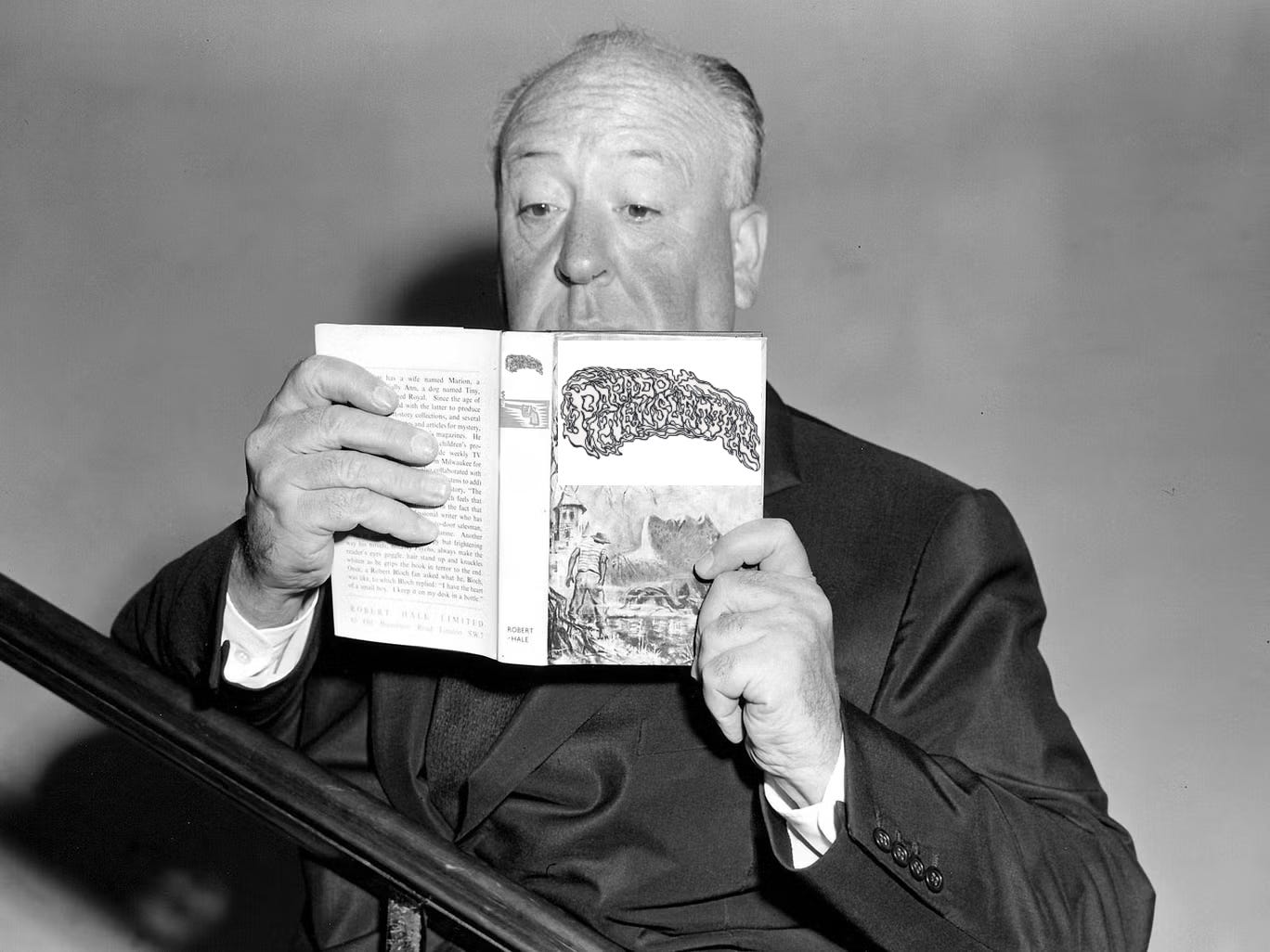
I started re-reading The Prince of Tennis (1999). It’s so awesome. I forgot that Ryoma Echizen and Baki Hanma start out with the same genre-subverting character motivation.


Speaking of these uncredited, maybe unintentional, similarities among art objects: here’s the most recent Music League playlist.
Voting is over so I can share I submitted a Miki Matsubara song based on its similarity to Michael Jackson.
Classics all around. These two songs are well-known as a pair, so I was lucky to get the submission in.
“Anyone could become obsessed with the past with a background like that”: Objet a and the Non-Existent Woman in Obsession and Vertigo
“[I]n its function as object, objet a cause of desire … we must give a function that will explain its place in the satisfaction of the drive”
Generally, I don’t think any work of art demands the peaks of enthusiasm demonstrated by contemporary audiences. Yes, I would scoff even at Vertigo (1958) “fancams,” though that is among the works most deserving of such slavish dedication. It is not Vertigo, however, that is enjoying such acclaim, but Obsession (2026), Curry Barker’s debut feature film. Despite its film festival premiere nearly eight months ago, lightning has struck during the theatrical release period. The film has taken audiences by storm. Yes, it’s very good, about as good as a modern film can be. And it’s no accident such a great film has caused such fervor among movie goers. Obsession is Vertigo.
For the benefit of the reading audience who I will assume have seen both films, I’ll be brief. Hitchcock’s Vertigo follows the investigative efforts of John “Scottie” Ferguson (James Stewart), a retired police detective, in service of Gavin Elster (Tom Helmore) to follow his wife Madeleine (Kim Novak) and prevent her suicide. Some time later, Scottie meets a woman named Judy Barton (also, Kim Novak) who he pursues based on her resemblance to Madeleine. In the background is Marjorie “Midge” Wood (Barbara Bel Geddes), a friend and confidant to Scottie whose romantic intentions toward him are not reciprocated.
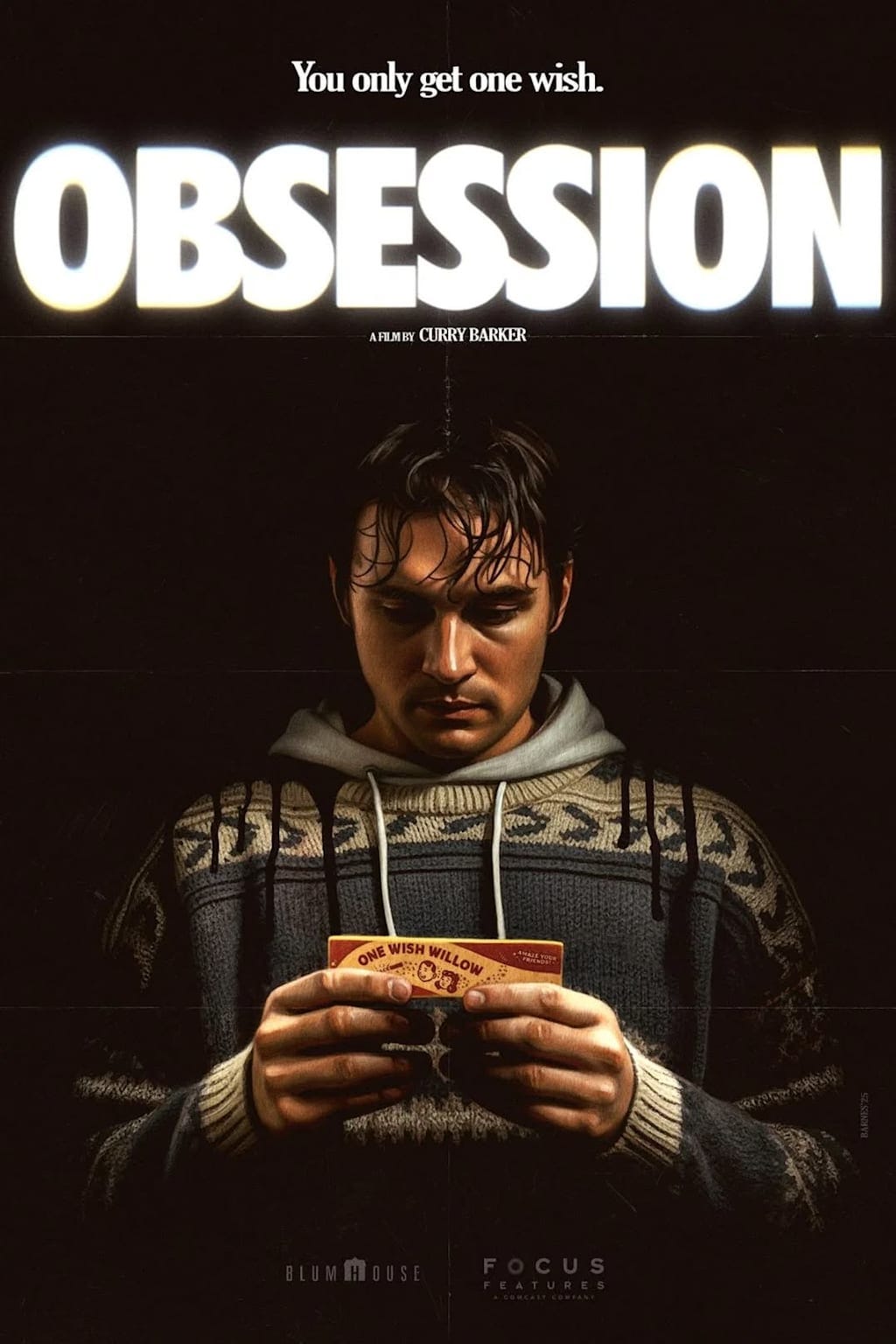
The plot of Obsession is less complex. A pathetic chump, Baron “Bear” Bailey (Michael Johnston), has romantic designs on his friend Nikki Freeman (Inde Navarrette) and relentlessly brainstorms a method to woo her. With the self-interested advice of his friend Ian (Cooper Tomlinson), Bear fails to convey his feelings and instead uses a strange object called a One Wish Willow to wish that Nikki “[love him] more than anyone in the … world.” In the tradition of the tale of King Midas, Bear gets what he wishes at the expense of Nikki’s sovereignty. All the while, Bear’s friend Sarah Harper (Megan Lawless) has romantic intentions toward him that are not reciprocated.
The most critical resonance between Vertigo and Obsession, aside from a brute mapping of their characters to a corresponding figure (Bear-Scottie, Cooper-Gavin, Sarah-Midge) is the rejection of the supernatural, specifically demonic, component of each film’s intrigue. In Looking Awry (1991), Žižek offers the turn-of-phrase describing the first half of Vertigo calling it, “the fascinating story of a woman possessed by demons from the past” (84). In an interview with CinemaBlend, Inde Navarette recounts Barker’s description of the power that compels Nikki to behave the way she does:
It’s not demonic, I wanna emphasize that. … Curry really nipped that in the bud at the beginning of the process. It was not demonic, it wasn’t a possession, it was a wish, and it was kind of like, for her … this draw to him. I have this veil that’s like over everything while the other Nikki is inside kind of peeping through that sheer material.
In this way, both Judy-Madeleine and Nikki-Nikki are incomplete in their division from themselves. Their duality is excessive and symbiotic. The woman Scottie believed to be Madeleine is in fact Judy pretending to be Madeleine, and in his attempt to re-create her he, at least, relegates her to the position of lure in Gavin’s plot. Žižek writes, “The elevation of an ordinary, earthly woman to the sublime object always entails mortal danger for the miserable creature charged with embodying the Thing, since ‘Woman does not exist.’” (68). This follows from Žižek’s render of Lacan on sublimation:
Hitchcock’s Vertigo, another tale of a woman who vanishes, a film whose hero is captivated by a sublime image, is made as if to illustrate the Lacanian thesis that sublimation, while having nothing to do with “desexualization,” has all the more to do with death: the power of fascination exerted by a sublime image always announces a lethal dimension. … His starting point is not the object of the allegedly direct, “brute’‘ satisfaction, but its reverse, the primordial void around which the drive circulates, the lack that assumes positive existence in the shapeless form of the Thing (the Freudian das Ding, the impossible-unattainable substance of enjoyment). The sublime object is precisely “an object elevated to the dignity of the Thing,” an ordinary, everyday object that undergoes a kind of transubstantiation and starts to function, in the symbolic economy of the subject, as an embodiment of the impossible Thing, i.e., as materialized Nothingness. (83)
Sublimation, and its ‘elevation’ of the object to ‘the dignity of the Thing’ is among the crucial overlapping themes between Vertigo and Obsession. Nikki’s humiliation is her transformation into the miserable, obsequious creature that is a manifestation of Bear’s own fantasy. Madeline is no different.


Relating this figuration to Hitchcock’s The Lady Vanishes (1938), Žižek writes:
It is difficult not to recognize in this phantomlike figure the apparition of Woman, of the woman who could fill out the lack in man, the ideal partner with whom the sexual relationship would finally be possible, in short, The Woman who, according to Lacanian theory, precisely does not exist. The nonexistence of this woman is rendered manifest to the hero by the absence of her inscription in the sociosymbolic network: the intersubjective community of the hero acts as if she does not exist, as if she were only his idée fixe. (80)
The Woman as such, ‘elevated to the dignity of the Thing,’ is featured in The Lady Vanishes, through her absence. One might allegorize this to a chalk outline in certain works of film noir. In Vertigo or Obsession, we see their excessive presence in their very creation by Scottie/Bear. These women, even as Scottie/Bear imagine them as Woman, that which will fill the lack, their ideal fails to live up to what the man imagines despite how exactly — in Obsession, exactly — they live up to the letter of what the man demands. In other words, the entire scheme of the monkey’s paw is revised to emphasize how it is men who don’t know what they want and don’t realize their lack cannot be filled.
If the story of King Midas and the monkey’s paw are the story of Lacan’s objet a,1 then one can look to Vertigo and Obsession to understand the relation between objet a and Woman who, in Lacanian logic, does not exist. It is critical to differentiate between this non-existent or barred Woman and the supposed ‘ideal woman’ precisely because this ideal is only supposed. When one obtains it to the exact specification of their fantasy, there is no satisfaction. Laurence Simmons writes of Vertigo and the MacGuffin that reveals Judy and Gavin’s deception:
Judy/Madeleine puts on the necklace inherited by Madeleine from Carlotta Valdes. For Scottie, the jewels belong to the real Madeleine not just the image of Madeleine (although they were present in the image of Carlotta Valdes) so they cannot belong to the real Judy. He now must ask himself how he got what he thought he wanted: the perfect image, agalma.
Obsession is more explicit. Nikki behaves with an absolute, animalistic devotion toward Bear. This devotion is ultimately threatening and demands from Bear equivalent… obsession. To some degree, this is where Vertigo and Obsession diverge. Nikki obtains a One Wish Willow herself and condemns Bear to a corresponding stupor of obsessive love. Their Bonnie and Clyde moment is short lived and transforms quickly to Romeo and Juliet. Bear consumes painkillers in an attempt to kill himself, and though he ultimately flinches and tries to vomit, his being overtaken by the power of the One Wish Willow leads to him, for one reason or another, not vomiting. So, he dies, and in turn releases Nikki from her obligation to the terms of his wish. Let us not make the mistake that this turn suggests the two might’ve been happy. They would only be equals in their mutual enslavement, and Bear’s death is a structural necessity for the plot’s logic. Thus, Obsession upholds the notion of Lacan’s non-relation as vehemently as Vertigo.
“Here I was born, and there I died.”
Viewing the films should make clear that both Obsession and Vertigo call into question the guarantors of one’s subjectivity regardless of gender. Although Bear/Scottie and Nikki/Judy are structurally analogous in the logic of each film, they each make opposite demands of their unwilling partners. For Scottie, identity is coextensive with the image. Bear not only wants Nikki to want him, but he wants her to want to want him. This final criterion is the one which Nikki can never meet, despite the only evidence of her resistance being her unending scream on the other side of a strange phone call or her unexpected plea to ‘kill me.’
Bear himself is as illusory as Madeleine Elster, a flaw with which the film makes clear at the outset. He practices a histrionic, overwrought confession of love to a waitress, supposedly his earnest, authentic feeling. What authentic feeling needs practice? Why would the audience believe that a contrived, juvenile expression of affection represents something real about Bear and his feelings? His faces only multiply as the film continues. There is the reserved, resigned Bear who refuses to admit his feelings to Nikki. There is the disaffected Bear who brushes off Sarah. Even this version of him rings false, as Bear tells no one about the death of his cat in any manner that suggests he is conveying his depth of feeling about it.
If Bear can be said to have any subjectivity at all, it is only that exposed through profound trauma and confrontation. He laments the accidental death of his cat. He, chillingly, refuses to assent to Nikki’s request to kill her, instead asking: “what’s so bad about being with me?” In a climactic moment with her, he repeats this is “all [he] ever wanted,” despite the evidence the facts of his subordination of Nikki do not match the contours of his fantasy.
What Bear and Scottie share, aside from nicknames, is the structural position of film villain. In Scottie’s case, the visual language is unambiguous. He stalks Judy and is ultimately the proximate cause of her death. Stewart’s performance is uniformly acclaimed for its chilling turn in the second act that makes his position clear. Bear’s villainy is equally unambiguous, though the way the film communicates it is unconventional. He is prompted, regularly, to kill himself to set Nikki free. Periodic bursts of ‘the other Nikki’ evince her suffering as a consequence of his wish. Even as Nikki terrorizes Bear as the ostensible supernatural threat, this is a threat of his own making. Her behavior toward him matches what he demands of her against her will.
“There’s someone within me and she says I must die”
Obsession unquestionably fits within the generic formalism of horror film. Much of the frenzied reaction to the film comes from how effective it is subjected to horror’s rubric. Nikki follows Bear, menaces him, entraps him, moves with an inexplicable, supernatural quality. The film’s gore is remarkably reserved for the first two-thirds. But the film never loses sight of the extent to which Nikki herself is the victim, out of control of her own body. Bear’s transformation of her afflicts her with what the film conveys as an illness. This, too, fits the archetype of Madeline and other ‘ideal women’:
The ideal love-object lives on the brink of death, her life itself is overshadowed by imminent death—she is marked by some hidden curse or suicidal madness, or she has some disease that befits the frail woman. (Žižek 85)
At the same time, both versions of Nikki have an inexhaustible vitality that Bear seeks to confine. Though her Wish Willowed version seems to control Bear, her control of him is a result of his ceding of control. His reluctance to speak, to exist, to be somebody, is what leads to the film’s sorry state of affairs.
The similarities between Vertigo and Obsession cannot be understated. There is certainly more to mine in the encounter between the texts. I, at least, will make the effort to continue it. Obsession is not itself without Alfred Hitchcock.
Weekly Reading List
Art is just out there for you to encounter.

https://www.arrowvideo.com/p/blu-ray/wandering-ginza-butterfly-collection-limited-edition-blu-ray/17699252/ — I did not get a chance to write about this movie for the letter, but you should watch it.
Event Calendar: More at the Brattle
I added listings for some screenings of one of my all-time favorite films, Malcolm X (1992) at the Brattle.
Until next time.
In Seminar XI, Lacan writes of objet a; “You see, the object of desire is the cause of the desire, and this object that is the cause of desire is the object of the drive—that is to say, the object around which the drive turns” (243).