

Issue #436: Gilda Is One of the Best Movies of the 20th Century
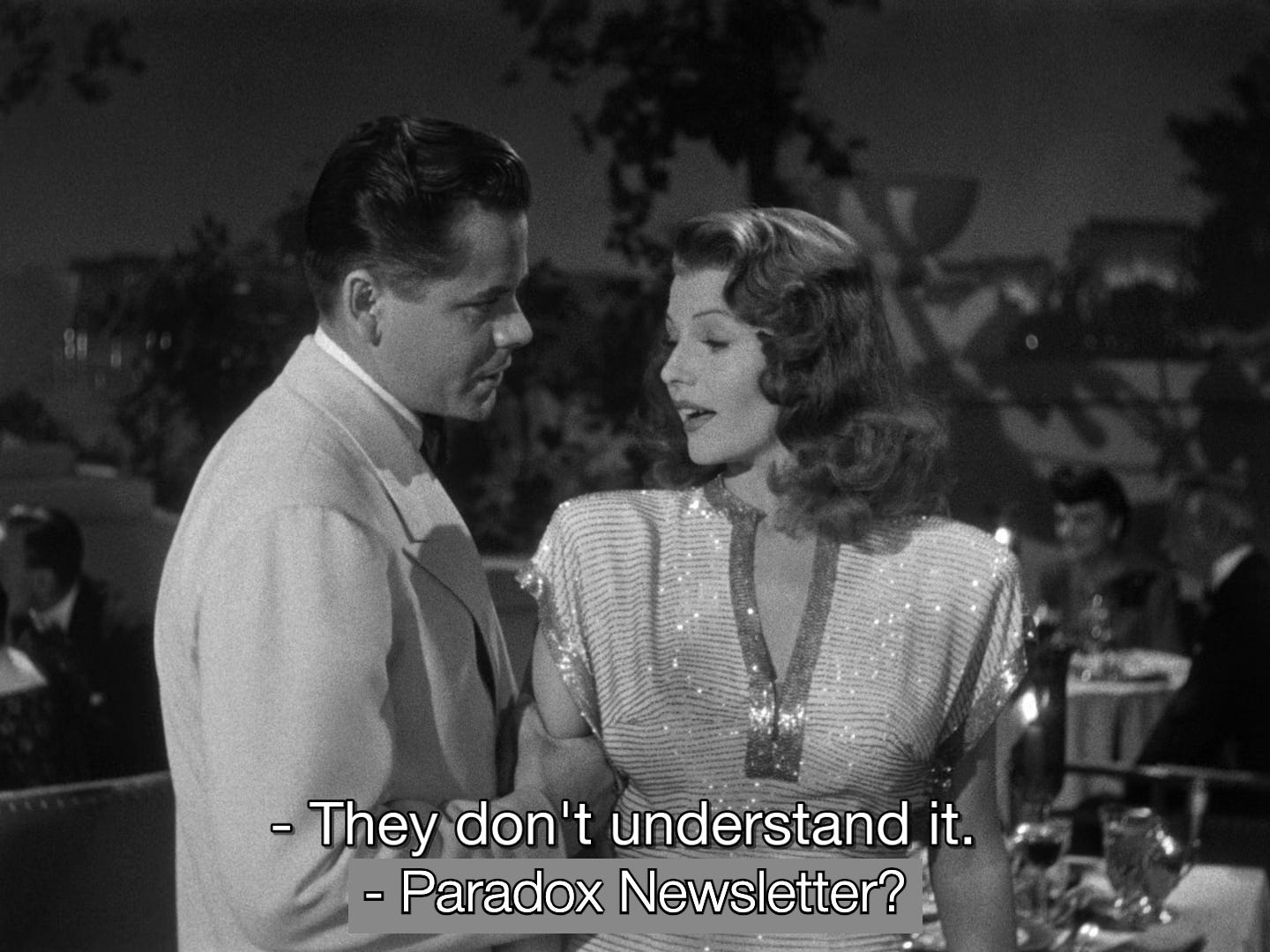
I had an idea for a podcast. Please, hold your groans. The premise would be, of course, film discussion with a guest. There would be some kind of scale that would dictate how we would discuss the film, chosen by the guest. On the high end, maximally unapproachable and complicated critical-theoretical film discussion. On the low end, the most rudimentary critique possible in the most democratic terms. As I thought about this, I started to wonder about different films as the subject. How difficult would it be to discuss certain movies under these constraints? Rush Hour 2 (2001) would be a little less amenable to a highly intellectual discussion, though it would be doable for me. Vertigo (1958) would be pretty tough to strip down to the pure, instinctive, non-academic pleasures of cinema, I think. But maybe that challenge is just for me. I maintain that there are movies that would be genuinely challenging to talk about in a non-intellectual way. Whether that is a limitation of myself as a critic or the films themselves, that’s for you to judge.
As I finished watching Gilda (1946) at Noir City Boston this year, I thought it was one of those films that might be hard to discuss without a robust intellectual apparatus. The more I consider about the film, the more I realize I was wrong in that initial estimation. Clearly this movie leaves an impression, no matter who you are.
Regardless, it is remarkable to me that this film has not been taken up with more fervor by Lacanians. Maybe it’s just too easy. The illustration of some of Lacan’s theoretical formulations are too clear, too schematic in Gilda. But I don’t think so. It is certainly a film I will write more about, hopefully in a peer-reviewed context.
Among the films I saw at Noir City Boston, it was by far my favorite. There were some other great ones, though. Anatomy of a Murder (1959) is almost too good. Unbelievable James Stewart plays piano with Duke Ellington in that flick. All Night Long (1962) and A Man Called Adam (1966) are both only debatably noir, but I liked both. The ‘62 British production re-stages Othello (1603) with the guy from The Prisoner (1967) as the Iago character. A Man Called Adam has taken some unfair slings and arrows. It would probably make a good double bill with Mo’ Better Blues (1990).
The theme this year was music; and each film had some explicit or implicit involvement of music, usually jazz. But much of what was on offer was closer to conventional melodrama than what I expect from film noir. Not complaining. Just an observation.
Let’s wrap up Music League coverage. We had one category of “upbeat or otherwise energized songs with depressing lyrics”:
And our final category was another run of cancelled artists:
Putting my cards on the table, I lost some of my joie de Music League by the end. And I still came in 3rd with some stiff competition.

Bobby, my movie trivia teammate, has become an absolute Music League ringer. Paolo has great taste and makes a great zine. Now, Music League is over. We’ll run it back:
“Understand what? Mean what?”: “La femme n’existe pas” and the Lacanian Phallus in Gilda
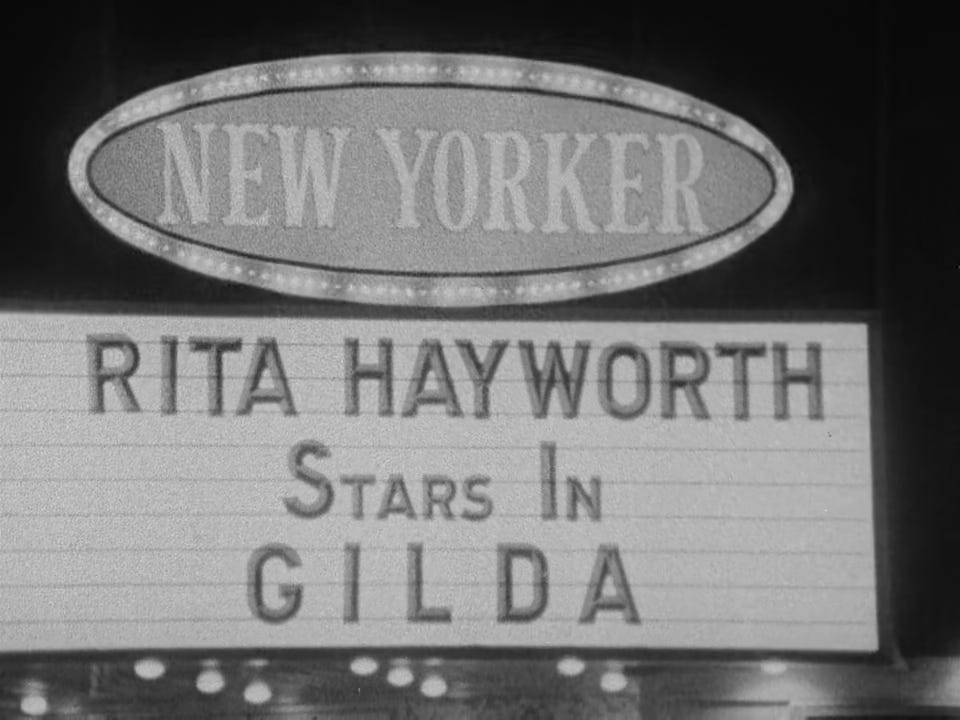
Gilda (1946) may be one of the most rich films for Lacanian reading ever. It offers a treasure trove of examples to demonstrate and anatomize Lacanian concepts. Take Lacan’s concept of the phallus, for instance, and its relation to sexed subjects. Elizabeth Grosz writes:
Instead of the Freudian commitment to a phylogenetic, pseudobiological explanation of the oedipal structure, Lacan will use social, unconscious, and linguistic explanations. While agreeing with Freud that the castration complex is the pivot of the child’s entry into culture, Lacan confirms Freud’s conflation of patriarchy with culture in general, yet he refuses to see women as castrated in any Real or anatomical sense. The mother is denigrated from her position as the all-powerful phallic mother, not because of the child’s perception of an anatomical lack. (70)
Grosz goes on, elaborating the idea of the phallus with more detail:
The mother carries the Law of the Father within her, in the very form of her unconscious desire (for the phallus). She invokes ‘his’ authority on loan whenever she threatens or punishes the child for wrong-doing. She requires the authority of he who is absent. Thus she does not lack in any anatomical sense. This is to attribute lack to the Real, which, as Lacan defines it, is the ‘lack of the lack’, a pure, unspeakable, pre-representational plenitude. Instead, she is positioned in relation to a signifier, the phallus, which places her in the position of being rather than having (the phallus, the object of the other’s desire) (71)
As I have described regularly through the life of the letter, the Lacanian phallus to which Grosz refers here is an empty signifier. Lacan writes in “The Signification of the Phallus,” “It … becomes the bar with which the demon’s hand strikes the signified, marking it as the bastard offspring of its signifying concatenation” (581). In other words, the phallus as signifier mangles the signified it would supposedly stand in for. This specific formulation is a bit different from the idea of an ‘empty signifier,’ but it is coextensive to the extent that whatever the phallus represents is illegible, meaningless, and disfigured. Grosz’s elaboration helps make sense of Lacan’s own view of the subject’s relation to the phallus. Lacan, again, writes:
But one can indicate the structures that govern the relations between the sexes by referring simply to the phallus’ function.
These relations revolve around a being and a having which, since they refer to a signifier, the phallus, have contradictory effects: they give the subject reality in this signifier, on the one hand, but render unreal the relations to be signified, on the other. (582)
Let us then turn to Gilda for further clarification. One symbol orients us and the characters to the phallus: Ballin Mundson’s (George Macready) “faithful and obedient friend,” his cane which hides within it a knife.


The cane-knife being a physical object should not deceive anyone. It is a phallic signifier, both in the logic of the film (which associates it with certain anatomical features) and in Lacanian logic. Ballin’s authority is derived from the cane-knife. He uses it to save Johnny Farrell (Glenn Ford) and his relation to it gives him authority over Johnny. In the obvious, though implied, gay relationship between the two men, the reductive relation between the two feminizes and queers Johnny while rendering the disaffected Ballin something of an asexual. His interest is in neither romance nor sex, but instead, power.1
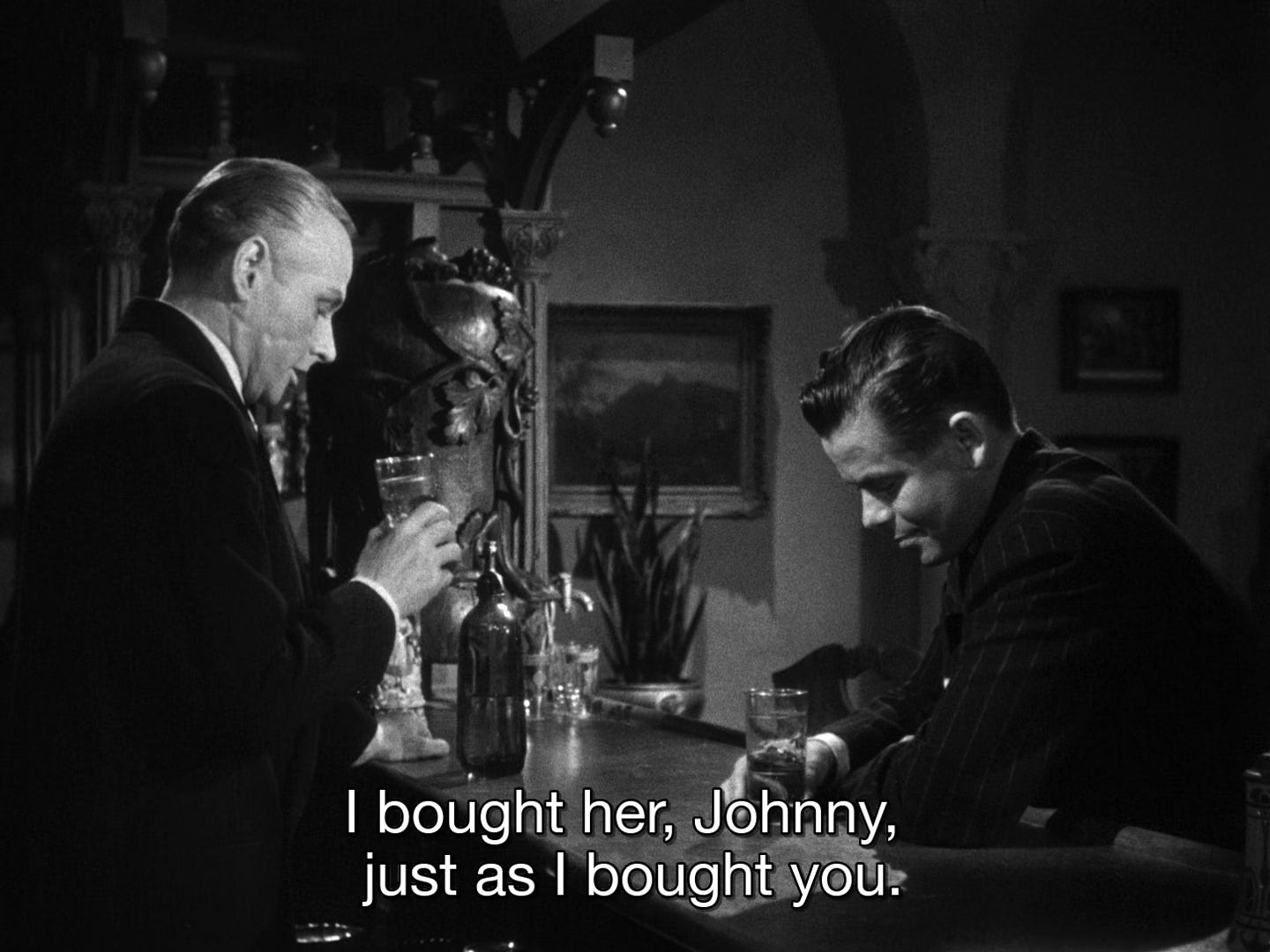
In this way, we can see how the disorienting, disfiguring power of the phallus removes a subject from conventional sexual and romantic orientation. But the cane-knife falls out of the film to be replaced by the film’s titular figure, Rita Hayworth’s Gilda.


Gilda replaces the cane-knife as Ballin’s phallus. The film is very explicit here: during the new trio’s first dinner, Johnny expresses his confusion. Before Gilda’s arrival, Ballin and he toast to “the three of us,” as in Johnny, Ballin, and the cane-knife. After, Gilda replaces the cane-knife in that configuration.


About this, Grosz writes, “The phallus as singifier is that by which the subject is placed as being or having” (104). This follows from the Lacan quotation above, where he elaborates the relations to the phallus which “revolve around a being and a having” on page 582 of Bruce Fink’s Écrits (1966) translation.
Being the phallus, for Gilda, is coextensive with her status as barred woman, or woman who does not exist in Lacan’s logic. Melvyn Stokes writes in his book-length treatment of Gilda for the BFI Classics series:
We had both imagined a fantasy of Gilda’s behaviour, rather than the real thing. Yet in many ways, this was symptomatic of Gilda as a whole. It rested heavily on what people wanted to see and what despite or perhaps because of the Hays Code – they sometimes believed they had seen. Gilda herself was the perfect sexual symbol for the confused, immediately post-war world: she acted as a catalyst for seething emotions but was in the end loyal, a woman who was at different times dangerous and supportive, free-wheeling but ultimately safe. (8)
This follows the reading of Gilda implicitly endorsed by her satirization in Who Framed Roger Rabbit (1988), where Jessica Rabbit is “not bad… just drawn that way.” Film critic and historian Eddie Muller attributes this quality to the producer, Virginia Van Upp, in his 2016 companion to the Criterion Collection release of Gilda:
Wholeheartedly, I believe that this movie is Virginia Van Upp’s take on Rita Hayworth’s career at this point. In that she sees Harry Cohn as Ballin Mundson … I think that drawing parallels between Gilda and Rita is dead-on accurate.
Prefacing his attribution to Van Upp, Muller describes Gilda as distinct from the femme fatale because she seeks not to bring Johnny to ruin but seems to have a genuine romantic affinity for him. Instead, it’s Ballin fitting into the structural position of “homme fatale,” according to Muller, “the last man that Gilda should meet.”
If Gilda is positioned as the phallus, just as she is a sympathetic and fully realized film character, we must examine her phallic qualities in the film. Lacan writes:
Paradoxically as this formulation may seem, I am saying that it is in order to be the phallus—that is, the signifier of the Other’s desire—that a woman rejects an essential part of femininity, namely, all its attributes, in the masquerade. (583)
One need only look to the literal masquerade of Gilda’s Carnival wherein she possesses her own phallic facsimile: a whip.


To the end of “reject[ing] an essential part of femininity,” the film turns on the idea, as Muller and Stokes have observed, that Gilda is ultimately a devoted, moral figure. Behind the artifice, she’s a “decent woman,” in the sense of ideological masculine chauvinism.


Both Johnny and Ballin misrecognize this fact, taking the artificial, imaginary projection of Gilda as the real one.


Of course, Gilda uses this misrecognition to her benefit, detriment, and eventually out of necessity when she is completely imprisoned through contrived machinations of Johnny that match the level of deception of Michael Douglas’s character in David Fincher’s The Game (1997).
Gilda the film and Gilda the character demonstrate beautifully how ‘being the phallus’ and ‘not existing’ under the Lacanian sex-gender schema coalesce. Every bit of Gilda’s presentation is the amalgamation of the fantasies of those who view her. This is borne through the text itself and the staging of it.
The “feminine image” is illusive precisely because of its illusory status. Gilda’s disposition changes, she deceives and has deception projected on her, and ultimately renders her speech meaningless in snappy dialogue with Johnny. The thing she seeks to unmask about herself in the “Put the Blame on Mame” number is exactly something that is untrue. Reading outside of the text, we see how the profoundly detailed, laborious, and expensive staging and costuming of Rita Hayward leads us also to conclude that the feminine image on screen has no referent but imagination. The Mame on which Gilda proposes everything be blamed is as non-existent as the Gilda of the film.
Weekly Reading List
From the Criterion bonus features.
Best music I heard in a flick at Noir City Boston. Sammy Davis Jr. goes unbelievably hard on “I Want To Be Wanted.”
Saverio Guerra might be my favorite Curb guest star.
Event Calendar: Adolescence of Utena and Not Much Else
It’s summer in Boston. The Harvard Film Archive is in hibernation. The Coolidge Corner Theater Union might be about to go on strike so I don’t want to add a bunch of screenings and then have to delete them. I added a few Brattle shows, but otherwise the headline is GKids bringing Adolescence of Utena (1999) to theaters across the US and Canada. Go see it.
Until next time.
Eddie Muller suggests, “He’s all about having power over people that he finds fascinating and attractive, whether they’re men or women.”
Looking forward to further writing from you on Gilda!