
Issue #438: The Cape Fear TV Remake Is as Good as Cape Fear Has Ever Been
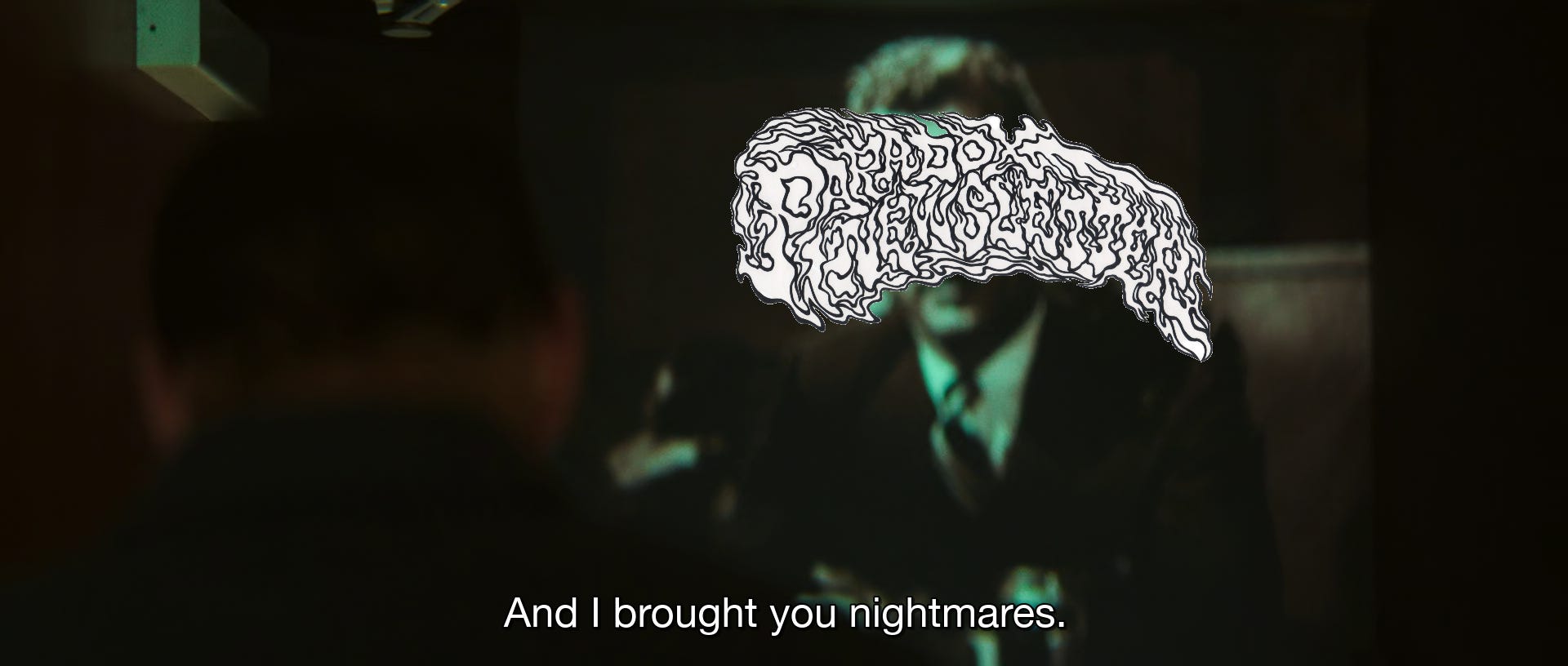
The newsletter never goes on vacation. But I have been actually on vacation. This kind of re-arrangement of my time can sometimes produce interesting results for Paradox. There is nothing topical here, although I have been reading Lacan’s The Logic of Fantasy (2023) on the beach.
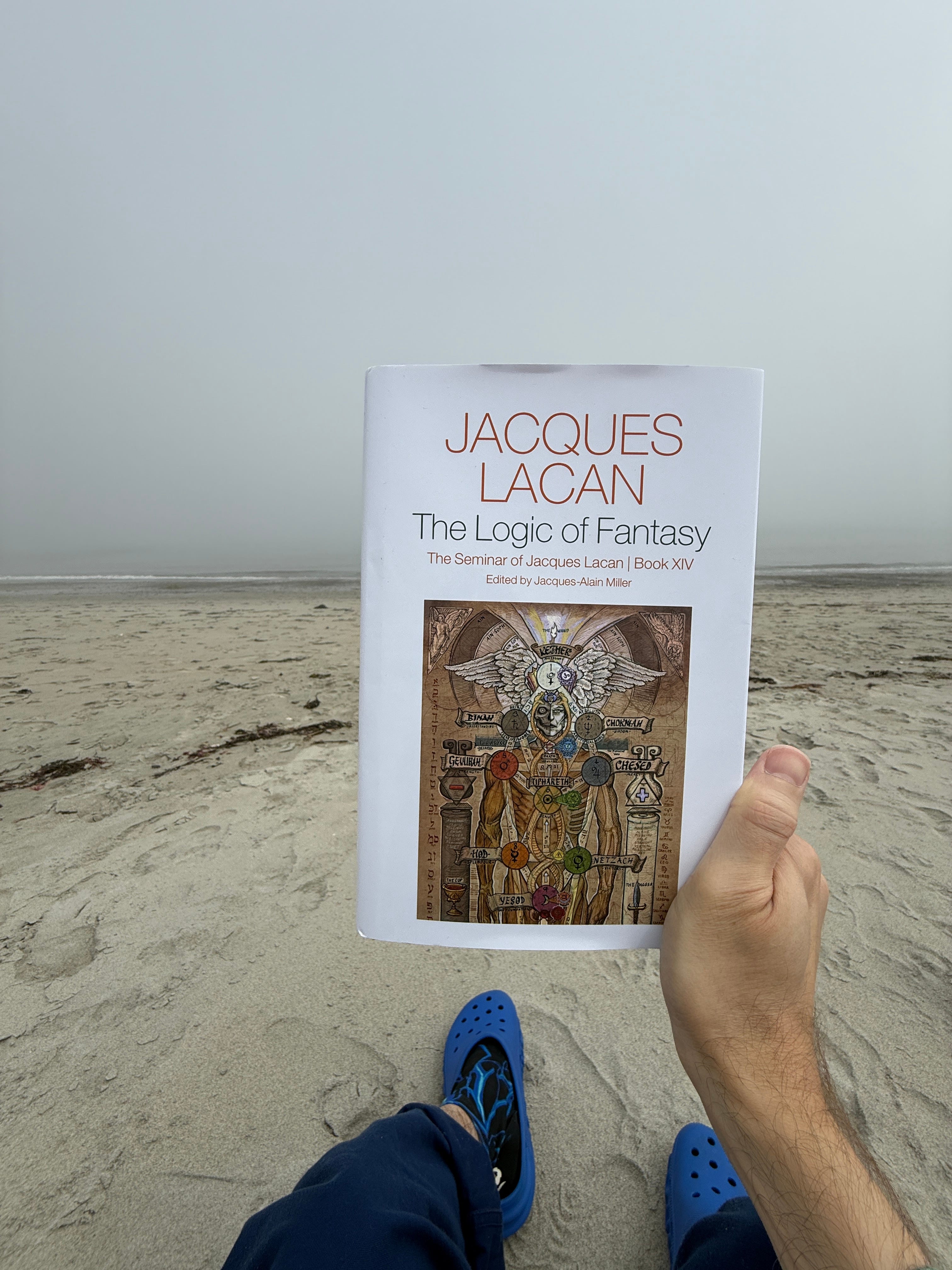
The culmination of all of this is some writing on the new Cape Fear (2026). I started the piece of writing right after watching the first episode and planned on restricting it to a close reading of only that episode. But, I’m on vacation, and my mom wanted to keep watching it. As a result, the essay touches on all five of the episodes that have aired so far. I made an effort to avoid major ‘spoilers.’
I made the connection between Cape Fear and Shadow of a Doubt (1943), not very subtle I’ll admit, before I saw the show actually excerpt Shadow of a Doubt within it. Sometimes the criticism is built into the text.
Cape Fears: From Uncle Charlie to Max Cady
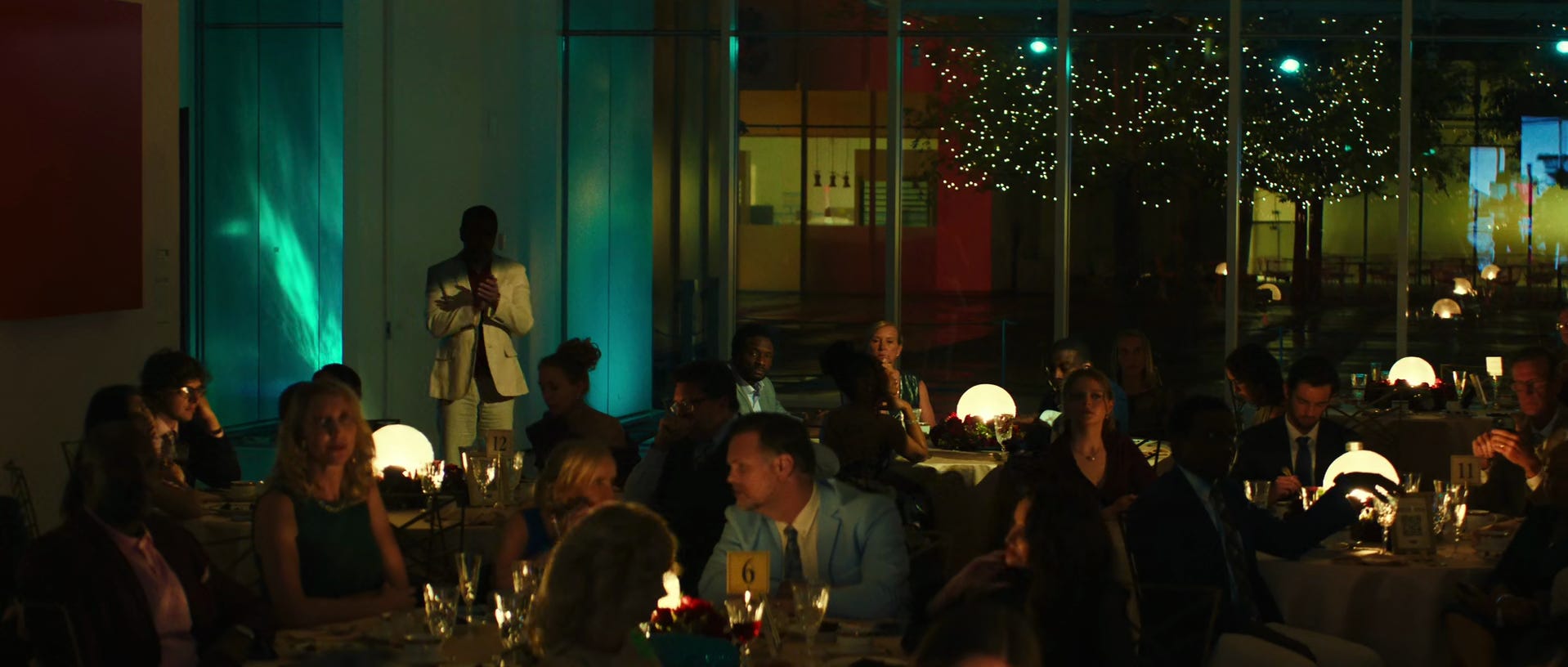
There is a small, but notable, sub-genre of horror film that focuses on the anxiety and self-sacrifice that exist at the most extreme manifestation of polite sociality. These include Michael Haneke’s Funny Games (1997), Kiyoshi Kurosawa’s Creepy (2016), Darren Aronofsky’s Mother! (2017), and Christian Tafdrup’s Speak No Evil (2022). These films are largely focused on a domestic situation running out of control, but follow from the same sort of themes and structures that exist in classics like Shadow of a Doubt (1943) and Rosemary’s Baby (1968). These films, taken together, intersect across the symbolic universe of unwanted house guests, desperate behavioral interpretations, and gaslighting. Again and again figures in these films will insist a situation is normal, when it is clear to the aggrieved party, and likely the audience, that what is unfolding is far from normal.
Shadow of a Doubt, by way of the various contemporary examples, would leads us to Cape Fear (2026). The series, starring Javier Bardem and Amy Adams with showrunner Nick Antosca, is the third version of Cape Fear after J. Lee Thompson’s 1962 film and Martin Scorsese’s 1991 remake. The Max Cadys of the works (Robert Mitchum in 1962, Robert De Niro in 1991, and now Bardem) each loosely follow the same kind of menacing blueprint of Uncle Charlie (Joseph Cotten). Likewise, a similarity among all of these works is the need for a plot structure that can accommodate the reassurances from one party to the unsettled other: “this is all fine.” In most cases, particularly in Cape Fear, the behavior some characters find acceptable is well beyond the realm of a reasonable person. 2026’s iteration is even more extreme in this respect.
The plot of Cape Fear always involves a sinister criminal named Max Cady menacing an attorney with the last name Bowden after his release from prison. In the original novel, The Executioners (1957), and the 1962 film, the attorney in question has always been an antagonist to Cady: these two versions Sam Bowden interrupting Cady’s attack and testifying against him. Scorsese’s version adds a wrinkle: this Sam Bowden (Nick Nolte) is Cady’s defense attorney and withheld evidence that might have aided in Cady’s defense. The version that is my primary subject today, the 2026 streaming series, follows the loose plot outline of Scorsese’s version with some significant changes. Sam Bowden is now Amy Adams’ Anna Bowden. Another divergence is Max Cady’s sentence: each of the prior versions involve Cady being released after serving his full sentence. The 2026 series has Cady sentenced to life in prison, but through some unclear machinations in the first episode is ultimately released, supposedly wrongfully accused. This ties Anna and Cady together even further: Anna has become a senior attorney for the Innocence Project-like Savannah Justice League Project and advocates for the release of incarcerated people who have been wrongfully accused.
As with any Cape Fear adaptation, Cady has every reason to hate Anna. Whether she withheld evidence as is the case in Scorsese’s version, she goes on to marry the prosecuting attorney in Cady’s case, Tom Bowden (Patrick Wilson). She also, clearly, believes him to be guilty. The SJLP director, Noa Toussaint (CCH Pounder) is intent on using Cady’s notoriety to benefit her non-profit. Her attitude is one among many examples of what strains the verisimilitude of “Fingers & Toes,” the series’ first episode. Despite seemingly knowing how stressful Cady’s release might be, she regularly encourages Anna to work with him to garner donations.


This is all necessary for the plot to unfold. The world cannot be hospitable to the perceptions of Anna and the Bowden family. Everything they feel as a slight or a threat has to be under-counted and undervalued by those close to them. The Bowden family must become isolated under the menace of Max Cady and the audience should see the world they do, equally frustrated by a money-grubbing charity executive who would put her friend and colleague in danger.
Such plot contrivances and psychological unreasonableness cuts across the various Cape Fears. In the 1991 version, Cady is able to orchestrate a caper that implicates Sam Bowden in retaliatory physical assault and attempts to re-litigate his criminal trial on a storm-shaken boat. Theoretical treatment of the films largely focus on the symbolic level of the absurd situations that unfold. Slavoj Žižek writes in Tarrying with the Negative (1993):
In the original version, the ex-convict (Robert Mitchum) is a figure of Evil who simply invades from outside the idyllic all-American family and derails its daily routine; whereas in Scorcese’s remake, the ex-convict (Robert de Niro) materializes, gives body, to traumas and antagonistic tensions that already glow in the very heart of the family: the wife’s sexual dissatisfaction, the daughter’s awakened femininity and sense of independence. In short, Scorcese’s version incorporates an interpretation homologous to the reading of Hitchcock’s Birds that conceives of the ferocious birds’ attacks as the materialization of the maternal superego, of the disturbance that already dwells in family life. Although such a reading may appear “deeper” than the allegedly “superficial” reduction of the force of Evil to an external threat, what gets lost with such a reading is precisely the remainder of an Outside that cannot be reduced to a secondary effect of inherent intersubjective tensions, since its exclusion is constitutive of the subject: such a remainder or object always adds itself to the intersubjective network, as a kind of “fellow traveler” of every intersubjective community.
In this sense, then, De Niro’s Max Cady and Mitchum’s Max Cady are two sides of the same coin in a way Scorsese’s film seems not to recognize in Žižek’s reading. The excess of Cady is radically exterior to the Bowden family, even as their own disorder, dissatisfaction, and desire “produces” Max Cady in a symbolic sense. The truest Max Cady would be one who is the synthesis of the remainder of what Žižek calls “an Outside,” that seizes the subject through the gaps in their own ideological frame — gaps in their own reality.
Enter Javier Bardem. This 2026 reinterpretation of Cady is by no means the goldilocks perfection Žižek alludes to; a Cady without the (somewhat) naive beliefs of each film. 2026’s Cape Fear does, however, introduce all manner of ambiguity to Cady. De Niro’s Max Cady is an unrepentant and unquestionably guilty sex criminal. Bardem’s Cady, by contrast, does not just legally maneuver his way to innocence. The show embraces the idea, to some small degree, that he might actually be innocent.
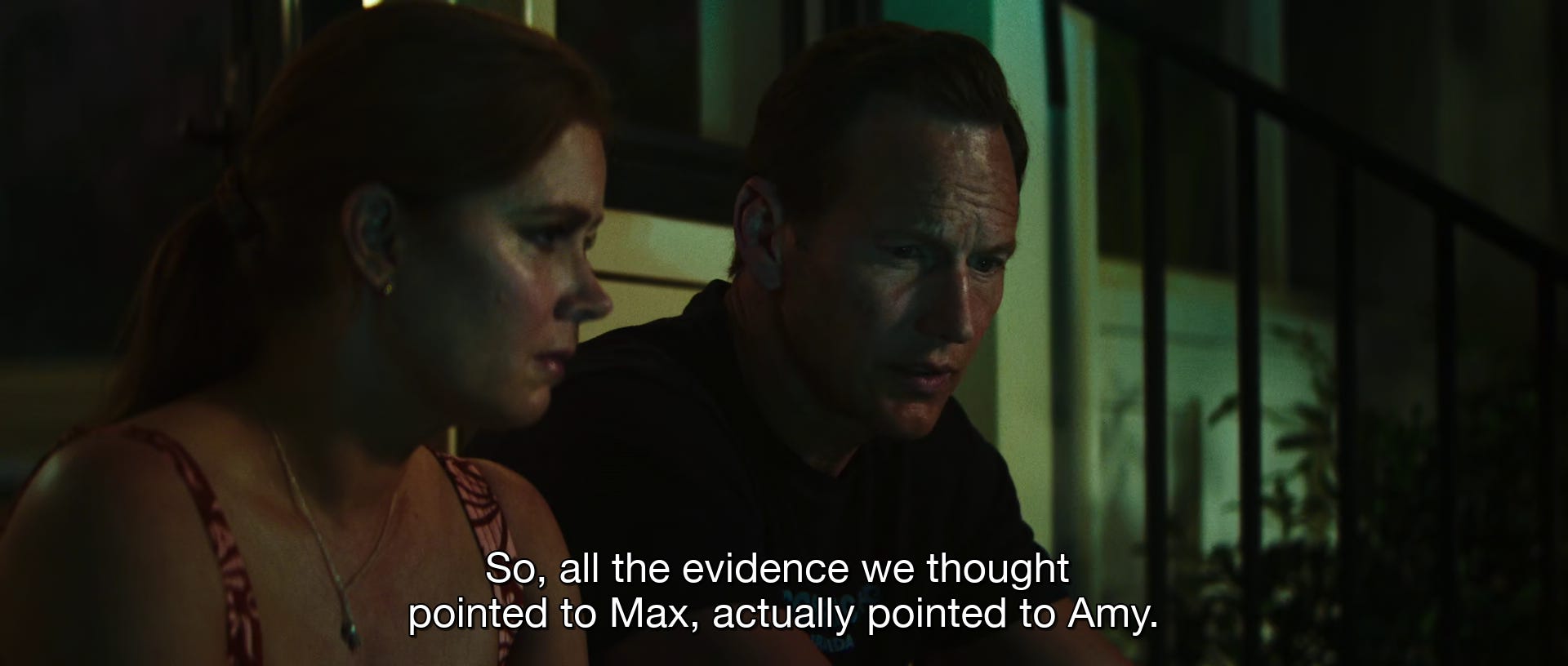
Of course, he is not. But Bardem’s Cady is at times compassionate, supportive, seemingly altruistically invested in the lives of the Bowdens for no other reason than his facade of being a stand-up guy wrongfully accused of a crime. In 1991, Cady’s ‘true face,’ the face of evil, is always exposed to Sam Bowden. It is only to the eyes of the law that he appears safe, domesticated, and a man exculpated from guilt only through the repayment of a debt to society via incarceration. The Cady of 2026 is janus-faced always. This masking to the Bowdens, particularly Anna and Tom, enriches the reading of Cady as the embodiment of their unconscious.
Bardem as Cady is, at times, ghostly. In the most recent episode, “Faith,” he sets up Tom to appear to be the aggressor in a bar fight, speaks with his voice, and tries to speak Tom’s thoughts back to him in a distorted form.


In the previous episode, “Pierced,” he does what Anna cannot and extracts a witness statement from a man who previously refused to give it.
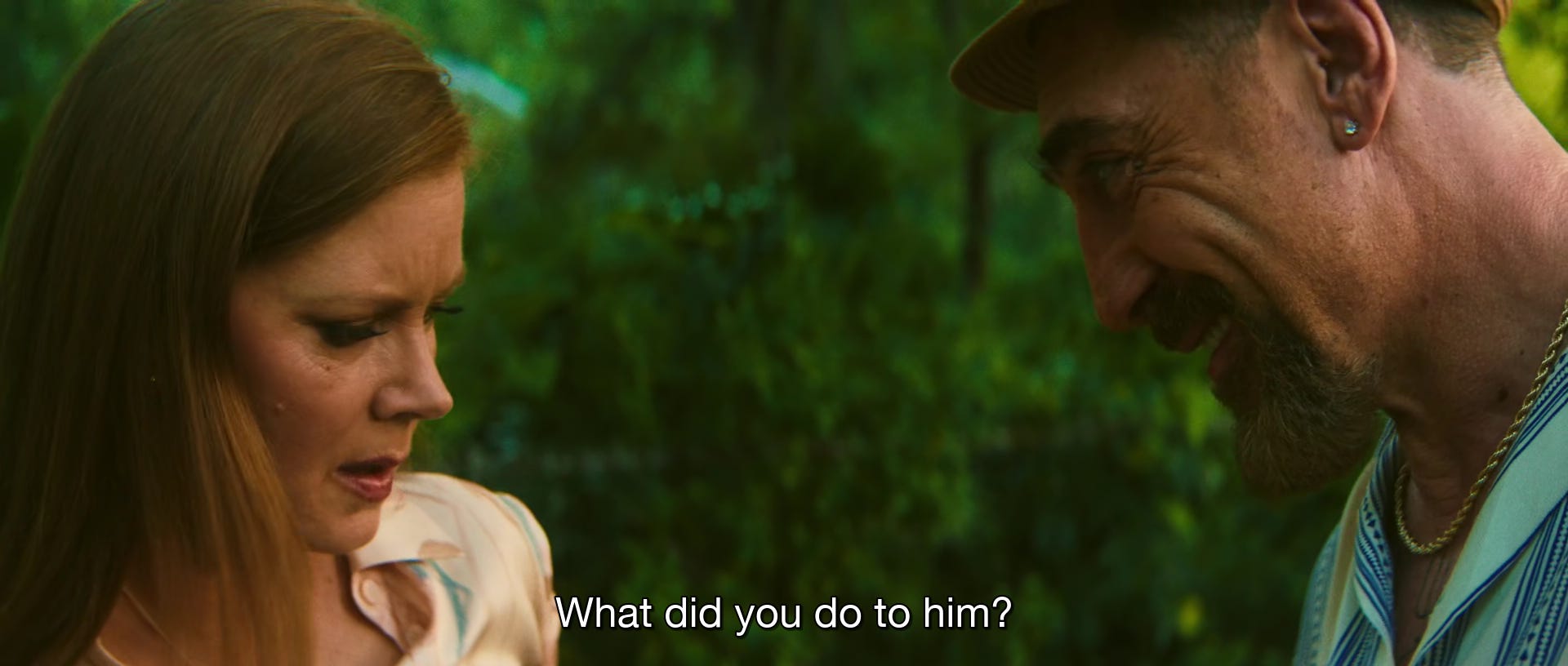
These are very typical ways of representing Cady as the desirous, libidinal unconscious in the tradition of cinematic doppelgängers. But when Cady takes Tom’s statement, “do the right thing,” and turns it into “stand up for yourself,” it demonstrates Cady’s own agency in his effort to undo the life of the Bowdens and render it utterly chaotic and disordered. This is what ties 2026’s Cape Fear all the more to Shadow of a Doubt, Bardem’s Cady is Uncle Charlie in the sense of his manifesting something impossible for Charlie Newton (Teresa Wright), “Young Charlie,” to articulate but is analogous to her existential ennui. Likewise, he matches also the degree to which Uncle Charlie takes the dissatisfaction Young Charlie feels and distorts it with that “remainder of an Outside” that any domestic family unit would be utterly incapable of assimilating.
In Lacan’s newly translated fourteenth seminar, The Logic of Fantasy (2023), he looks at two critical elements related to this Cape Fear remake: reality and intersubjective relation. He writes:
How thereafter are we to define reality? Well, as what I earlier called that which is ready-to-bear the fantasy … We shall then see that human reality as a whole, is nothing but the montage, an assemblage, of the symbolic and the imaginary. Desire, which lies at the centre of this apparatus, this frame, which we call reality, is equally, as I have been spelling out from the beginning, what covers over what is properly speaking the real. (10-11)
The constant confusion for the non-indoctrinated is disjunction between the so-called Lacanian Real, held out from the Symbolic and Imaginary, and reality, subjective experience, which is only constituted by the Symbolic and the Imaginary. Reality knows nothing, and wants to know nothing, about the Real. But it is the Real that emerges, surging through the desire that covers it over, in the moments of Cape Fear that make no logical sense — contradict reality.
In “Faith,” one such moment comes when Anna confronts Nevaeh (Malia Pyles), a seemingly threatening paramour of her son Zack (Joe Anders), outside of a movie theater. What posters is the theater advertising? The Lawyer’s Secret (1931), The Crime of the Century (1933), Guilty as Hell (1932), and Dangerous Waters (1936). Is this theater in Savannah, Georgia in 2026 running repertory programming of pre-Code thrillers and crime film?
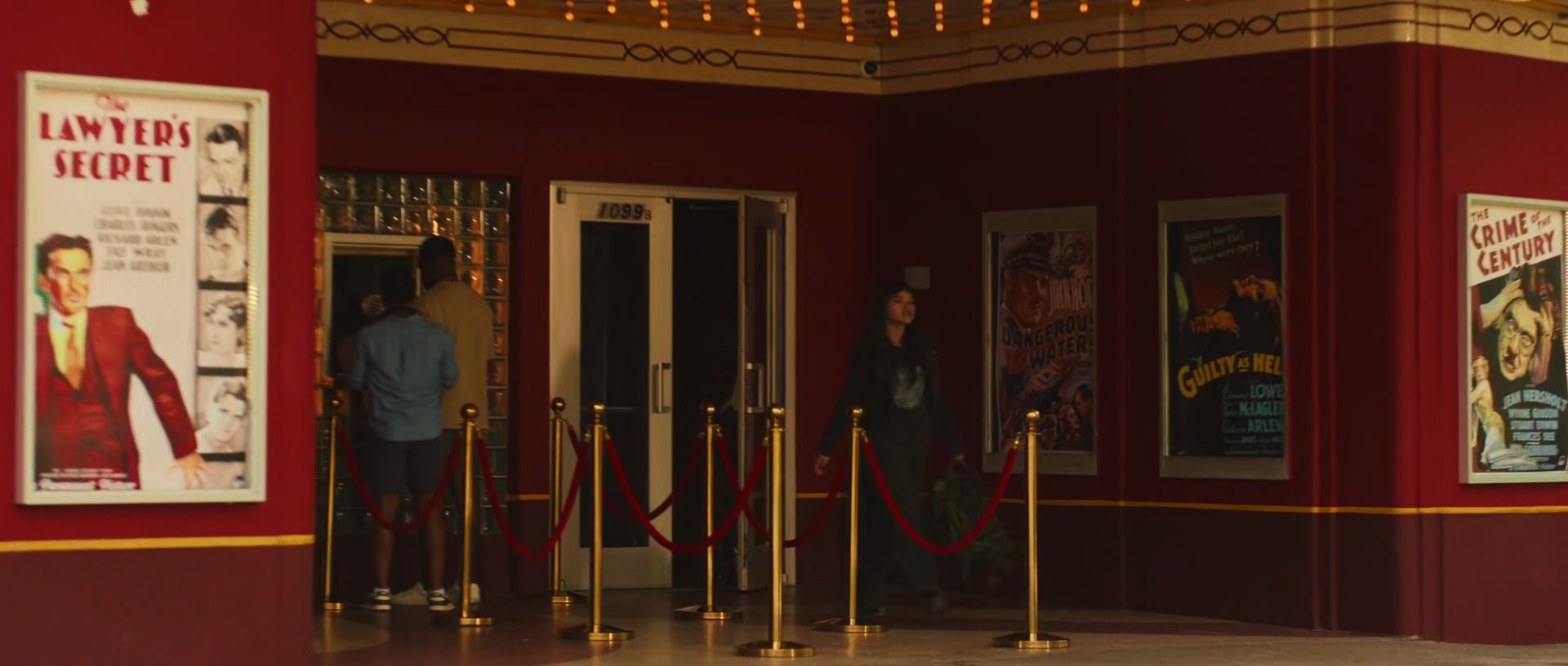
Not for nothing, the Bowden couple have a lawyers’ secret about Cady, Anna feels guilty as hell, and the two of them may have carried out the crime of the century by implicating him. If the series follows the plot of the previous versions, the Bowdens will be in the dangerous waters of Cape Fear by the end. This is yet another example of the absurdity of Cape Fear that emphasizes the symbolic meaning and structure of the series as it relates to the transgressive desirousness which might cover over the Real and the places where the Symbolic order fails to cohere.
“Pierced” also makes the association between Cady and Uncle Charlie, Cape Fear and Shadow of a Doubt by showing a clip of Shadow of a Doubt in the episode. Tom and Zack visit an art show where Tom runs into the grim face of Uncle Charlie.
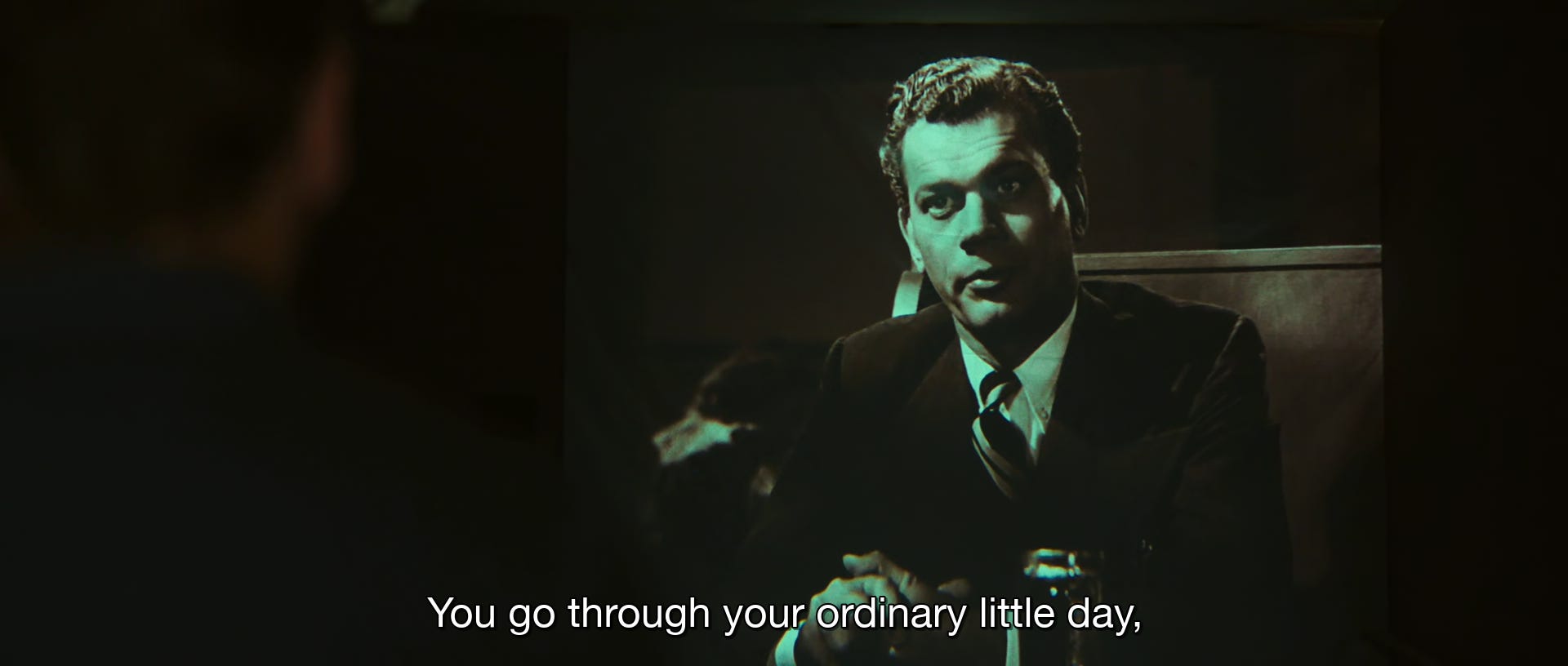
The episode excerpts this bit of monologue from Shadow of a Doubt:
You wake up every morning of your life and you know perfectly well that there’s nothing in the world to trouble you. You go through your ordinary little day, and at night you sleep your untroubled ordinary little sleep, filled with peaceful stupid dreams. And I brought you nightmares.
In the next episode, Cady says to Tom:
I can tell what you’re afraid of. It’s … entropy. Chaos. Disorder. Collapse … you’re fucking terrified of it. It’s obvious. But you of all people, you need to lose control sometime. Because that life you’re leading, something inside you is dying.
This pastiche of Uncle Charlie is an example of a rare moment of honesty from Cady. Honestly to the extent that it is Cady’s genuine belief about the restricted, anodyne, inert Tom.
Cady serves as the distorted mirror for both Anna and Tom. His difference from the De Niro iteration extends to the crime he (allegedly) committed, killing his wife and unborn son. He constantly pines for a family, with allusions toward a dysfunctional childhood. Cady also secretly proselytizes a bizarre religion he invented himself. He’s covered in tattoos that reference his as-yet unexplained cosmology. In The Logic of Fantasy, Lacan writes:
Urverdrängung, or primary repression, is this — that which a signifier represents for another signifier. It doesn’t bite into anything. It constitutes absolutely nothing. It makes do with an absolute absence of Dasein. (13)
This follows from Lacan’s description of the objet a, that which “in an alienated form … forever continues to leave its stamp upon any enunciation concerning Dasein” (12). Objet a, then, is a “punch mark,” a small hole that marks an absence in the subject’s Being. Max Cady makes hay where he sees these subjective pockmarks borne through the surface. Cady is not doing any favors to the Bowdens, but he does threaten to shake them loose from their concretized modes of being. The primary repression to which Lacan necessarily requires, he argues, accepting the barred subject as “something coming from one locus where it is supposedly inscribed and shifting to another locus where it will be inscribed afresh” (13). That which is repressed being brought to the surface by Cady’s bottom trawling will necessarily require such a shifting, the re-inscription of the Bowdens existence as signifiers to some other kind of existence. This transformation is occurring for them, by the fifth episode of the show, already.
As for Cady, he has been transformed by his imprisonment, as evident by the inscrutable religious symbols tattooed on him. His barred subjective status is demonstrated by the signifiers inscribed aflesh.
Weekly Reading List
I am excited for this movie.
Event Calendar: Speedrunning
SGDQ begins Sunday. I will be watching.
Until next time.