

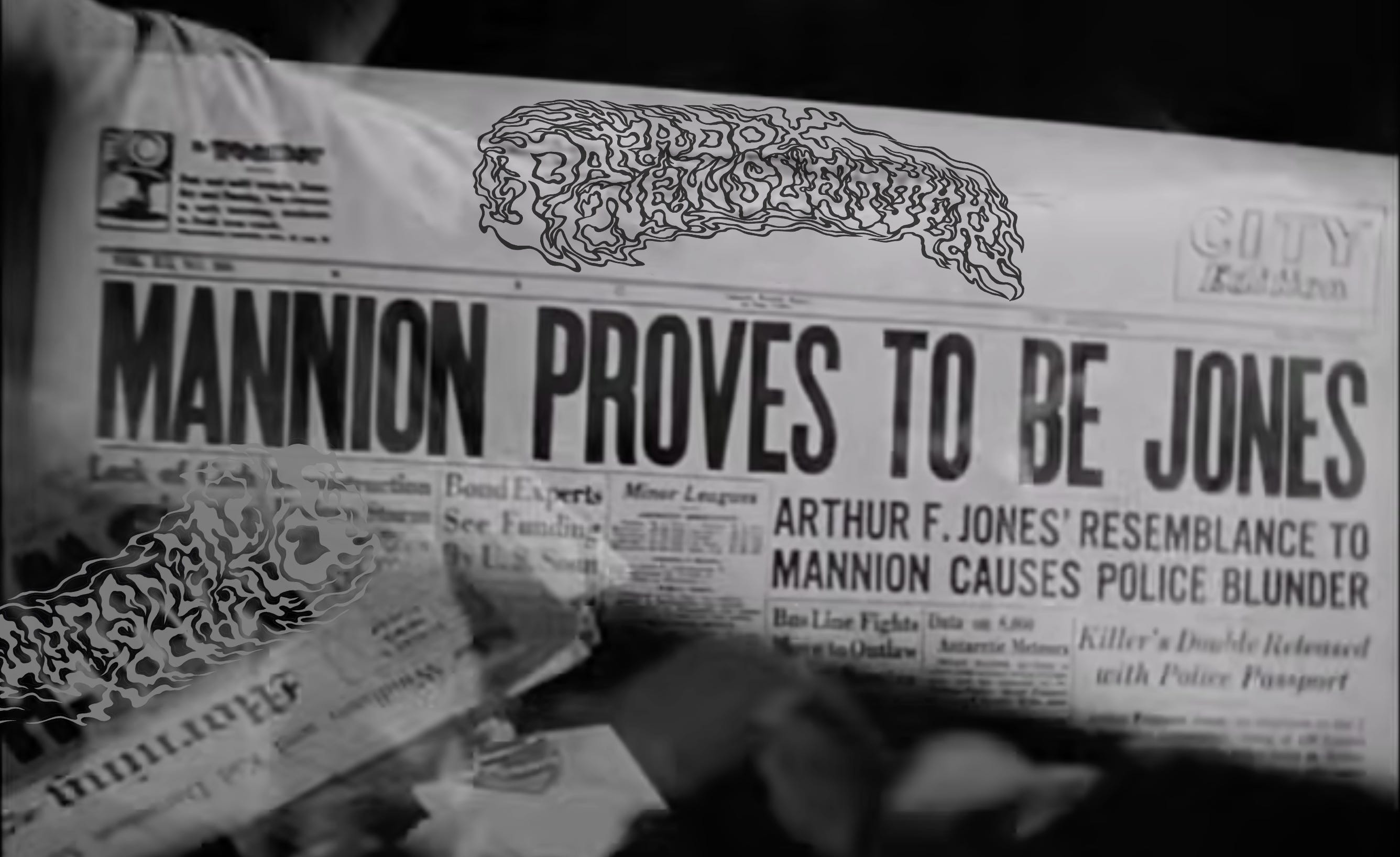
OverClocked ReMix, ocremix.org, is one of the longest-running institutions of the nerd’s internet. Founded in 1999, I have a distinct recollection of downloading from it via a dial-up internet connection. Maybe I got thirteen songs or so in a week if I was lucky.
OC ReMix doesn’t come up very often for me anymore. I rarely listen to music from it. But one thing brings it back to the fore twice a year, Games Done Quick.
I’ve written in the past about how GDQ marathons (SGDQ is underway now) take average gaming hobbyists and turn them into some of the gaming world’s biggest celebrities for two weeks out of the year. But it also spotlights, in a much more subdued way, the hard work of these fan remixers from the earliest period of the internet’s existence. Yes, OC ReMix is still going strong.
But I am sure it is never hitting more ears than when the GDQ team is running the tunes in their breaks between speedruns.
Desire, Identity, and Repetition in The Whole Town’s Talking
After watching John Ford’s The Whole Town’s Talking (1935), I’ve been thinking a lot about comedy. I am more likely to laugh at a movie from the 1990s or the 2000s than one from the 2020s or the 1930s. These worlds, despite their remoteness in time from each other, are alien to me in ways the twenty or so years of my adolescence and young adulthood are not. I’m not sure this is a universal feeling, but I imagine it’s not totally idiosyncratic. Humor in the realm of play is associated with childhood. Alenka Zupančič also recognizes the association between humor and childhood through a third term: repetition. In The Odd One In (2008), she writes:
In other words, comedy as genre is not simply about failure, about the hero’s ludicrous but stubborn, “mechanical” attempts to accomplish something which he is absolutely not up to. Instead, it functions in the background of something that has always-already succeeded, and draws its power from there. This remark is important not only because it points to an important fact that I hinted at in the beginning of this section—a possibility of repetition that is constitutive for the comic genre as such—but also because it indicates a way of redeeming what is otherwise rather problematic in the Deleuzian account of comic and tragic repetition. (158)
Though she glosses Deleuze here, the theoretical interest of repetition is Freudo-Lacanian. She quotes Lacan, “Whatever, in repetition, is varied, modulated, merely alienates us from its meaning … this sliding away conceals what is the true secret of the ludic, namely, the most radical diversity constituted by repetition itself” (Zupančič 171/The Four Fundamental Concepts 61). She then goes on:
What exactly is at stake in this difference between repetition through variety and textual repetition? The briefest answer would be: the difference between the fact that we can tell something in hundred different ways, and the fact that we cannot, absolutely not (not even by literally repeating it) tell something in only one way. (171)
And following from the explanation of Freud’s fort-da game in Beyond the Pleasure Principle (1920):
If we simplify things and relate them to the example above, we could say: the child demands repetition because its failure nevertheless realizes something, and this something is precisely what he wanted to see, appearing in the form in which he wanted, or was able, to see it. In other words: the failure of repetition itself fails at some point, or, something disturbs the pure failure of repetition: something fleeting, elusive, something perceptible at one moment and gone the next. (172)
We know, evidently, that repetition and escalation is an absolutely indispensable aspect of comedy. In The Whole Town’s Talking, which stars Edward G. Robinson as both the mild mannered Arthur Ferguson Jones and wild criminal Mannion, repeatedly has Jones mistaken for Mannion, swapped with him, or otherwise confronting the inexplicable congruence of their appearance. Despite what I think is a reduced likelihood that I would laugh aloud at a comedy from this period, The Whole Town’s Talking had me in stitches.
Zupančič casts repetition as a failure, but one that periodically does what it sets out to do with the paradoxical quality of “the failure of repetition itself fail[ing]” (172). That moment of the “fleeing, elusive” is extended in The Whole Town’s Talking, with Jones and Mannion exact repetitions of each other in terms of appearance with their attitudes diametrically opposed. Indeed, the movie plays with the idea of Jones’s own duality. After his introduction into the film, his uncharacteristic late arrival at work puts him in yet another paradoxical position. Seaver (Etienne Girardot) says to Jones:
This morning, J.G. instructed me to raise your salary. But he also gave me instructions to fire the next employee who came in late. And you’re both people, Jones. Now, what am I going to do? I can’t raise your salary and then fire you. [emphasis added]
Symbolically, it is Jones’s unconscious that leads him to oversleep (the film attributes it to an alarm clock) just as it is his unconscious that makes him appear to Wilhelmina Clark (Jean Arthur) as the rabbit who “has something.” That something is the unconscious desire with which Jones moves through life and cannot escape. It is concretized in the form of Mannion, who, in the tradition of cinematic doubles, (which include Max Cady [Bardem, De Niro, Mitchum, take your pick]) is in some ways the self that Jones represses. Jones is an efficient worker, but Mannion is an unparalleled criminal with a seemingly endless capacity for stick-ups and murders.
The gag of Jones and Mannion’s shared countenance is an interesting symbolic and visual device. Mannion is, at times, who Jones sees in the mirror: a misrecognition that is close enough to an extension of Lacan’s mirror stage.


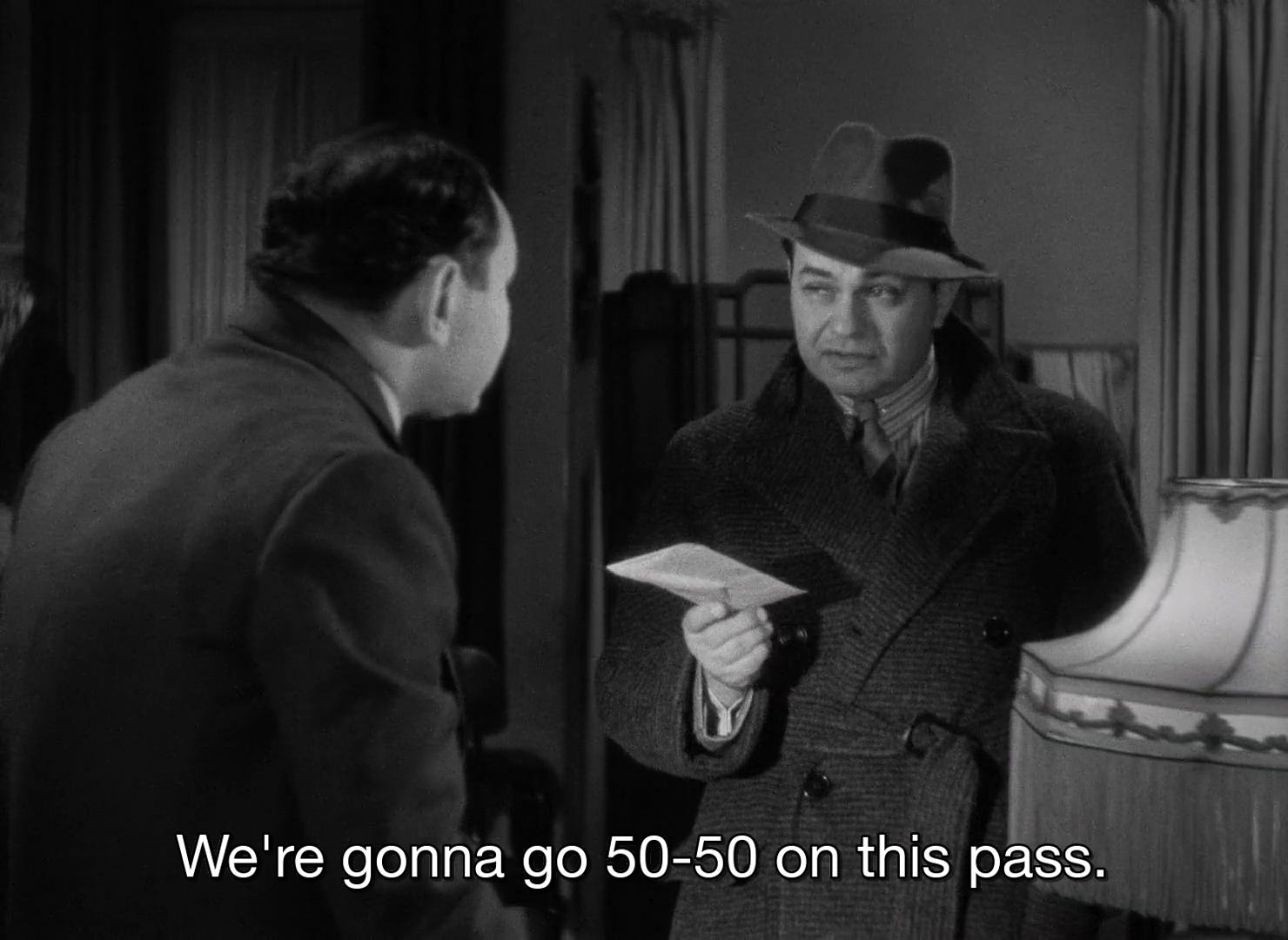
One of the film’s more impressive comedic beats involves Jones looking at himself in the large mirror of a restaurant emulating the facial characteristics the newspaper attributes to Mannion. Another man eating dinner (Donald Meek) has his own series of misrecognitions, first believing Jones is menacing him and then identifying Jones as Mannion. Of course, the gag here is that he identify Mannion correctly. Yes, the man he sees is Jones, but Jones’s visage is identical to Mannion’s and he is attempting follow Mannion’s description to the letter. Later in the film, the prison warden (J. Farrell MacDonald) from which Mannion escaped says, Jones “looks more like Mannion than Mannion does.”
The absurdist conceit of the film is a letter, written by the district attorney, that identifies Jones as himself rather than Mannion to protect him from being wrongly hassled by the police. Never mind that the letter is not enough to guarantee Jones’s identity. This becomes painfully clear as Mannion immediately moves into Jones’s house and demands the letter, which the film calls a “passport.”
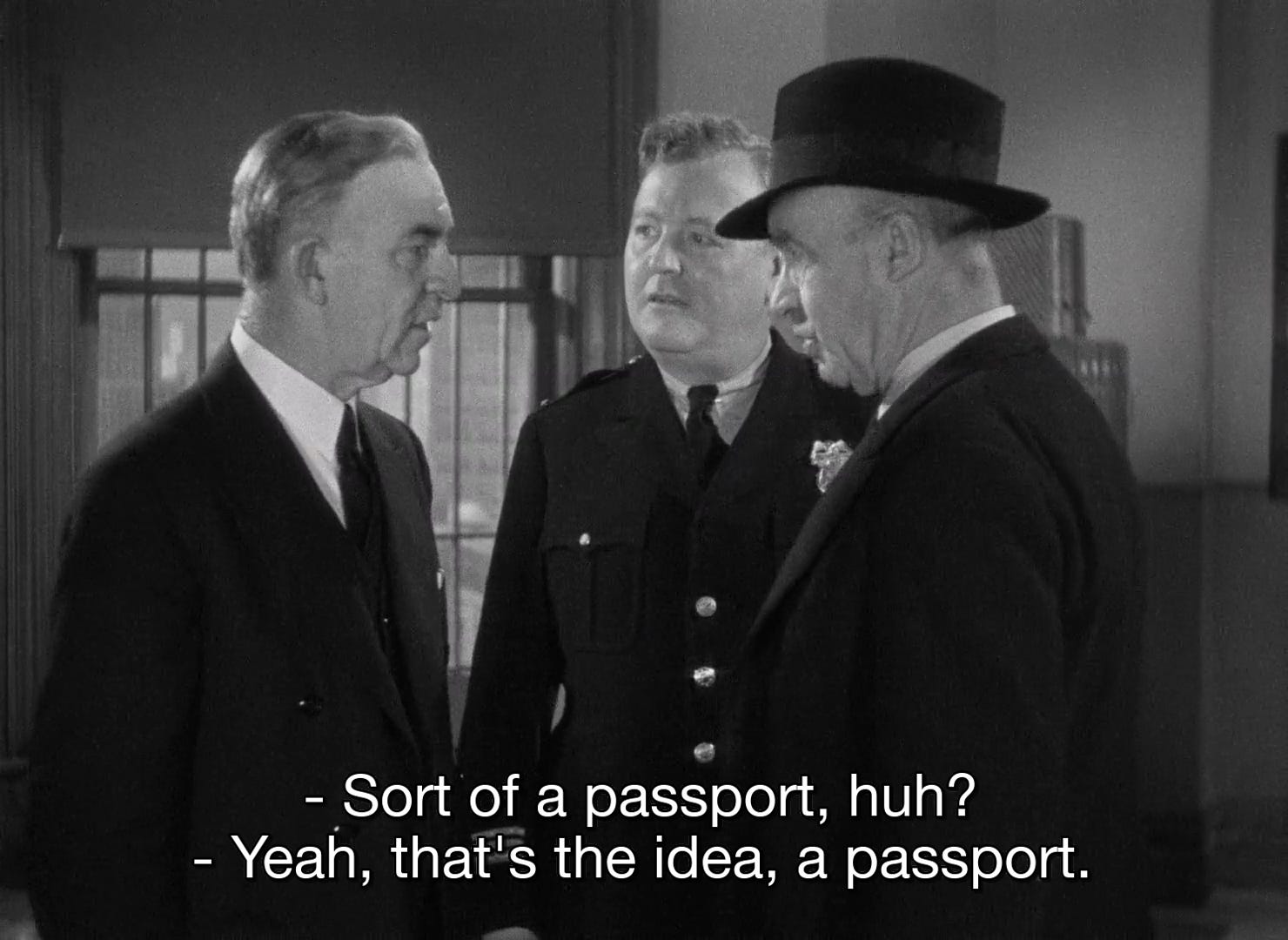
Mannion demands, “we’re gonna go 50-50 on this pass. You’re gonna use it in the daytime and me at night.” The assurance of the letter that Mannion is Jones overrides the circumstantial evidence of his repeated proximity to the bank robberies he goes on to commit.


As Jones navigates his subordination to Mannion, desire running amok, the film makes homoerotic jokes about a relationship between Jones and Mannion. Jones’s boss, J.G. Carpenter (Paul Harvey), calls Mannion Jones’s boyfriend. Less than two minutes later, Jones is in an apron serving Mannion coffee, embodying the modern plight of the woman who comes home from work only to assume domestic responsibilities.
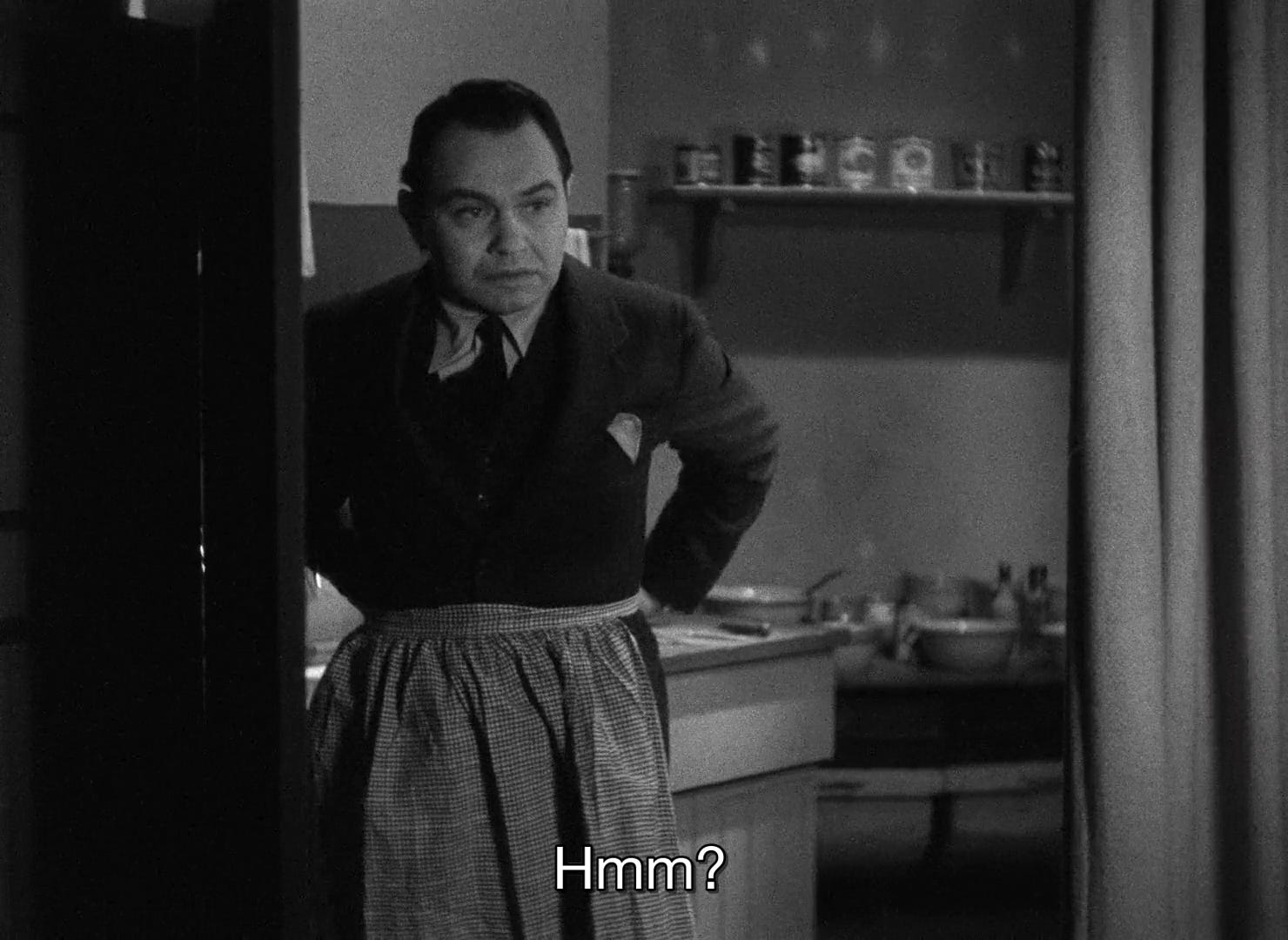
The homoerotic subtext of The Whole Town’s Talking is about as subtle as that of Gilda (1946), but it’s just as substantive. For Jones and Mannion to be in a relationship isn’t just homoerotic, it’s autoerotic. They look exactly the same.
Jones also makes clear his dissatisfaction with this arrangement, pliant though he is in the face of Mannion’s demands. Jones earlier describes Mannion as a “false alarm,” “a criminal is as brave as his gun. You take his gun away and he’s a coward, just like anybody else.” Jones, even with a gun in his hand, doesn’t have the supposed bravery he believes it confers on Mannion.


With this dynamic, the film reveals that both Mannion and Jones are more than their gun or their gray suit. But their excessive subjectivities and orientation to one another is what causes them to repeat over and over again. Mannion is the disruptive desire that shakes Jones from his stupor.
The letter, supposedly, protects Jones, but it is also the letter that exposes his subordination to Mannion. Jones writes a daily column on Mannion using information and descriptions Mannion gives to him. Jones not only knows things about various criminal exploits only Mannion could know, he uses “juicy underworld lingo” that exposes him as having a source. His relationship to Mannion doesn’t just change his attitude, it also enriches him as the author of these popular newspaper pieces.
To call The Whole Town’s Talking ‘a funny movie’ is to sell it short. It is hilarious, yes. But the treatment of psychoanalytic doubles, the corresponding mistaken identity, and the confrontation between desire’s trajectory and society’s demand is unparalleled. From the man who directed The Grapes of Wrath (1940), Stagecoach (1939), and The Quiet Man (1952), The Whole Town’s Talking stands among them.
Weekly Reading List

I have been reading Jed Mackay’s ongoing run of X-Men that started back in 2024. It’s a classic X-Men story with all of the complicated detritus from the last two decades of X-Men stories involving mutant brain clones or whatever else they were doing. It’s a very approachable entry point for ongoing X-Men comics. And Juggernaut looks really cool in it.
SGDQ is underway and now, conveniently, on Youtube.
They are making an anime based on my favorite video game of all time.
Judge’s Tower
Great songs are immortal. They will also show up where you least expect them.
Event Calendar: Hitchcock’s Birthday at The Brattle
On Alfred Hitchcock’s birthday weekend, The Brattle Theater will celebrate showing three of his classic films on 35mm. Or, two of his classic films and another one, depending on who you ask. Need an impromptu film discussion after these heaters.
Until next time.