

Issue #442: Adaptation Theory for the People Who Watch One Movie a Year
It’s pretty rare that I write about the same movie two weeks in a row. The cultural gravity The Odyssey (2026) exerts is impossible to escape. And it’s not so much the film itself that interests me as much as the critical response and how critics treat adapted works. That is a perennial focus for the newsletter that is crystalizing in the remarkable reaction to Nolan’s latest.
Today is a great day to purchase a paid subscription to Paradox Newsletter if you are reading week in and week out.
If the newsletter enriches your life, getting that paid subscription from you goes a long way. Those not in a position to subscribe, or not interested in doing so, can also help by sharing the newsletter with a friend.
Now back to your regularly scheduled cultural criticism.
André Bazin, Stuart Hall, and Christopher Nolan
If there is a summary logic of the way Paradox Newsletter looks at adaptation, it is simply that an artist has no obligation to the work they are adapting whatsoever.

Among the examples that make this principle obvious and indisputable are André Malraux’s Espoir (1945), Yukio Mishima’s Patriotism (1966), Clive Barker’s Hellraiser (1987), or Katsuhiro Otomo’s Akira (1988). These are, of course, examples where the author of the original text serves as director for the film adaptation. Thus, none would begrudge the venerated original author amending or altering their work. André Bazin writes extensively about Malraux’s film as an exemplary of adaptation in “André Malraux, Espoir, or Style in Cinema” (1945):
Despite its fidelity to the book for which not even the adapters of Henry Bordeaux’s novels could be criticized, Espoir remains, but for a few reservations, as deeply original as the book … For [Malraux], this is not an adaptation but two creations, engaging him equally. (André Bazin on Adaptation 62-63)
One can imagine such praise lavished on any adapting author, whether they share authorship of the source text and the adapting text. Why shouldn’t any director be given the same agency? The reverence for accurate adaptations emerges coincident with their frequency in cinema, according to Bazin. In “Cinema and Novel” (1954), he addresses the question of ‘fidelity’ to the adapted text:
With Aurenche and Bost, who adapted this and so many novels for cinema, a new concern emerges: respect for the original as a criterion of a film’s value. (84)
Bazin goes on:
This ambition has fairly often elicited skeptical remarks from literary critics as well as from many film critics. The former, always considering cinema with more or less unmasked condescension, claim, and with some degree of truth, that in the best cases the finesse of language, its intellectual and poetic subtleties, are untranslatable to the screen. The more benevolent critics deign to acknowledge that cinema may have considerable powers but that these are of another order: in any event, literary energy could at best be very partially converted to images, and only when at its most banal. They therefore agree with those film critics, partisans of “pure cinema,” who worry about the perils to the screen posed by the temptations of the novel almost as much as those posed by the theater. Borrowing from literature is for them ultimately just a stopgap in the absence of good screenplays. (85)
Ultimately, though, he remains suspicious of the notion of fidelity not because he reveres the unique powers of the novel, but because there is a different axis of cinematic evaluation: quality. Bazin writes:
fidelity does not, in itself, ensure cinematic quality, and we gladly lauded Aurenche and Bost precisely for their ability to take great liberties with their transposition so long as these liberties did not appear to degrade the original too much.
It is clear, then, following from Bazin, that if one is evaluating an adapted work, one may evaluate the axes of “fidelity” and “cinematic quality” separately. A great film’s greatness is fundamentally unrelated to the strictness with which it adapts the source text. Even Bazin’s qualifying statement of liberties which “did not appear to degrade the original too much” proposes a minimum standard of relation to the source material even as exceeding that minimum does not make the film any better. In some cases, it might make it worse.
The same year as “Cinema and the Novel,” François Truffaut would also take up the work of Jean Aurenche and Pierre Bost in “A Certain Tendency in French Cinema.” Unlike Bazin, though, Truffaut looks at the work of Aurenche and Bost with disdain if only because the duo, in Truffaut’s view, “look down on the cinema because they undervalue it” (The French New Wave 46). Far from embracing Aurenche and Bost’s “celebrated process of equivalence” (43), Truffaut’s picked bone is the question of the unfilmable. He believes the idea of the unfilmable scene is a disparagement of cinema and rejects it outright, “I am by no means convinced that a novel can contain unfilmable scenes, and even less so that scenes decreed to be unfilmable are unfilmable by any director” (43). In other words, the right director for the right adaptation renders all of the source material “filmable.”
Truffaut’s ultimate argument is not in favor of painstakingly accurate adaptation, but against the titular cinematic tendency of supposed ‘psychological realism.’ Aurenche and Bost’s screenwriting, and their “water[ed] down” adaptations (47), embody this tendency. Their ‘equivalence’ (substitution of a new film scene in place of an ‘unfilmable’ segment of the source text), “always tends to encourage betrayal or timidity” (47). Truffaut’s final damning charge is of formulaic repetition that divests from the auteur their particularity (56-57).
How can Truffaut possibly critique divergences from the source text on the one hand but on the other hope that auteurs embrace a more particular kind of filmmaking and avoid repetitive formulas with the alibi of realism (one of Truffaut’s subheadings: “Psychological realism, neither real nor psychological [50])? Like the “partisans of pure cinema” that Bazin describes, Truffaut is not prescriptive about how one adapts, “[b]orrowing from literature is … ultimately just a stopgap in the absence of good screenplays” (Bazin on Adaptation 85). Though Truffaut’s point is well taken, adherence to a derivative formula is not a good reason to make changes to source material from which one adapts, the more salient point is Bazin’s regarding cinematic quality. Evaluating an adaptation based on its fidelity is a different normative exercise than qualitative evaluation or even hermeneutic analysis.
I am hardly systematic in my qualitative evaluation of films, although I try to be systematic in my hermeneutic analysis. But my critical framework borrows from both Bazin and Truffaut. I consider a film’s cinematic quality and adaptational fidelity separately. Generally, though, the poorer I find a film, the more divergences from the source material seem egregious, unjustifiable, and offensive. There is little worse a film can be than boring, uncreative, and thoughtlessly (or thoughtfully — in service to market demands) derivative. In that sense, I am following the logic of Truffaut’s critique.
Stuart Hall creates the formulation of “conventionalization” that helps elaborate the nuances of Truffaut’s condemnation of the tendency toward the misnamed “psychological realism.” Hall takes as his subject TV westerns, which he describes as having a “clear-cut, good/bad Manichean moral universe … [a] clear social and moral designation of villain and hero … [and a] clearly-registered climax in the violent shoot-out, chase, personal show-down, street or bar-room duel” (Writings on Media 251-252). He goes on:
a set of extremely tightly-coded rules exist whereby stories of a certain recognizable type, content and structure can be easily encoded within the Western form. What is more, these “rules of encoding” were so diffused, so symmetrically shared as between producer and audience, that the “message” was likely to be decoded in a manner highly symmetrical to that in which it had been encoded. This reciprocity of codes is, indeed, precisely what is entailed in the notion of stylization or “conventionalization,” and the presence of such reciprocal codes is, of course, what defines or makes possible the existence of a genre. (252)
While Hall is discussing the ‘original’ (non-adapted) artistic output within certain genre-forms, one can easily see that the propagation of such codes when adapting a work present a risk of “conventionalization” that would make Truffaut shudder. Simply put, the prevalence of genre-forms can shape what seems to be possible when adapting a work from one medium to another. An “unfilmable” scene from a novel may seem unfilmable only when thinking within the horizon of established cinematic genres. Truffaut suggests a truly inventive, unconstrained director could bring any source material to the screen with appropriate reverence for the source material.
All of this is in service of a better understanding of an as-yet unmentioned work: The Odyssey (2026) and its relation to its Homeric source material. I discussed the incomparable Daniel Mendelsohn’s critiques last week. Over the past week, I read Richard Brody’s review for The New Yorker and Emily Wilson’s exhaustive excoriation of Nolan’s film for the London Review of Books. Both Brody and Wilson make some reasonable points. Brody extends my criticism of the film’s ending to the broader characterization of Odysseus:
Psychologizing Odysseus like this lends “The Odyssey” a readily digestible modernity—ancient Greeks, they’re just like us!—but does so at the expense of the richness of detail and societal complexity that makes reading Homer such a vital and immediate experience.
Brody follows Truffaut, here, as I do. From Brody’s perspective, some of the vital richness is lost becaause of Nolan’s ultimate structural analogy between ancient Greek culture and contemporary culture. I am less convinced, though, that there is not some of the arresting, alien quality to the obsessive fascination with “Zeus’s law.” Likewise, I would argue such a preoccupation by the film reflects some degree of accuracy in reproducing Homer’s Odyssey’s (8th Century BC) themes.


One of Brody’s silliest points, though, is his opening gambit that one of Nolan’s greatest failings is the “pervasive absence” of the gods. Wilson agrees, mocking the film as small because of its failure to include “real gods” along with a few extended riffs on missing “notable sequences” with little argument regarding their significance. There is a whole paragraph in Wilson’s review dedicated to the absence of Odysseus’s deception of the cyclops. Is this truly the best these critics can do? Complain about excluded details like a gasping Marvel movie fan overly excited by easter eggs and cameos? It’s no accident that both the Marvel Cinematic Universe commentator Eric Voss and many of the supposedly urbane maligners of Nolan’s Odyssey lament the absence of Achilles.

Some of these critics signal their intellectual superiority by claiming they do not watch or care for film. Only the epic cultural event of Nolan adapting Homer could motivate them to leave their fire-lit cave and watch their first ever movie. Their unfamiliarity, disinterest, and disdain for the medium is obvious when complaining about some of the most routine exigencies of cross-medium adaptation. That: or here we encounter the omnipresent specter of bait. If you translated the Odyssey, if you’re a scholar of ancient Greece, this is probably the most attention you’ll ever get. But this deluge of condemnation is embarrassing.
What is uniform among these critics, even the venerable Richard Brody, is their insistence that the film is worse for its departures from Homer. But the critics are far from having done enough to substantiate why their version of fastidious adaptation is preferable to the choices Nolan makes in service of accuracy. Nolan’s accuracy, however, is certainty more “faithful to the spirit” rather than “faithful to the letter” (Truffaut 41). The most substantive divergence is his attempt to make his Odyssey a contemporary moral fable.
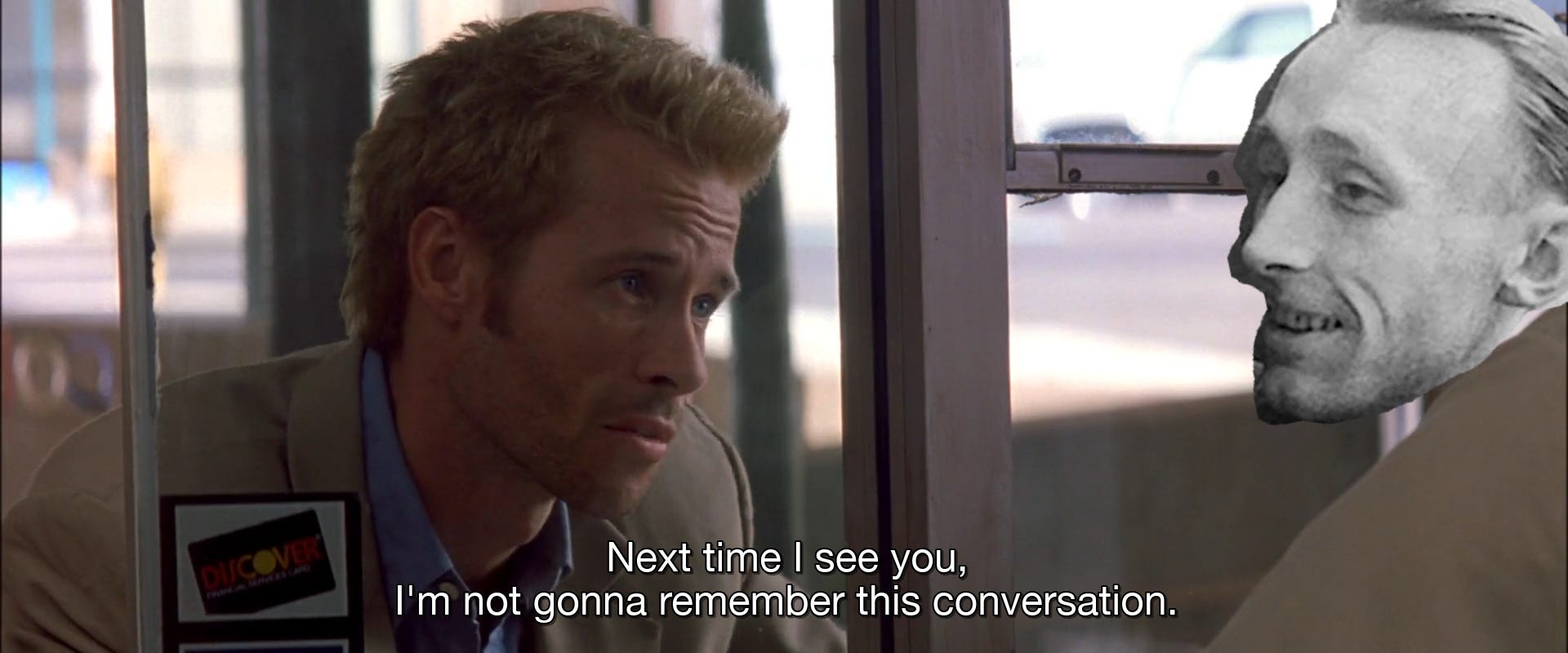
I hate to be defending Nolan’s The Odyssey. I would take Tenet (2020) or The Dark Knight (2008) or Memento (2000) or even maybe Insomnia (2002) over The Odyssey any day of the week. But what the wave of high-minded Nolan criticism reveals more than anything is the failure of most of its critics to address the question of adaptation as such. For them, The Odyssey is an artistic failure because it omits and transforms elements of Homer’s original epic. For the slings and arrows of these critics to pierce the storied corpus of Nolan, they must bring more than a laundry list of omissions.
Weekly Reading List
This week, I’m trying something a little different. My reading list includes the various material I read for this newsletter issue, including stuff I didn’t cite. A few earlier issues of the newsletter are included.
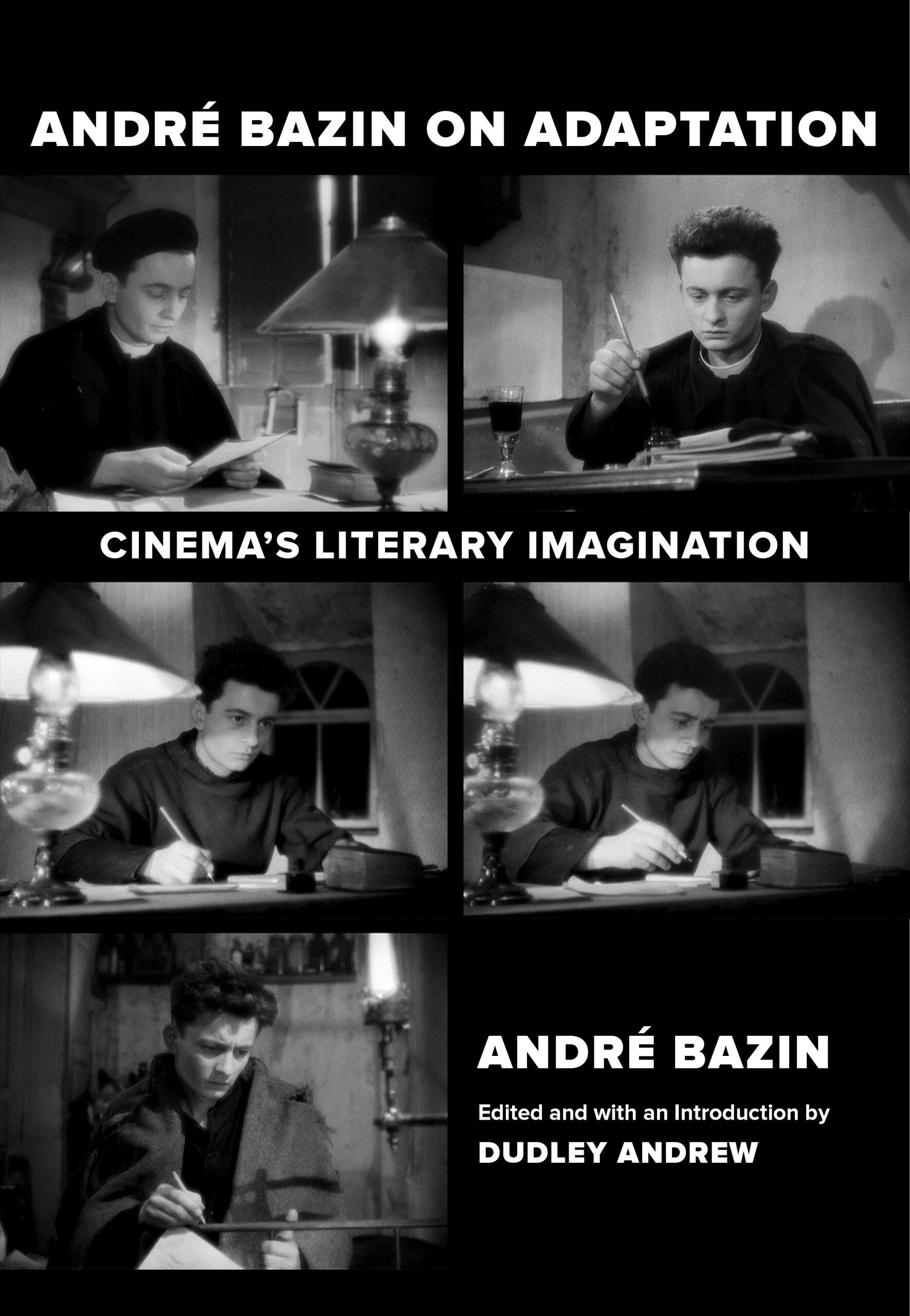
Bazin, André. André Bazin on Adaptation: Cinema’s Literary Imagination. Edited by Dudley Andrew, Translated by Deborah N. Glassman and Nataša Ďurovičová, University of California Press, 2022.
———. Bazin at Work: Major Essays and Reviews From the Forties and Fifties. Edited by Bert Cardullo, Taylor and Francis, 2014.
———. What Is Cinema? Vol. I. Translated by Hugh Gray, University of California Press, 2004.
———. What Is Cinema? Vol. II. Translated by Hugh Gray, University of California Press, 2004.
Brody, Richard. “‘The Odyssey’ Movie Review.” The New Yorker, https://www.newyorker.com/magazine/2026/07/27/the-odyssey-christopher-nolan-movie-review. Accessed 27 July 2026.
Graham, Peter, and Ginette Vincendeau, editors. The French New Wave: Critical Landmarks. Second edition, British Film Institute, 2022. K10plus ISBN, https://doi.org/10.5040/9781839022333.
Hall, Stuart. Writings on Media: History of the Present. Edited by Charlotte Brunsdon, Duke University Press, 2021. Stuart Hall: Selected Writings.
Rivera, Miguel. “Issue #194: Dune? Don’t.” Email Newsletter. Paradox Newsletter, 26 Oct. 2021, https://www.paradoxnewsletter.com/p/issue-194-dune-dont.
———. “Issue #316: American Contradiction.” Email Newsletter. Paradox Newsletter, 27 Feb. 2024, https://www.paradoxnewsletter.com/p/issue-316-american-contradiction.
———. “Issue #396: Can We Get Much Higher? Spike Lee and Denzel Washington Say ‘Yes.’” Email Newsletter. Paradox Newsletter, 9 Sept. 2025, https://www.paradoxnewsletter.com/p/issue-396-can-we-get-much-higher.
Wilson, Emily. “An Uncomplicated Man.” Review of The Odyssey by Christopher Nolan. London Review of Books, vol. 48, no. 14, 27 July 2026. www.lrb.co.uk, https://www.lrb.co.uk/the-paper/v48/n14/emily-wilson/an-uncomplicated-man.
Event Calendar: Sci-Fi Summer
The Brattle has added a ton of amazing 1950s sci-fi programming through the end of the summer. If I could, I’d see every one of these screenings.
Until next time.