

Issue #445: Accepting Rejection (the book)

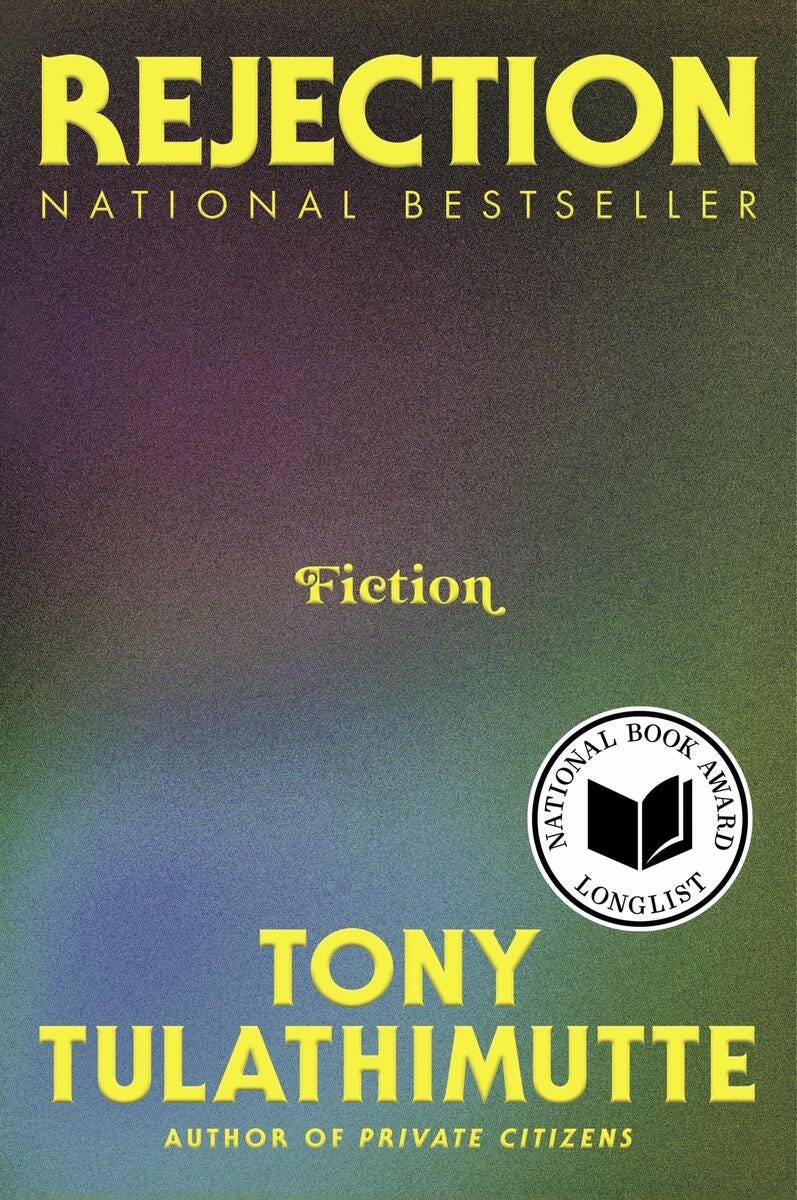
The topic of the nearly five-thousand word essay, beneath the work I close read, is the question of timeliness and timelessness. I have certainly not been timely in reading Tony Tulathimutte’s Rejection (2024) even after reading “The Feminist” back in 2019. But the novel came back to mind because of Cape Fear (2026), in a quick scene of Natalie Bowden (Lily Collias) reading the book. Then, it took my wife reading it for me to finally crack it open. Now, re-opening three Jean-Paul Sartre books later, here we are.
Timeliness and Timelessness in Tony Tulathimutte’s Rejection
What does it mean for a work to be timeless? Frank Kermode writes in The Classic (1975) that timeless work “possesses intrinsic qualities that endure, but possesses also an openness to accommodation which keeps them alive under endlessly varying dispositions” (44). There is also available a much less interpretive view one might take of the timeless. A work that is timeless may lack the markers to situate it in time, it may use fantasy or science fiction generic tropes in an attempt excise it from any recognizable era of human existence.
One might consider, too, whether a work being ‘timely’ would preclude it from being ‘timeless.’ Timeliness could be defined as of the moment, carrying in it the considerations, anxieties, and antagonisms of the contemporary. I want to argue, though, that Tony Tulathimutte’s Rejection (2024) is a work that has qualities of timeliness and timelessness. While it certainly does not fit my latter definition of timelessness — Rejection is firmly entrenched in the language, culture, and events of contemporary culture — the text’s broader philosophical concerns will endure; mostly.
Rejection, according to its publisher, is an “electrifying novel-in-stories.” I will regularly refer to it as a novel (mostly because, ironically, that’s shorter than “short story collection”), though there is value in focused investigation of the form I’ll defer to another essay. Really, it is a short story collection packaged up as a novel. Tulathimutte describes the work for The London Magazine: “Rejection doesn’t really progress in terms of plot. The individual stories mostly create an illusion of plot by having things happen to a character and their personality develop in response – though the events themselves are pretty disconnected.” Each short story chronicles a different rejection and a point-of-view character’s perception of it. Characters might appear across different stories, but there is only one vaguely continuous thread between two stories. More than anything, Rejection’s plot is downright evasive. Tulathimutte regularly introduces inflection points or unresolved incidents that he never returns to.
The most widely read of the included short stories is “The Feminist” by virtue of its publication in N+1 (I read it there). Craig is the story’s retroactively named protagonist, suffering the slings and arrows of romantic rejection because of, from his vantage point, his narrow shoulders and stout allyship. He’s a remarkable character: passive, reactive. Tulathimutte recounts Craig’s litany of non-confrontational post-rejection postmortem emails: “he writes a third email clarifying that she’s by no means obliged to reply, though if she wants to, he’d love hearing her thoughts” (4). But there are some nagging qualities to Craig’s expression of feminist. Opening his dating profile, he describes himself as “Abortion’s #1 fan” and continues:
I can usually be found haunting the bookstores and bakeshops of our fair burgh, when I’m not dismantling the imperialist male supremacist hetero patriarchy. But I’d also be fine saying “To hell with it!” and staying at home for an Agnes Varda marathon sesh followed by discussion . . . and perhaps a wee snogfest? 😉 [sic] I always do my own cooking (thanks Mom!) so I’ll make a killer brunch for you! Trans women are women, duh. All races, ethnicities, and body types—but NOT all ages—very welcome! (10-11)
This self-description is like a nauseating gut punch for any well-adjusted person, as Tulathimutte well knows. It’s one of many examples in Rejection that could be categorized as “cringe comedy,” along with its social commentary. Still, if a good man is hard to find, finding a Craig in 2026 with the ascendency of the manosphere and the interpellation of the sexually frustrated incel into the familiar lexicon of movie villainy (see: Obsession [2026]) might be impossible. It seems to me that one couldn’t throw a stone without hitting a Craig in 2015, but they have been entirely replaced by new models: “performative males” and self-disfiguring looksmaxxers.
Does this immediately retrograde quality mean anything for the story? There is a stark juxtaposition between “The Feminist” and all of the stories that follow. The concession to timeliness and the accident of masculine dating behavior have rendered Craig, and “The Feminist,” a relic from a bygone era of heterosociality. The rest of the films deal with techno-optimism, LLMs, the profoundly familiar ‘micro-aggressions’ that cut across all manner of identitarian lines (”I’ve always believed that microaggressions warrant microapologies” [199]), and ideological formations that surge against the tides of compulsory identitarianism (but are at least as old, in the form they’re represented in the novel, as the work of Alyson Escalante, Lupus Dragonowl, Flower Bomb, or even Noel Ignatiev and John Garvey).
The amber within which Craig is trapped and seeks violent relief from, only reveals just how easily one can trace each cultural trend in masculine social embodiment from one to the next. Tulathimutte anticipates the transness of looksmaxxing in Craig’s attempts at self-modification:
He hits the gym, where he targets his deltoids with set after set of shrugs and lateral raises, and afterward takes zinc sulfate, lysine, and arginine … horny goat weed and pumpkin-seed extract for libido, cabergoline to lessen the refractory period by lowering prolactin. He gets a prescription for Depo-Testosterone and Deca-Durabolin to manage hypogonadism and improve pelvic muscle tone. Then somatotropin. Then trenbolone. (20-21)
Unlike looksmaxxers, most of his attempts at ‘self-improvement’ (using the term very generously) are invisible and meant to assuage anxieties he has about his imagined sexual performance. The idea that some other bizarre practice or some physical prosthesis or medical supplement will complete one’s masculinity is unmistakably shared across Craig and the idea of looksmaxxing.
If indeed there are aspects of “The Feminist” that are more timely than timeless, it has much to do with the story’s publication history. The story was published, unchanged from its novel version, in 2019. Tulathimutte began writing the story in 2011. It’s a relic, a brilliant and informative one. And why the story will endure is precisely because, though the specific codes change, the behaviors stay the same. Craig, like Obsession’s Bear (Michael Johnston), masks a repressed contempt for women under deference, agreeableness, and uniform adherence to behaviors which may or may not endear him to any given woman.
Other stories in the collection represent a more current view of social life. What runs through these works, at their core, is not just cultural critique or pastiche but a treatment of existentialism. Rejection has much in common with Dostoevsky’s Notes from Underground (1864) (something Tulathimutte discusses in his London Magazine interview), Ellison’s Invisible Man (1952), and Naipaul’s “One out of Man” (1971). Has Tulathimutte thrown his lot in with a passé philosophical and aesthetic movement, or does this interconnection make it all the more vital.
In Gregory B. Sadler’s introductory lecture in the “Glimpses Into Existence” (2014) series, he posits about existentialism:
I don’t think that it is really irrelevant. And I’m going to tell you why, but I’m going to tell you a little bit of my background in it. So the story and my reasons for thinking that kind of tie in together. I’ve been studying philosophy since I was in high school. Started doing it before I realized that I was actually engaging in philosophy. I started reading people like Nietzsche and Kierkegaard and Dostoevsky back then before I knew that they were supposed to be existentialists. And like a lot of younger people who get into, particularly Nietzsche and Sartre and Camus, I was attracted to the ideas of sort of sticking it to the system and, you know, you’re not going to categorize me. you know, revolts, all those sorts of things that we associate with adolescence. And as I, you know, ended up going into philosophy and studying it and going to graduate school, I started to think, yeah, that’s the reason why people are, that’s why you can always teach an existentialism class, because you’re always going to have 18, 19, 20 year olds who want to say, I’m an individual. And maybe that’s all there is to existentialism.
The resistance against a conformist tidal wave, simple and adolescent as it may sound, is no small act to which one might dedicate philosophical study. Sadler, in the series, does just that. Tracing the history of existentialism, its definition is somewhat less rigid than other kinds of philosophical movements or retroactively constructed schools of thought. And it has fiction, short story, poetry, the novel, built in from its very inception. Thus, we can understand existentialism as simultaneously a set of aesthetic and philosophical concerns expressed across literary fiction, film, poetry, as well as non-fiction theoretical writing.
What are these critical themes and concerns? Turning to Sadler again:
Kierkegaard is also very critical of what he called the leveling tendencies of the press. You know, the modern press, the appeal to the mass. And this is a theme that you’re going to see in all of these existentialist authors. This notion that the individual is not only sort of threatened by getting lost in the mass, It’s amorphous, anonymous, they, but has to make efforts to extricate themselves from that. Kierkegaard actually said the crowd is untruth. That was one of his catchphrases.
He goes on:
[T]he individual for [Nietzsche] is somebody who extricates himself from the existing culture and expresses their forcefulness, their dominance, and is what he calls the superman, the person who frees himself of all conventional morality.
Whatever might be prescriptive about existentialism, it is not a system of self-help or a path to mental wellbeing in the socially recognizable sense.1 Dedication to individuation, to extricating oneself from the mass, is not all it’s cracked up to be. Craig’s renewed, though deeply distorted, sense of self does not make him happy:
This can’t happen again: all this not-happening. The nothing that is made of words, the reading and processing and discussing and journaling and posting with which he’d attempted to understand the hundreds of women’s voices he’d then gone on to uplift and amplify, only to hear that those voices were mocking him, all the listening—wasted effort constituting a wasted life. Words by themselves have no substance, he realizes, they are only ever meant to underscore acts. Being correct has been its own reward and no reward at all. Now with whatever miserable span of life remains to him he must commit himself to action[.] (30)
The same sort of resolve gives way to a grim resignation, instead of a suicidal, annihilative impulse, for Santosh in Naipaul’s “One out of Many”:
Then I looked in the mirror and decided to be free. All that my freedom has brought me is the knowledge that I have a face and have a body, and that I must feed this body and clothe this body for a certain number of years. Then it will be over. (50)
Perhaps one might throw a dart at the full text of Notes from the Underground wheatpasted to a wall to find some similar sentiment:
I, for example, quite naturally want to live so as to satisfy my whole capacity for living, and not so as to satisfy just my reasoning capacity alone, which is some twentieth part of my whole capacity for living. What does reason know? Reason knows only what it has managed to learn (some things, perhaps, it will never learn; this is no consolation, but why not say it anyway?), while human nature acts as an entire whole, with everything that is in it, consciously and unconsciously, and though it lies, still it lives. (Richard Pevear trans. 47)
Where freedom intervenes in these examples is relative to what existentialism takes as an imminent social feature: alienation. Rather than the Marxist definition, one can follow from Sartre’s treatment of the idea:
By alienation, we mean a certain type of relations that man has with himself, with others, and with the world, where he posits the ontological priority of the Other. The Other is not some specific person but a category or, if you will, a dimension, an element. There is no object or privileged subject that has to be considered as Other, but anything can be Other and the Other can be anything. It is just one way of being. In a conception of the world based exclusively on the Other, the subject derives all his projects and everything about his existence from what he is not and from what does not exist as he does. He interprets each object in the universe not as it is but as being profoundly other than it is (the tree and the pebble are also bears), the Other being the substance and the same being the accident and the appearance. Finally, he makes the Other a way of existing in otherness, that is, in the very heart of every upsurge of being he sees a way of not being itself, of escaping itself, of signifying something other than itself, which is in no way the mode of existing of the For-itself but, if you will, its projection in the objective and reified element of the Other. (Notebooks for an Ethics 382)
For Sartre, intersubjectivity as such, other subjects or objects that might occupy the structural position of Other, necessitates alienation. It is not just separation, but subordination at the level of (supposed) ontological category which renders the antagonistic relation between self and Other as determinative of the self. In Being and Nothingness (1943) Sartre writes:
It is at this point that I can react against these interdictions by declaring that race, for example, is purely and simply a collective fiction, that only individuals exist. Thus here I suddenly encounter the total alienation of my person: I am something which I have not chosen to be. (671-672)
He theorizes the individual more extensively in Critique of Dialectical Reason (1960):
But we are not concerned, at this point, with interrogating consciousness about itself: the object it must give itself is precisely the life, the objective being, of the investigator, in the world of Others, in so far as this being totalises itself from birth and will continue to totalise itself until death. On this basis, the individual disappears from historical categories: alienation, the practico-inert, series, groups, classes, the components of History, labour, individual and communal praxis - the individual has lived, and he still lives, all of these in interiority. (51)
The very sense of being perceived makes this state of affairs most obvious: “I grasp the Other’s look at the very center of my act as the solidification and alienation of my own possibilities” (Being and Nothingness 352), a notion Fanon would elaborate in Black Skin, White Masks (1952) attempting to suture this notion of “the look” with the Lacanian gaze.
Bee, the protagonist of “Main Character,” seems to be the most evident and sympathetic proxy for Tulathimutte. Though the novel is polyphonic, like the work of Dostoevsky, and thus difficult to attribute the views of a character to the author, one can’t deny the positioning of Bee as a relative success compared to their counterparts. Bee conceives of themself as particularly smart (197), attends an Ivy League university, does reasonably well compensated white collar work (202), and enriches themself from AI video scams despite having “no use” for money (214). All of this means nothing relative to their sense of absolute exception relative to others, even if that sense is in part driven by some of their conventional ‘specialness.’
Early in the chapter, Bee recounts an anecdote of selling their gender:
Sometime in third grade, I saw the Simpsons episode where Bart sells his soul to Milhouse, who later offers it back for $50, the lost soul appreciating with remorse. Something must have clicked for me, seeing that with a few words on a scrap of paper you could commoditize any abstraction. I mean I didn’t think in those terms, I just thought Why not? Who says I can’t sell something I never asked for? So after asking around and getting that Um, okay look I would become very familiar with henceforth, I found a buyer in Sean Pennell … I offered to sell him my gender, implying it would allow him to do whatever girls did, even enter girls’ bathrooms, and he went for it. I wrote my name on a folded sheet of ruled notebook filler, and he gave me $22 in a wad of ones and change, which by the conversion rate of childhood made me a millionaire. In this way, before I learned gender was fluid, I’d learned it was liquid. (174)
This sale prefigures both the economizing of online desire and antagonism Bee accomplishes at the end of the story as well as Bee’s own objection to categorization. Can one not simply defer identity? Plenty of theorists (the aforementioned anarchists as well as Ignatiev and Garvey) leave open that possibility or advocate a confrontational stance toward categorization. Bee embodies this imperative. Bee responds to the questions about their identity in their progressive, high-minded Stanford dorm: “I said I thought it was strange to respect how people identify, but not the refusal to identify” (186). They continue with an emphatic rejection of the conventional calculus of what might make identity valuable:
what if I don’t care about limiting my reach, it’s not worth other people representing me—it’s nonsense to lump together, for instance, a Vietnamese refugee, a Korean adoptee, an engineer from Delhi on an H-1B, and an undocumented Cambodian garment worker. Like I don’t care if both our parents made us learn piano, or we both take off our shoes in the house and know what Haw flakes are, I don’t think those facts are in any way definitive about me and they’re certainly not what I’d lead with. (189)
Bee is painstaking clear: “I don’t want to be racialized … which is why I don’t go in for the taxonomies that racism creates” (192). But this kind of anti-identity (Bee later discusses the idea of ‘identity terrorism’ [211]), living with it, is not amenable to the ideological version of prescriptive progressive politics. This antagonism is precisely what existentialism diagnoses in its formulation of alienation. Bee is something because of the subordination to the Other which brings them into existence as something other than a them, a truly particular them devoid of the non-determinative qualities that aggregate them into such-and-such a group, and all it takes is a look.
Like The Underground Man, or The Invisible Man, or Santosh, Bee does not end up satisfied or enriched because of their rejection. The aspiration to not be categorized can only be accomplished by explicit deception, first schematized by a Rachel Dolezal-like figure, a ‘race grifter,’ Bee’s roommate Zamira (really Bethany, a white woman). That schema is transposed onto the assumption of many identities by Bee, ‘ragebaiting’ and creating the impression of semi-legitimate grievances by misrepresenting themselves as multiple distinct individuals on social media. None of this works to relieve Bee of their “diseased inner life” (231), a sickness that afflicts all the characters across this novel but may also be “the most humanizing thing about” (215) each of them. Bee says in their final accounting:
Understand this is no confession. I never got the point of online apologies, this notion that you’re accountable to strangers who aren’t affected and maybe wouldn’t have even known of your offense, had you not apologized. I guess we feel responsible to the image of ourselves we’ve installed in other people’s heads. But real accountability requires a community. Online you can meet people, hang out, hook up, meet your soulmate, but it’s not a community. In a real community bonds are hard to dissolve and antagonisms must be sustained, there’s continuity, and unavoidable neighbors. The internet is millions of solitudes blinking in and out of existence, each dreaming the others, where “consensus reality” is less an agreed-upon reality than a reality made of agreement. With identity it’s the same—this idea that a checkbox on a form is a service tunnel to a stranger’s soul. People will always fall for it.
It’s a mistake to believe social media is all about hearts and thumbs, flames and eggplants. If everyone were only trying to be liked then it’d be kinder, and way more boring. But discourse is loneliness disguised as war. What people there really want is to be perceived on their own terms, which is so, so funny. Because if the grand promise of the internet was to be whoever you want, in reality it will make of you whatever it wants, and beneath every mask is another mask mistaken for a face. (231-232)
The final move by Tulathimutte, by way of Bee, is to contend even the confession is a half-truth, one out of many (2³⁰) variations of this story generated by a language model trained on the concrete facts:
I cannot be represented in any way I haven’t already represented myself (though my larger point of course is that everyone alive is a misrepresentation). In my apotheosis from human to spam, I’ve ensured that the facts—which do exist—are spread over billions of iterations and perfectly unverifiable. This is what’s been keeping me busy as I look for the next place to be no one. (233)
There is no victory or escape here, as the anonymous commentariat says regarding Bee’s story, presented as an online post:
we can appreciate the classical irony of Bee’s retreat to the internet to escape the prison of identity, only to institute another one. Or how the account of someone who wanted to end the practice of identifying with others might move someone to identify with them. (Or as them.) (242)
Bee’s state of individuation, such that it exists, leaves them as impoverished, vulnerable, precarious, and uncertain as the frustrating interpellation into identitarian categories might have. The founding texts of existentialism, too, have always built into themselves this cautionary fatalism. One must reject the crowd, but not to alleviate their suffering. They will only exacerbate it.
Tulathimutte writes a remarkable novel in Rejection, one that revitalizes the tradition of existential novels and short stories more than its ostensible post-modern formalism. Rejection includes forum posts, letters, emails, group texts, meta-fictional flourishes (Tulathimutte is a bit character in his own work), and frequent allusions. Even with a character named Kant, references to Marcuse and Deleuze, Tulathimutte omits the most obvious rosetta stone for making sense of his text. This is a convention of modernism or realism rather than post-modernism. Withhold. Let the reader figure it out. Let the reader invent the meaning. Such a withholding mirrors the structure of Rejection’s static plot with the climactic moments excised or deferred.
Critical reactions, and even Tulathimutte’s own self-description, suggest that the foibles of the characters are what open up the ability for the audience to distance themselves from these characters. When Craig falls into a right wing rabbit hole, when Alison melts down at a wedding or berates her fair-weather friends, when Kant discloses a repulsive, cartoonish sexual fantasy, or when Bee farms engagement with bot accounts and online social justice false flags,2 these are the moments when we reject the characters; when we look at them and go “they might have seemed like me, but now I know I could never be as messed up as they are.” Leah Abrams makes this case in her Interview Magazine discussion with Tulathimutte, “you take these pitiful characters and you don’t let them remain objects of sympathy.” Tulathimutte tacitly endorses this reading in the London Magazine interview:
When you see somebody trip and fall, it’s like, ‘ha ha ha, I’m better than that’. And that makes me think of cringe. It’s this kind of meeting ground between these almost opposed forces where you have to be empathetic enough to put yourself in that position, but also, have the distance of laughing at another person’s misfortune. And the tension between the two is unstable. I think that it actually accounts for a lot of the response I’ve seen to the book already, which is that people almost disavow it at the same time that they praise it. Jia Tolentino’s review said something like, ‘I didn’t know I could have such a good time reading about a bunch of huge fucking losers.’ There’s this sort of recoil or distancing from the subject matter because there’s something in us that makes us want to not fully associate ourselves or relate, even if we do relate on some level.
He even builds this reading into the text itself, in the somewhat poor concluding chapter “Re: Rejection,” a faux-rejection letter of the book from an imaginary, anonymous publisher criticizing Kant, the protagonist of “The Ballad of Sexual Repression”:
This resemblance might trick some readers into believing you’re putting more of your personal experience into him—Wow, maybe the author had a rough time too, and maybe this is his way of processing it, poor guy! But in our reading, this special treatment is a bit of “leverage” to help get away with the ending, which, with its flagrant and prolix obscenity, feels like a punch line at the reader’s expense, punishing us for being fool enough to care about the character, not to mention running a heavy risk of playing on stigmatizing tropes of homosexuality as deviant or degenerate. (251-252)
I don’t think these critics are getting the book right, nor are Tulathimutte’s imagined publishers. Even if this is what Tulathimutte might intend, the book chafes against this assertion. The more reliable ‘speaker’ that captures the essence of the novel is Bee, not these anonymous publishers. They put it best, “only to later be taken down for hideous indiscretions that were ultimately the most humanizing thing about you” (215). For Rejection, it’s true. I felt compassion for these characters most deeply in their moments of disgusting, destructive self-exposure. I don’t think it’s just me. The novel presents their low moments with remarkable clarity and following strictly from the moments which do resemble human life, which make painful sense of the sometimes heinous actions of the characters. Even, to some degree, the pathetic protagonist of “Our Dope Future,” who seems prima facie to be the most shallow, archetypal character of Tulathimutte’s novel. But that chapter is also the funniest. Like Kant (the character), this would-be entrepreneur is sympathetic because of how profoundly naive he is about what would bring him happiness. As complete and detailed as each of these characters’ fantasies might be, their fulfillment would never relieve them of the pain that drove them to fantasize in the first place. Thus, desire’s perpetual metonymy.
Rejection is a remarkable archive of the bizarre social structures, conventions, and ideas that have produced various “disease inner [lives]” which make obvious the timeliness of existential ideas. As the internet lingo, cultural references, and caricatures fade from collective memory, the ideas of alienation, uncertainty of the Other, and the evasiveness of happiness are what will endure. As constrained to the contemporary is it might seem, my guess is Rejection is timeless.
Weekly Reading List
Yeah, they got me watching Big3 highlights of the Boston Ball Hogs. Spoilers: Boston might still be a basketball champion this year.
I learned a lot from this video.
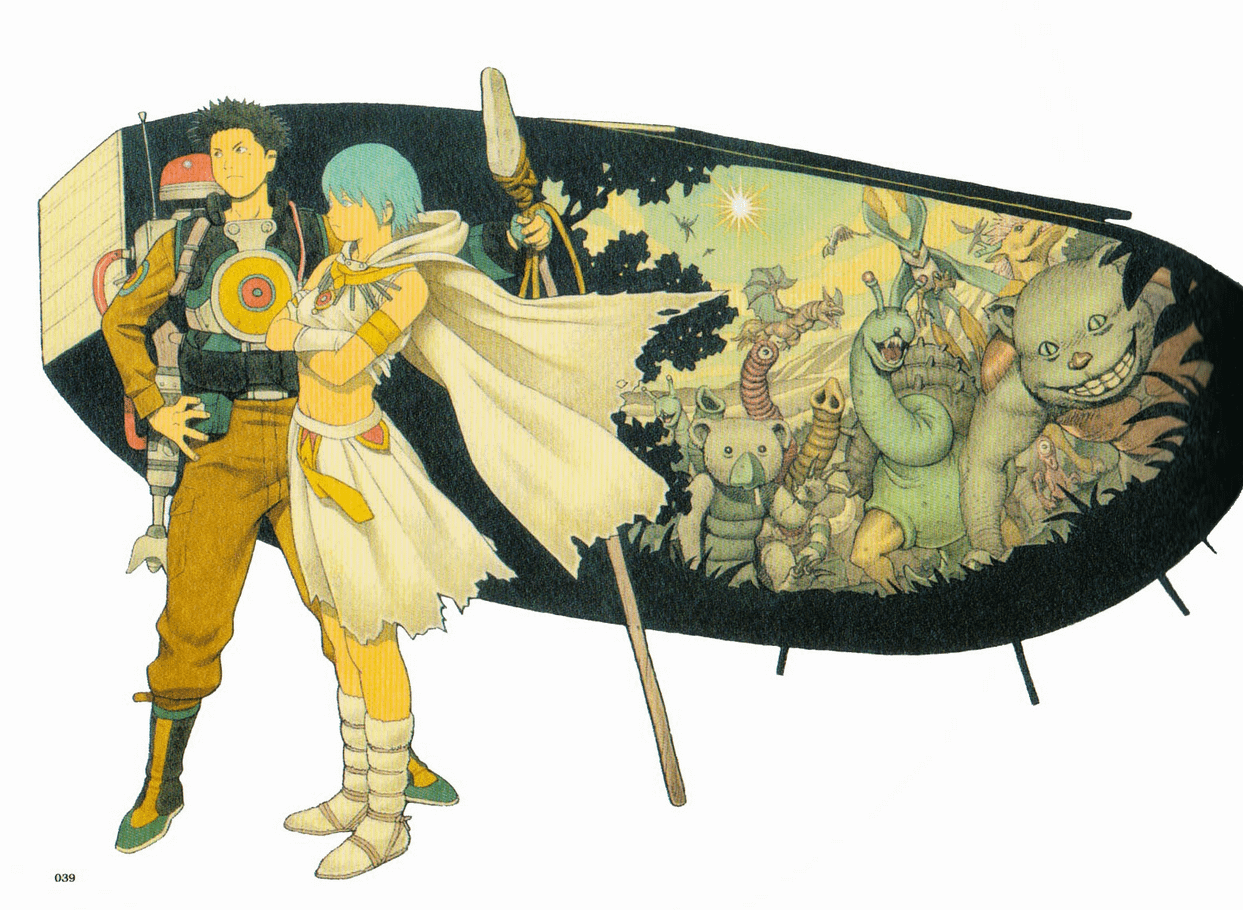
https://readonlymemo.com/linda-cube-again-explained-fan-translation-interview/ — There are still horizons of enthusiast knowledge I have yet to reach. One of those is the game Linda Cube (1995), which I learned about this weekend.
Event Calendar: Mini-Marathons
Added the upcoming GDQ showcase at Gamescom to the event calendar. I’ll be watching something, at least.
Also, you can see where The Samurai and the Prisoner (2026) is playing near you: https://samuraiandtheprisoner.film/buy-tickets. It’s good. I’ll probably write about it next week.
Until next time.
There’s a whole digression here I might offer about Lacanian psychosis and the destructive character of what constitutes so-called mental wellbeing within an ideological framework. Alas, there is only so much time to write the newsletter every week. You can probably piece some of this stuff together from previous issues.
This ultimately seems like a far different order of magnitude of ‘bad thing’ than the actions of the other characters, another piece of evidence in the case for Bee’s particularity and status as authorial proxy.