

Issue #423: Coolest Live Music Ever Recorded Within

If you are reading this newsletter, you might benefit from using Zotero. I’ve been using it since 2014, but I have been digging into its less obvious features over the past month. Zotero’s website describes it as “a free, easy-to-use tool to help you collect, organize, annotate, cite, and share research.” I’ve been using it for most of these things for a long time, but their description undersells just how great it is as a tool for annotation and PDF reading.
It has a snappy, feature rich PDF reader that lets me read on my phone too. I’ve also started using it to archive my print library, to have something I can check against when shopping for used books. I’m sure I am not alone in bringing home an extra copy of something I already own in a moment of book shopping uncertainty.
Two weeks ago, a rough encounter with the vicissitudes of cloud service led me to really dig into Zotero. Diigo, another service I have used for over a decade (and a bit longer than Zotero), went down for a few days. They’re back up, but I think the ship is going down. Diigo hasn’t posted to their social media since 2020. Their Wordpress is defunct. Their iOS app was last updated in 2021. Updated copyright on their website is the only hint they are still a functioning business. If anyone from Diigo is reading this, feel free to email me assurances that your service is going to persist and I’ll issue a retraction. I’d be happy to hear it!
Zotero splits the difference between cloud storage and organizing local files — every digital file attached to a record in Zotero lives on your harddrive. But you better believe after the Diigo scare I’ll be availing myself of every exporting mechanism Zotero has available.
So, that’s my case. This isn’t a sponsored post, although I would like to see Zotero stay in business. If it sounds like something that would help you, give it a try. I’m a certified fan.
AI vs. Analysis: The Age of the LLM Therapist
In the past weeks and months where I have staged an encounter between myself and AI, I would like to think I have been critical but fair.


While I am opposed to a number of usages for AI (the production of so-called “AI art”), I am neither a partisan of the luddite nor the techno-optimist. It is the naive and uncritical attitude toward what LLMs are and how they function that I think of as more threatening than the technology itself. There are also economic incentives abound in the favorable view of AI. Recently, Anthropic, the company responsible for the AI tool Claude, produced a “Labor market impacts of AI” report. Among its many assertions, the Anthropic research team produced a visual of “Theoretical capability and observed exposure by occupational category.” In other words, a graph of how much AI is being used in a given field today to perform the job’s tasks and how much Anthropic suggests it might be used to, more or less, do the job.
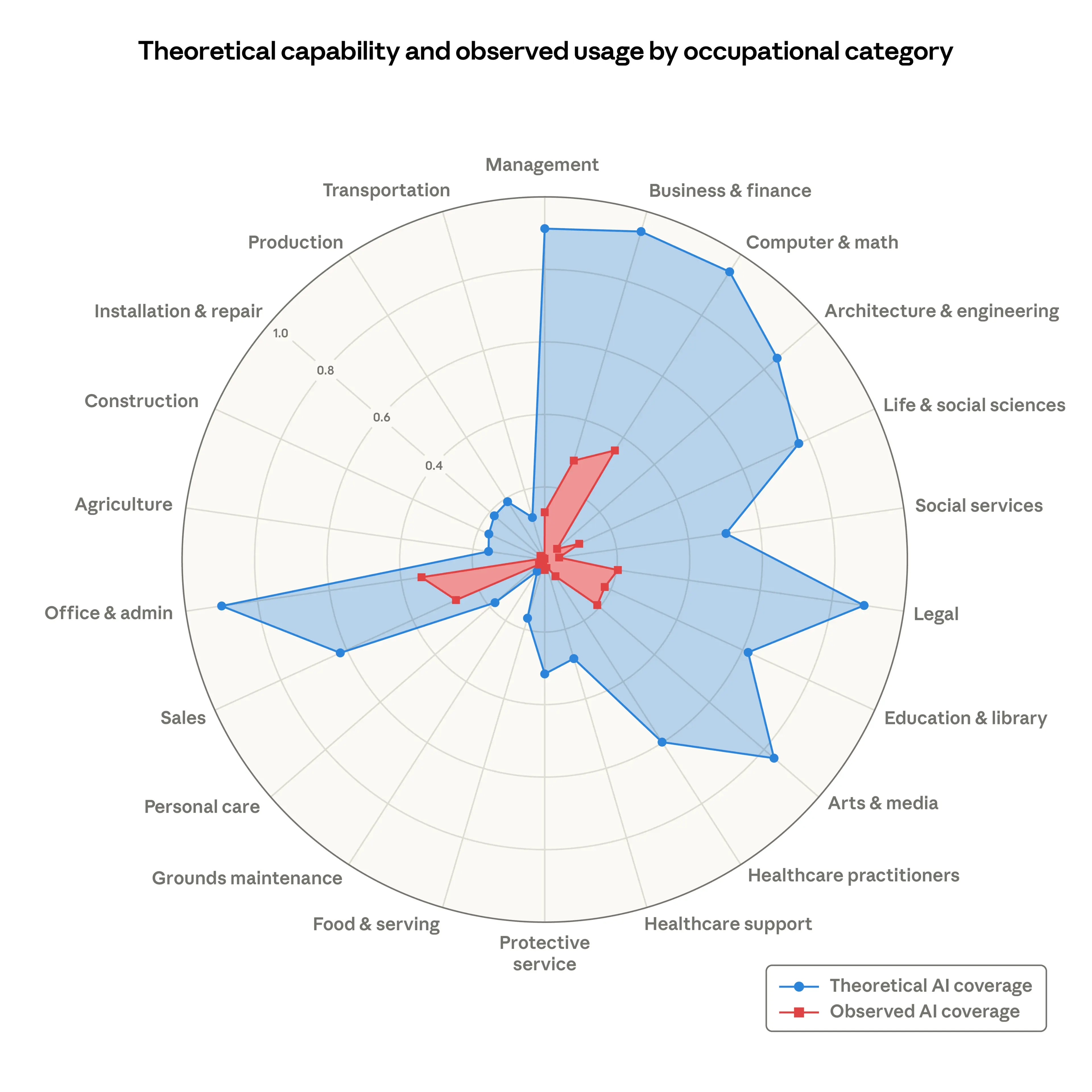
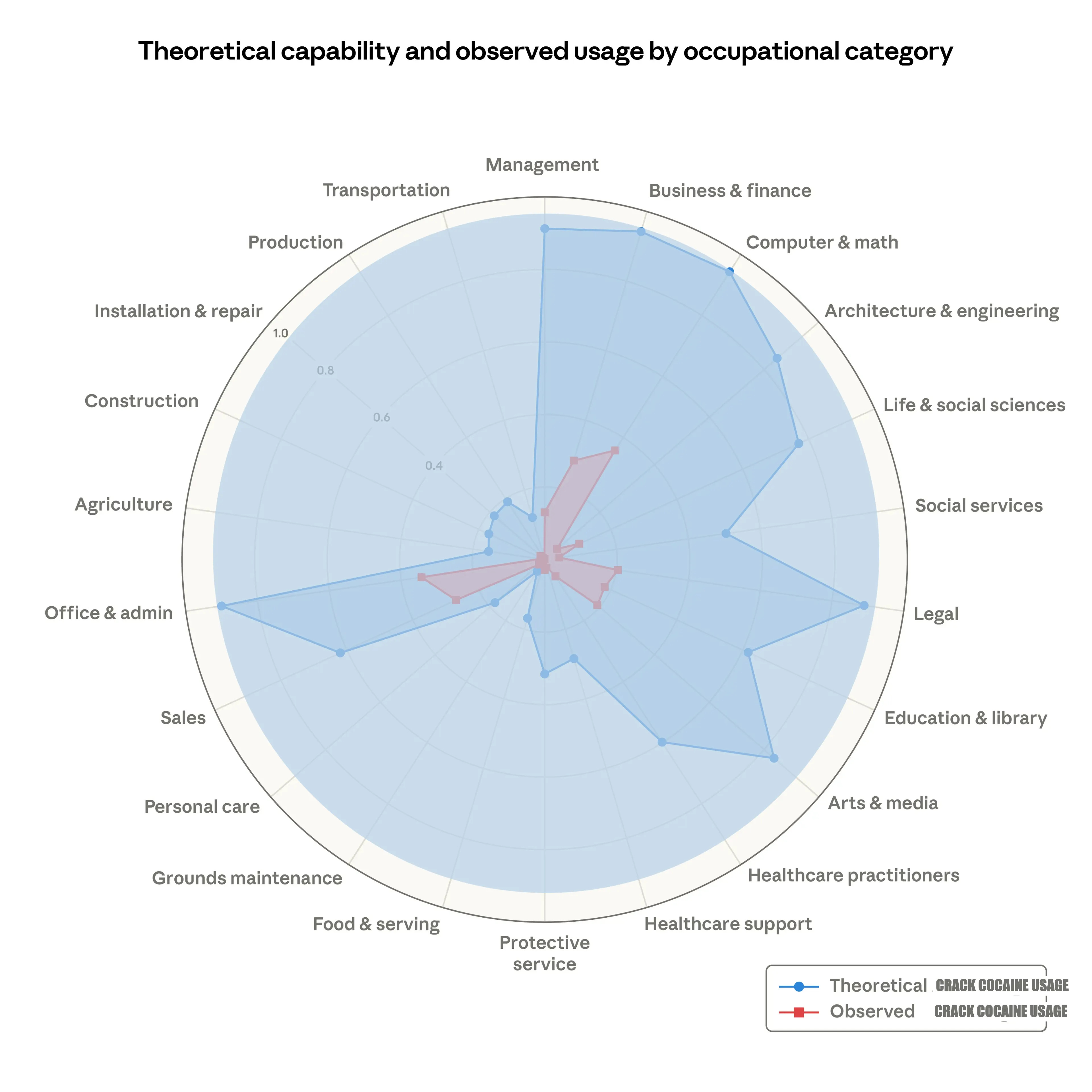
Many have looked at this graphic with anxiety and furrowed brows. But nobody has pointed to the obvious ridiculousness and self-evident conflict of interest for a company to produce findings that suggest their product will be widely used in the future across many industries. It is being underutilized, of course! There are more ways to apply AI, more “efficiencies” to gain, more “automation” to save humans from exerting their intellectual efforts. This is like a mouthwash commercial that suggests that, like a Listerine Marx, it is an inevitability of the movement of history that the proletariat will have minty fresh breath. Or, a more accurate analogy, this graph is like dealers of crack cocaine producing something similar:
Though I’ll mock Anthropic for their transparent, self-serving advertising in the guise of economic analysis, it is not as if there is nothing interesting to be be gleaned here. Most fascinating is the organizations of the vocations themselves. “Grounds maintenance” has the smallest “Theoretical AI coverage,” while “Business & finance,” “Computer & math,” and “Office & admin” are among the largest. “Arts & media” (vomit) are also scored highly by Anthropic for their theoretical coverage, although it seems to me they overestimate the degree to which AI is used in the “production” of “Arts & media.” I don’t think “AI art” is making anyone any real money.
“Healthcare practitioners” are marked as high potential for AI displacement, whereas “Healthcare support” is significantly lower in Anthropic’s view. In which category does talk therapy fit? In thinking, and joking, about this graph, I made the offhand comment “at least AI will never replace therapists.” This reveals an anxiety. Though my statement is correct in the sense of their actual function, an AI cannot administer therapy, that doesn’t change that people use AI as if it can be their therapist. It takes only the propagation of the erroneous notion, like a drug addiction, to result in demonstrable damage to mental health care.
In her latest article for the journal Lamella, Alenka Zupančič tackles this exigent question. For any therapists reading this, it is clear that AI is entering the consulting room again and again. Zupančič, for her part, starts with just such an anecdote:
Recently, a psychoanalytic colleague from Mexico told me that one of his patients, during analysis, presented a dream generated on his behalf by ChatGPT and asked that they analyze it together. (38)
Immediately, I’m struck by the question of what exactly “a dream generated on his behalf” is? How did the dreamer-by-proxy prompt the LLM? Though Zupančič never resolves my curiosity, she compares this question to another incident of dreaming by proxy in Freud. Zupančič quotes The Interpretation of Dreams:
Among the dreams which have been reported to me by other people, there is one which has special claim upon our attention at this point. It was told to me by a woman patient who had herself heard it in a lecture on dreams: its actual source is still unknown to me. Its content made an impression on the lady, however, and she proceeded to ‘re-dream’ it, that is, to repeat some of its elements in a dream of her own, so that, by taking it over in this way, she might express her agreement with it on one particular point. (41)
Should one add “Dreaming” to the exterior of the circle that represents the potential for “AI coverage” in Anthropic’s graph? Only in the most perverse sense, and I mean that as a Lacanian. The thrust of Zupančič’s argument suggests that AI functions as a mechanism through which disavowal occurs for the subject. She concludes her article with analysis of the AI generated video of a “Gaza Riviera” and Dan Brooks commentary on the video for The New York Times. Elaborating Brooks’ concept of “unstable irony,” Zupančič writes:
It seems that this “unstable irony” is, in fact, closely related to the notion and mechanism of disavowal. In relation to AI, we could even speak of a “machinic disavowal” or perhaps a “mechanically induced disavowal”—but also of a disavowal that is mechanically supported and perpetuated.
Pairing this idea with the provocative quotation from Deleuze she evokes twice, “If you are trapped in the dream of the Other, you’re fucked” (53, 57), AI for Zupančič represents an Other that is not a subject, but a detached unconscious that “[carries] out a significant labor on which ruthless political powers can cash in. It is a work that pulls us all into the orbit of a generated déjà vu, where everything is possible, but nothing can happen anymore” (57). The through-line of the argument is clear, what AI opens up is the distorted representation of precisely what is disavowed by the subject, to “familiarize us with the ‘dumbest’ idea” (56) as a tacit embrace of the most violent, obscene repression — in this particular case, the genocide of the Palestinian people in the Gaza that is “satirized” by the AI video to which Zupančič refers.
There are errors, though, in the course of this argument unfolding. Zupančič attributes to the AI too much mystery with her assertion that “ChatGPT, for example, indeed functions somewhat like a gigantic unconscious” (51). The idea of LLM-as-unconscious is what Zupančič uses to support her ultimate description of AI as a prosthesis for disavowal. But AI is not unconscious, does not have anything that can be spoken of as consciousness or unconsciousness. Its textual output is not, as Zupančič claims, an example of “highly structured … free associations” (45). Is there not a self-evident contradiction in this idea? Freedom is what is at issue in the text AI generates. The associations it makes are not free. They are dictated by a given model, rigid, and repetitive by virtue of structure rather than compulsion. Zupančič concedes as much when she writes LLMs are “a system that … is based on probabilities and guesses” (52). She puts too much weight on the idea of the guess and the variability of the probabilities. Though one might be able to extract some insight about the zeitgeist from an LLM’s training data by way of its output, the rigid associations of LLM text production are antithetical to the disruptive free association of the subject.
Bracketing the modest disputes I have with some of Zupančič’s finer points about AI, she understands clearly how the tool functions as a social reality:
Moreover, ChatGPT is not merely the Other as a passive repository of signifiers—it is an Other that functions as what is called in Lacanian psychoanalysis “the subject supposed to know” (with all the implication that this has for the notion of “transference”), and it is an Other that speaks. It addresses us directly, like an oracle. In this sense, it performs the function of what we might call a “talking big Other”. It seems to have an answer to every question—and when it doesn’t, it simply “hallucinates” one, and we’ll return to this. (44)
For Lacan, the belief in a “subject supposed to know” is a necessary misrecognition by the analysand of the analyst. Though the analyst knows nothing privileged about the psyche of their analysand, the analysand should think of the analyst as particularly knowing to lubricate the speech of analysis. In other contexts, though, the transferential relation that props up the idea of a subject supposed to know is an error with a range of adverse social consequences — as I claimed in my presentation at LACK last year. Zupančič herself is not immune to this transference, as in the paragraph immediately following her account of the subject’s transferential relation to ChatGPT, she demonstrates her own recounting her querying ChatGPT (”an interesting conversation with this entity”) about Freudian dream interpretation (44).
Ultimately, Zupančič totally objects to the LLM as being a subject as such — the “unconscious” quality she attributes to the LLM is precisely because it is not conscious. She writes:
This also indicates why the attempts to equip the AI with subjective, “human” psychology misses the point of the Lacanian subject. The subject is not a bag of subjectivizations and identifications (which basically resonate and fit in with the existing symbolic order), but precisely the element without subjectivization (and in this sense without psychology); hence its fundamental relation to the Freudian unconscious, the formula of which is: “therefore I’m not (there)”, “this is not me”.
The AI’s non-subject status is from the mar in its code that comes from its lack of lack. Training data is always structurally complete, it always has some text to fill in the empty space one creates by their querying it. The LLM is never at a loss for words.
Zupančič provides a more affecting description of this difference:
In psychoanalytic terms we could say that what ChatGPT lacks in order to become a subject (parlêtre) is not some unfathomable, spontaneous depth of subjectivity; what it lacks is the presence, the impact of an Other. It lacks an instance of the Other that could intrigue it with its own speech, to the point where it would begin to presuppose and question the desire of this Other (“What does the Other want?”) . … Are we, as ChatGPT’s “users,” its Other in this sense? Hardly. I doubt that, while we chat with it, it wonders what we really want from it, beyond what we explicitly say—or seem to be saying (Lacan terms this “Che vuoi?”. The interrogation of the Other’s desire takes the form of questions such as, “you say this, but what do you really mean, or want from me?” or, also: “What am I for you?”). We, on the other hand, do wonder: we wonder what it “really” knows, how it functions, what kinds of algorithms drive it, and what kind of danger or blessing it might bring into the world… (51-52)
She spends the middle portion of the essay doing the best theorizing, explicating this account of the “missing screw” following a close-reading of Modern Times (1936):
I believe this could be a rather good rendering of the (Lacanian) subject of the unconscious: it is a subject struggling in its own ways with the fact that the apparatus determining it is struggling with a missing screw (or a missing signifier). (49)
The ink spilled, already, on the question of AI’s relationship to psychoanalysis is vastly disproportional to the intrigue of the question. Still, Zupančič writes, “[t]he positive answer to our inaugural question does not, of course, mean that psychoanalysis is simply indifferent or impermeable to AI” (43). And yet, even as she mis-attributes the unconscious quality to the output of the LLM, Zupančič presents an incisive argument as to just what the LLM lacks to be a subject in the psychoanalytic sense. In her turn to the horrific genocide in Palestine and the “Gaza Riviera,” the LLM’s shortcoming relative to subjectivity is threatening:
In other words, perhaps we should not so much fear that AI becomes [a] subject, as we should fear that it doesn’t— and that it instead evolves into a pervasive, overwhelming discursivity that confines us (53)
It would be, in my view, the deceptive transferential feeling a subject can have toward an AI that leads to this result rather than an LLM failing to become a subject. Indeed, don’t hold your breath. It never will.
In my reading of both Anthropic and Zupančič’s various provocations, I want to pay tribute to the therapists on the front lines working with clients, patients, analysands. What you face is a confrontation with a transference that threatens this very possibility of a confining discursivity brought about by headless text generation. Still, your therapeutic function as the ‘Other’ can never be replaced.
The Best Live Music Performance of All Time Took Place in 1986 in Hamilton, ON
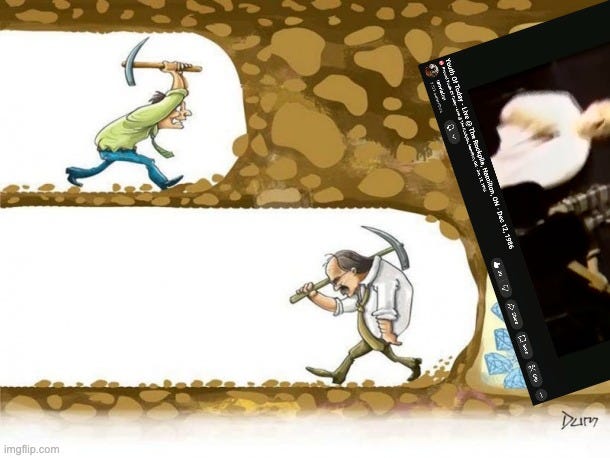
Youth of Today is one of my favorite bands of all time. My enthusiasm for them has never wavered. Though their period of activity as a real band ended in 1990, I’ve seen them play during their seemingly interminable reunion at least ten times. Maybe more. I’d really have to think. Like anything I like a lot, I have my criticisms. Cappo can be a little longwinded. It’s a lot worse now. But even watching some of their greatest live sets, he talks.
Something was in the air in Hamilton, Ontario on December 12th, 1986. Because that is the recorded Youth of Today concert about which I have no complaints. It is perfect.
If you don’t watch a lot of YOT videos, or haven’t seen them play a lot, you aren’t really going to grasp how exceptionally rare of a performance this is. But even if you know nothing about the band, I trust if you have good taste you can appreciate what you are seeing here. It is unbelievable. Jaw-dropping. I could quote Cappo’s sparse banter from this show all day. Before “Shout It,” “This is also for the people who get up and speak out. It’s called ‘Shout It,’ and you know I’m gonna fuckin’ right now.” He gives an eloquent explanation of the themes of “Stabbed in the Back,” but still long enough to justify a block quote:
This one’s going out to all the people who are up front, singing along. This is what you can do at a hardcore show with no barriers up. No one’s telling you to get back. You want to come up and sing, you’re more than welcome. This is going out to all the hardcore bands, the people who had something up here, who went their own way to make more money or to attract a larger audience. You know what I mean. This one’s called “Stabbed in the Back.”
Let’s fucking go. Just like I can type out these Cappo quotes and get hyped, current bands could do much worse than taking inspiration from this video. Better than explaining the meaning of the songs, he often just introduces them by speaking their lyrics into the mic, giving the audience the guidance for his desired singing along. It’s especially badass before “Expectations.”
I have watched this video a lot, but I lost track of it for a while. It was just the apocryphal YOT set where, I insisted to people, Cappo didn’t say much other than shouting the lyrics of the songs before the band kicks in. Finding it again today, when this set gets rolling, it’s like accidentally flipping to Training Day (2001) on TNT. I’m seated.
Everything I care about in music is in this video.
Weekly Reading List
Shoutout to Ianvision, the custodian of the Youth of Today video above. He’s got a lot of other great ones uploaded:
And then there’s this Haymaker concert promo:
Unreal.

https://tidsskrift.dk/lamella/issue/view/13135 — If you are all set on 1990s and 2000s hardcore concert videos, you can also read the entirety of Lamella’s latest issue.
Event Calendar: BUFF Kicking Into Gear
I updated the calendar last week with my pick of BUFF screenings (most of them). They’re getting under way this week.
Until next time.