

Issue #431: The Original 13 Assassins is an Indisputable Samurai Classic
Music League’s theme this week was a song you like by an artist you hate.
I already discussed my difficulty making a selection here. Ultimately I chose a song by Drake that is 60% inside joke with a friend of mine. I don’t feel like I was exceptionally adhering to the prompt. “Hate” would be kind of a strong descriptor for my feelings about Drake, though I do think most of his music is pretty terrible. We had some pretty easy to hate representation: Maroon 5, Dave Matthews Band, Red Hot Chili Peppers, Foo Fighters. We also had shocking feelings of hatred by the edgiest of us: Bauhaus, Pixies, Pavement.
But the best choice, the one that I thought would have been more true for me than even my own submission was Post Malone. My friend Eric submitted “Congratulations.” I’m sure everyone has heard it. I would’ve gone a little further back.
What can I say, I am a sucker for melancholy rap songs about mortality. I don’t even know what kind of terrible music Post Malone is making now, but there’s a fall off study to be had looking at his career.
This week, Eiichi Kudo.
“When he fights with the aim to die, he lives. When he fights with the aim to live, he dies”: Critique and Chivalry in 13 Assassins
In a conversation with Gene Siskel from the November 11, 1973 edition of the Chicago Tribune, François Truffaut makes a critique that has reverberated through film criticism for decades:
For example, some films claim to be antiwar, but I don’t think I’ve really seen an antiwar film. Every film about war ends up being pro-war.
Truffaut makes no exception to this critique, even indicting Paths of Glory (1957) and Dr. Strangelove (1964) as proponents of war. The films to which Truffaut are far from the only example, I’ve written about this idea in relation to The Legend of Heroes: Trails of Cold Steel (2013), Black Mirror (2011), and Severance (2022). In my first engagement with the idea for Paradox, back in 2019, I also discussed Mobile Suit Gundam (1979):
In the case of Gundam, Yoshiyuki Tomino as the series’s architect is faced with the impossible task of telling a story critical of war all the while having to sell models of the war machines to children. And the machines that Tomino should revile are instead almost objects of worship.
Indeed, much of the Gundam works are subordinate to the capital incentives that justify their existence — down to some of the most egregious examples of Mobile Suit Gundam Narrative (2018) largely structured to re-use toy molds.
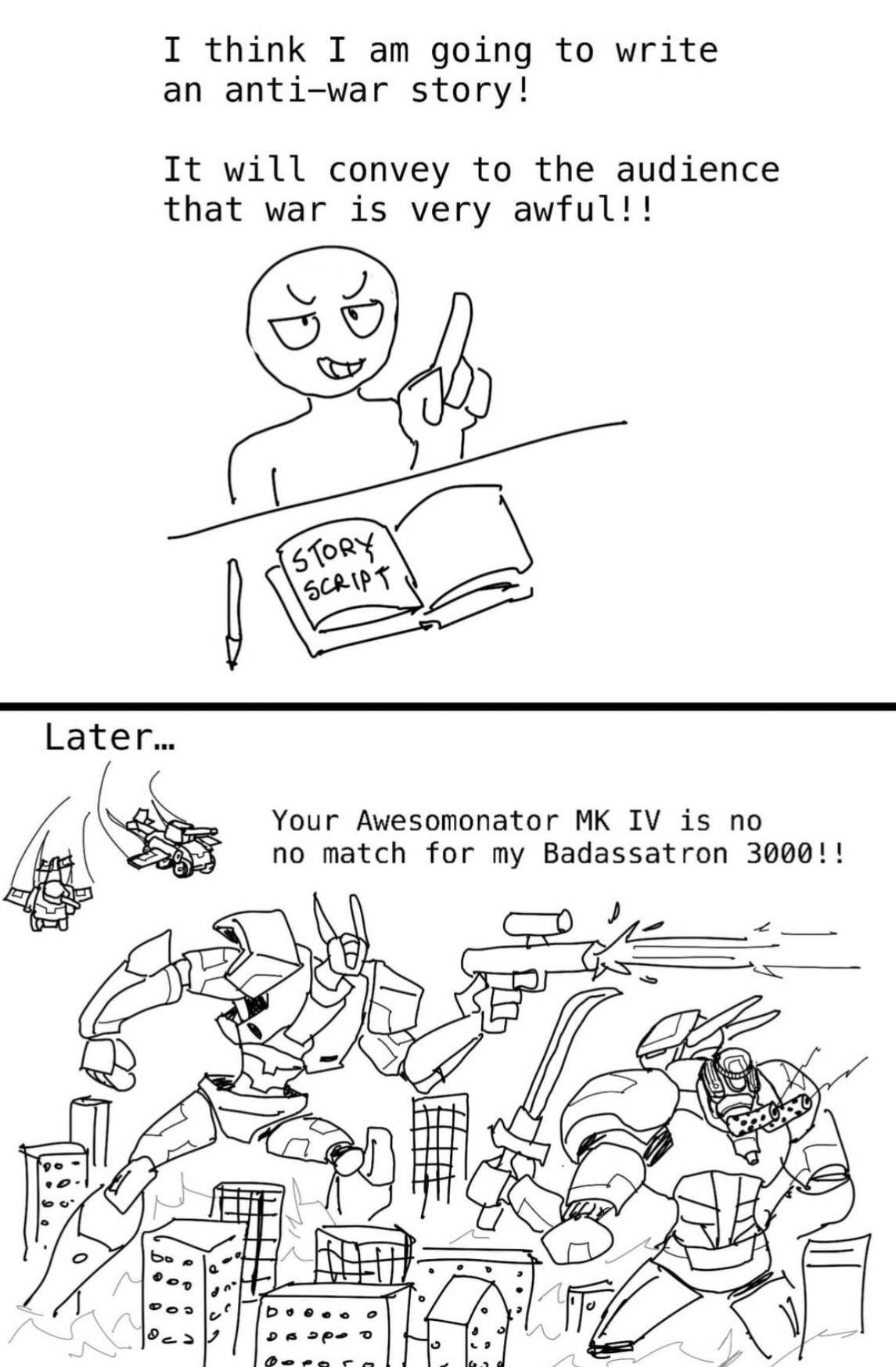
The tension here, especially in the cases where the contrast is so apparent, can make a text more rich. Paths of Glory and Dr. Strangelove clearly works that critique war whether or not they inadvertently also endorse it. In contrast to Truffaut, I think there’s evidence to suggest they’re successful. To quote myself again:
Kubrick was certainly on to something here. The best way to make an antiwar film might be to have the majority of the film’s runtime dedicated to the tedious bureaucracy of the court martial and the insistent pleas of men consigned to death.
Unlike those two films, Gundam is a self-awarely Janus-faced beast. Bandai expects toy commercials while Yoshiyuki Tomino, Yasuhiro Imagawa, and even Toshikazu Yoshizawa are trying to make art. The samurai-focused jidaigeki encounters the same tension, as films present heroic characters and finely choreographed chanbara action while also critiquing the social hierarchy and ideological inconsistencies embodied by the samurai class. No movie more than Eiichi Kudo’s 13 Asssassins (1963) demonstrates this contradiction.
“We must figure out a way to correct the distortion of this injustice”
In their summary for the film’s re-release, Arrow Video writes:
By 1963 Eiichi Kudo was already a jidaigeki veteran. But for 13 Assassins, he decided to buck the emerging trend for colourful, family-friendly samurai films and renew with the radical traditions of the genre. The resulting film is a compelling and suspenseful samurai drama that remains impactful to this day.
Despite the gritty quality of Kudo’s film, it is far from the nihilistic, caustic condemnation of Masaki Kobayashi’s Harakiri (1962) from a year before. Neither Akira Kurosawa’s Yojimbo (1961), nor Masahiro Shinoda’s Assassination (1964), nor Kihachi Okamoto’s The Sword of Doom (1966) make available a reading that romanticizes the “samurai spirit” (samurai no kokorozashi) or “Way of the Warrior” (samurai no michi). 13 Assassins, though, explores both with a naive earnestness through its principal characters Shinzaemon Shimada (Chiezō Kataoka), Shinrokurō Shimada (Kōtarō Satomi), Kujūrō Hirayama (Kō Nishimura), and antagonist Hanbei Onigashira (Ryōhei Uchida).
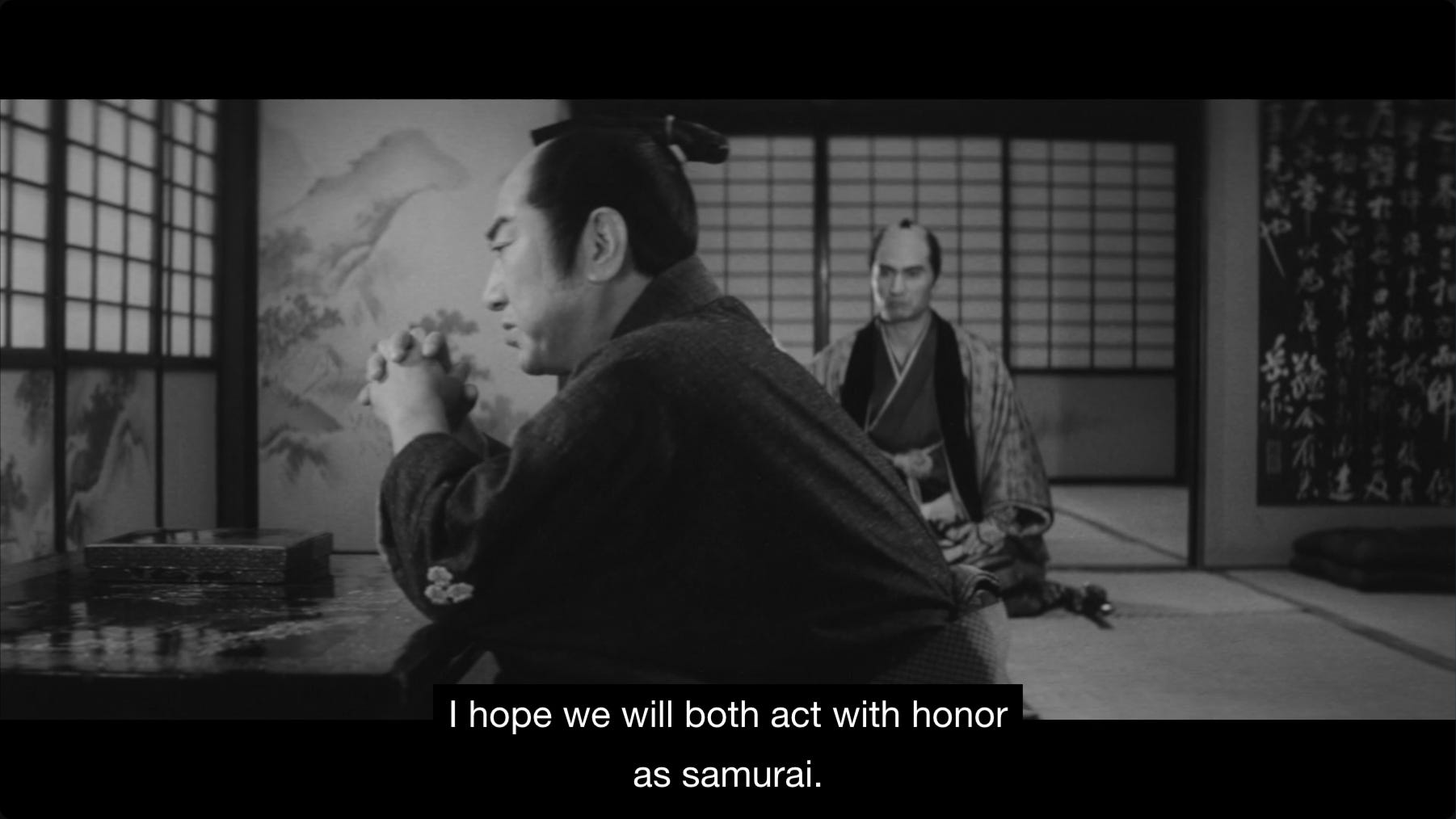
All of this is to say, despite the violence and salacious material in 13 Assassins, it valorizes and ennobles the samurai as something more than a privileged social position rife with hypocrisy. There is certainly something ‘family friendly,’ or ideological, about that.


13 Assassins sets Shinzaemon and Hanbei against each other. What is critical about the film’s structure is neither man acts on their own behalf. Were it up to them, they wouldn’t be fighting at all. Shinzaemon works on behalf of Doi Ōkō Toshi (Tetsurō Tanba) to exact punishment on Hanbei’s lord, Naritsugu Matsudaira (Kantarō Suga). Naritsugu evades public censure as the half-brother of the Shogun and Hanbei reluctantly fulfills his obligation as his retainer despite Naritsugu’s apparent sadism.
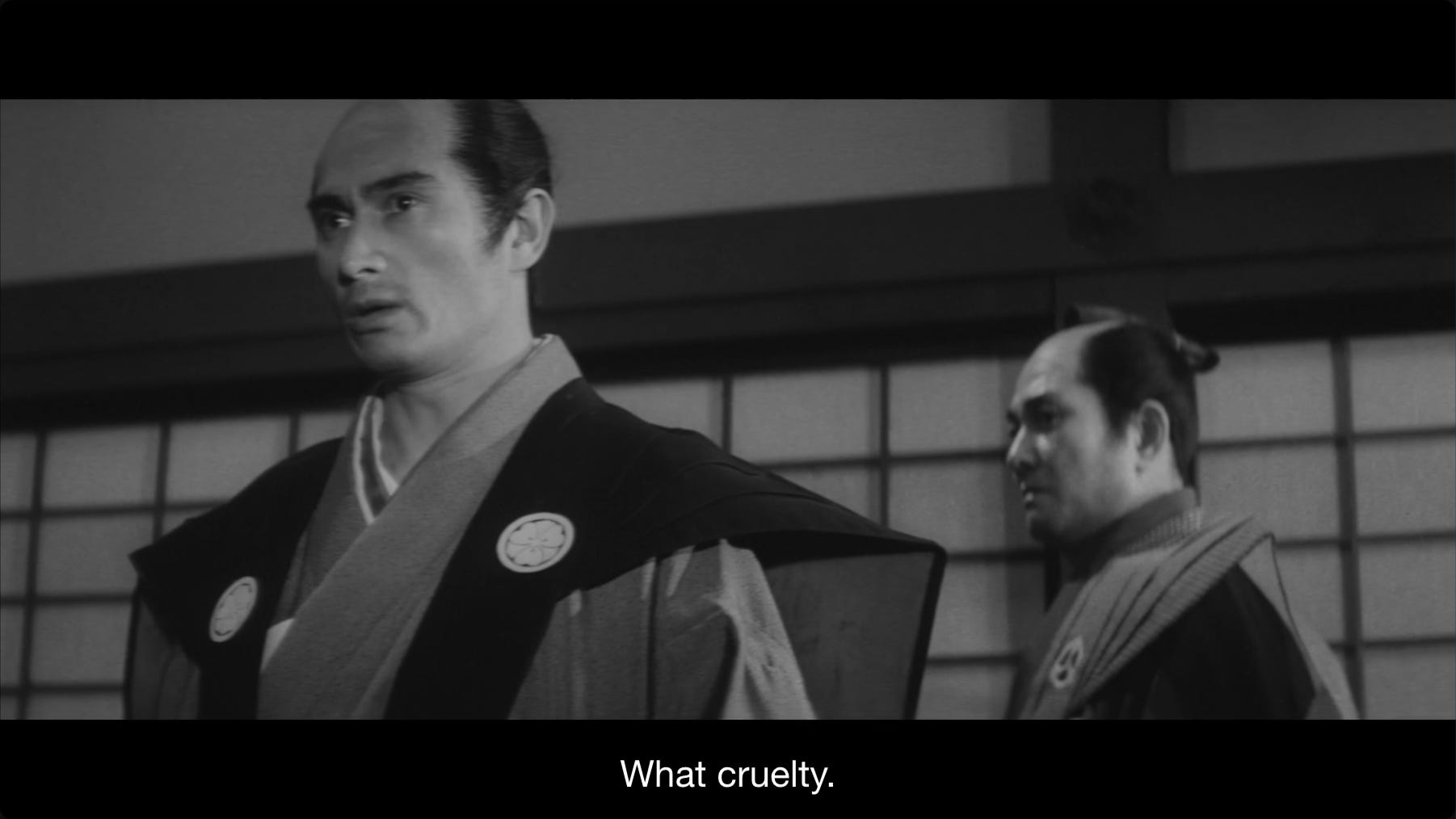
Doi’s instructions to Shinzaemon are secret. He says, “To betray the word of the Shogun, and find fault with his political leadership, that’s something, as a senior advisor, I cannot do.” Instead, he sets Shinzaemon on his mission as a clandestine assassin with dubious legal authority. I write in my Letterboxd review of 13 Assassins:
Thus, the lawful and moral hierarchy that insulates Naritsugu calls for the intervention of Shinzaemon Shimada (Chiezo Kataoka). Shinzaemon is not a sole actor in a state of exception who violates the written law in service of a higher one. Instead, he is a disavowed government operative bestowed his authority by Doi Ōkō Toshi, in a quick but memorable performance from Tetsuro Tanba.
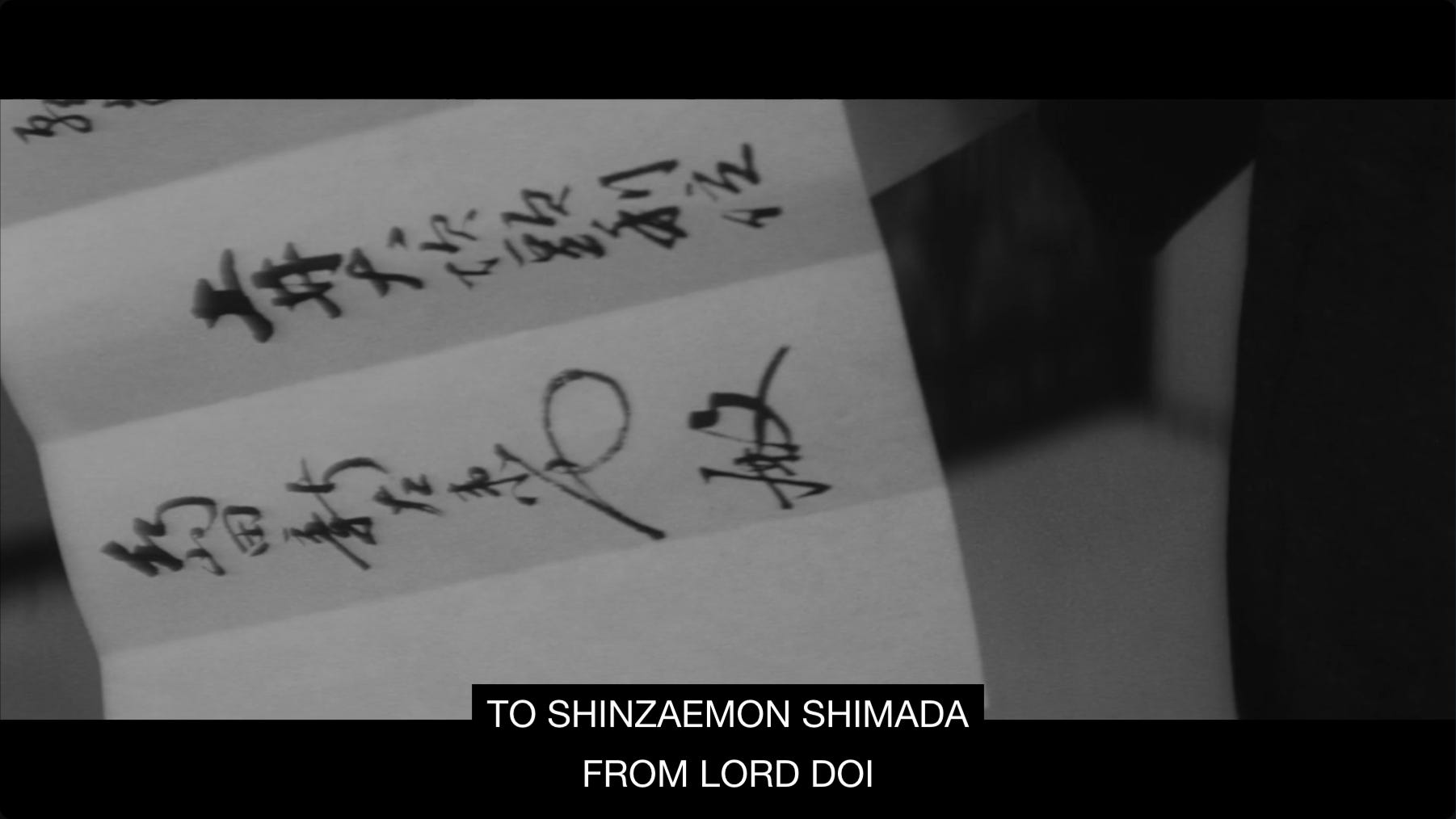
Shinzaemon acts with authority that Doi would ultimately deny. The missive that grants him that authority, Doi burns. This is a familiar pattern for viewers of 007, Mission: Impossible, or 24. But more than any of those works, 13 Assassins invites the question of how such an anonymized, denied authority within the scope of law differs from absolute criminality. How is Shinzaemon different from heroes like Hanshiro Tsugumo (Tatsuya Nakadai) who ignore the authority of written law all together? Shinzaemon’s authority is explicitly unwritten. Or, more emphatically un-written, erased from the archive despite its official status.
Shinzaemon fits squarely into the trope of the “disavowed agent.”
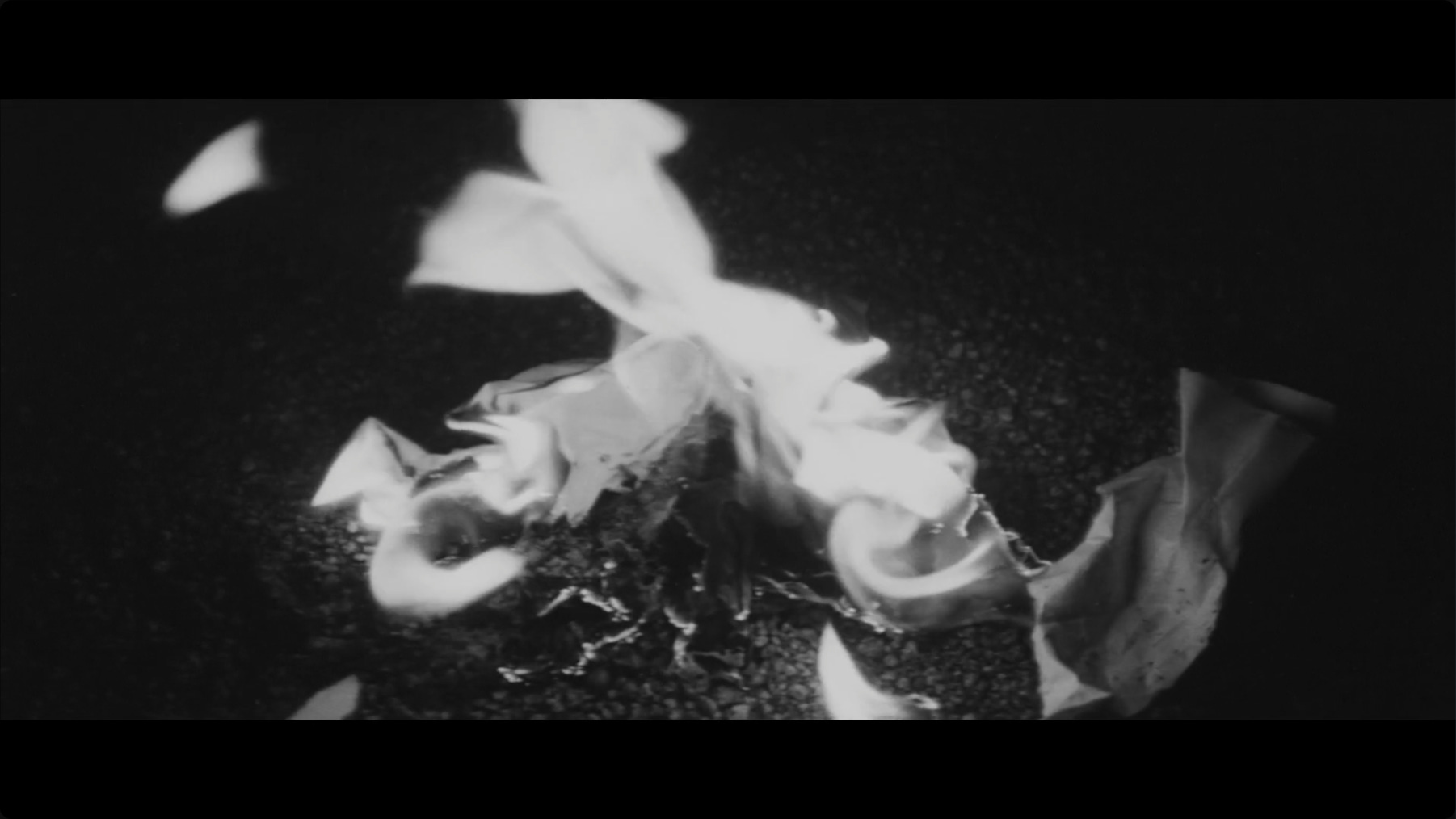
Despite the cloak and dagger instructions from Doi, he must still censure Shinzaemon. Halfway through the film, Shinzaemon is dismissed as a law enforcement official:
By the ruling justice of the country, you have been relieved of your position. Should you fall at arrowpoint, your responsibility weighs tremendously. And the day of life and death shall be determined.
Though Shinzaemon’s status as a judicial functionary is unverifiable, it both sets him apart from the many noir-ish or cowboy-influenced samurai protagonists who have no such authority. Likewise, it places him in structural opposition to Hanbei. Even as Shinzaemon acts in accordance with his convictions in the way Hanbei does not, it is a duty imposed by someone else that causes Shinzaemon to act.
“It’s beyond anyone’s imagination what actually happens when two men fight, throwing their lives at each other”
The caper to assassinate Naritsugu requires co-conspirators, and Shinzaemon enlists twelve other samurai to make up the titular thirteen assassins. The film is unique in that it presents sword fighting as that which has been sublimated into a martial art rather than a tool for killing. Even Shinzaemon is inexperienced in warfare, and the collective working on his behalf acknowledge that for both the assassins’ squad and Naritsugu’s samurai, it will be their first experience in life-or-death combat.
Aside from the social hierarchy and ethical structure that is the subject of so much samurai cinema, Kudo demystifies samurai labor in a time of peace more than other films. Yes, 13 Assassins has ronin like Hirayama and Heizō Sawara (Michitarō Mizushima). The question of being or not being a samurai is inextricable from the status of employment. In this sense, Shinzaemon and Hanbei are yet again opposed to one another. Shinzaemon is gainfully employed, but far from wealthy as an ōmetsuke. Despite his relative economic precarity, Shinzaemon is also a hatamoto, from a distinguished samurai lineage that, in turn, dictated his own class and profession. Shinzaemon had no choice but to be a samurai.
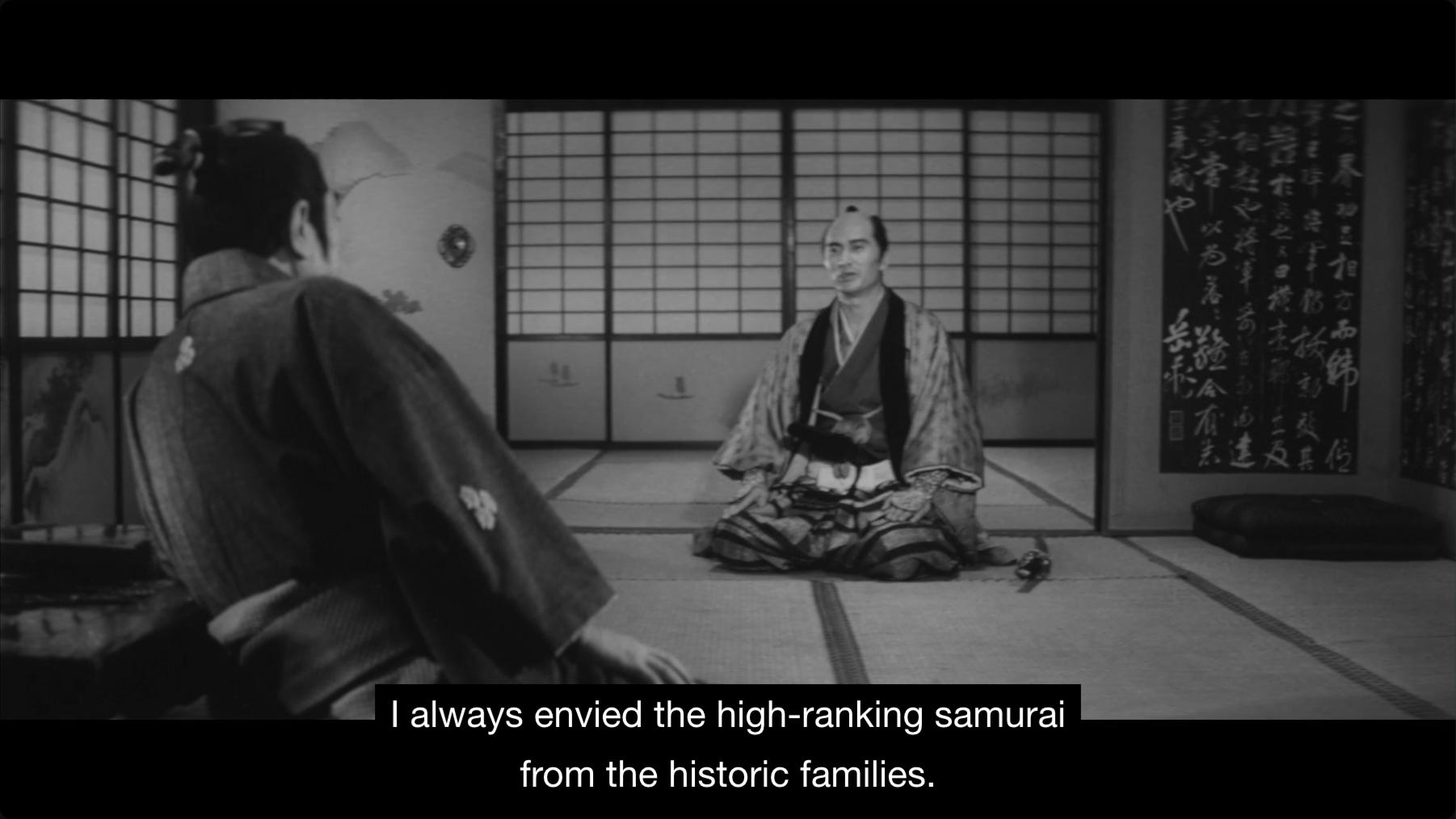
By contrast, Hanbei is neither an ōmetsuke working on behalf of the Shogunate nor a hatamoto, with no impressive samurai in his family tree. However, he is much more wealthy than Shinzaemon as Naritsugu’s chief retainer. Naritsugu repeatedly alludes to the wealth of the clan by the number of rice bales (specifically koku of rice) in storage. Shinzaemon does not have generational wealth to fall back upon, only generational status. But Shinzaemon’s meager paycheck does allow him to support Hirayama, though Shinzaemon calls it only a “small contribution.”
Shinzaemon’s nephew, Shinrokurō, is yet one more rung removed from the celebrated samurai family of Shimada. Shinrokurō lives with a geisha and refers to himself as a gokudō and works to learn the shamisen, rejecting his implicit obligation of public service. However, after a demonstration of Shinzaemon’s prodigious shamisen skills despite also being an accomplished samurai, Shinrokurō joins Shinzaemon’s cause. Being a great shamisen player never satisfies Shinzaemon, no matter how proficient he becomes at the instrument. His virtuosity passes that dissatisfaction to Shinrokurō, less accomplished as both a musician and samurai.
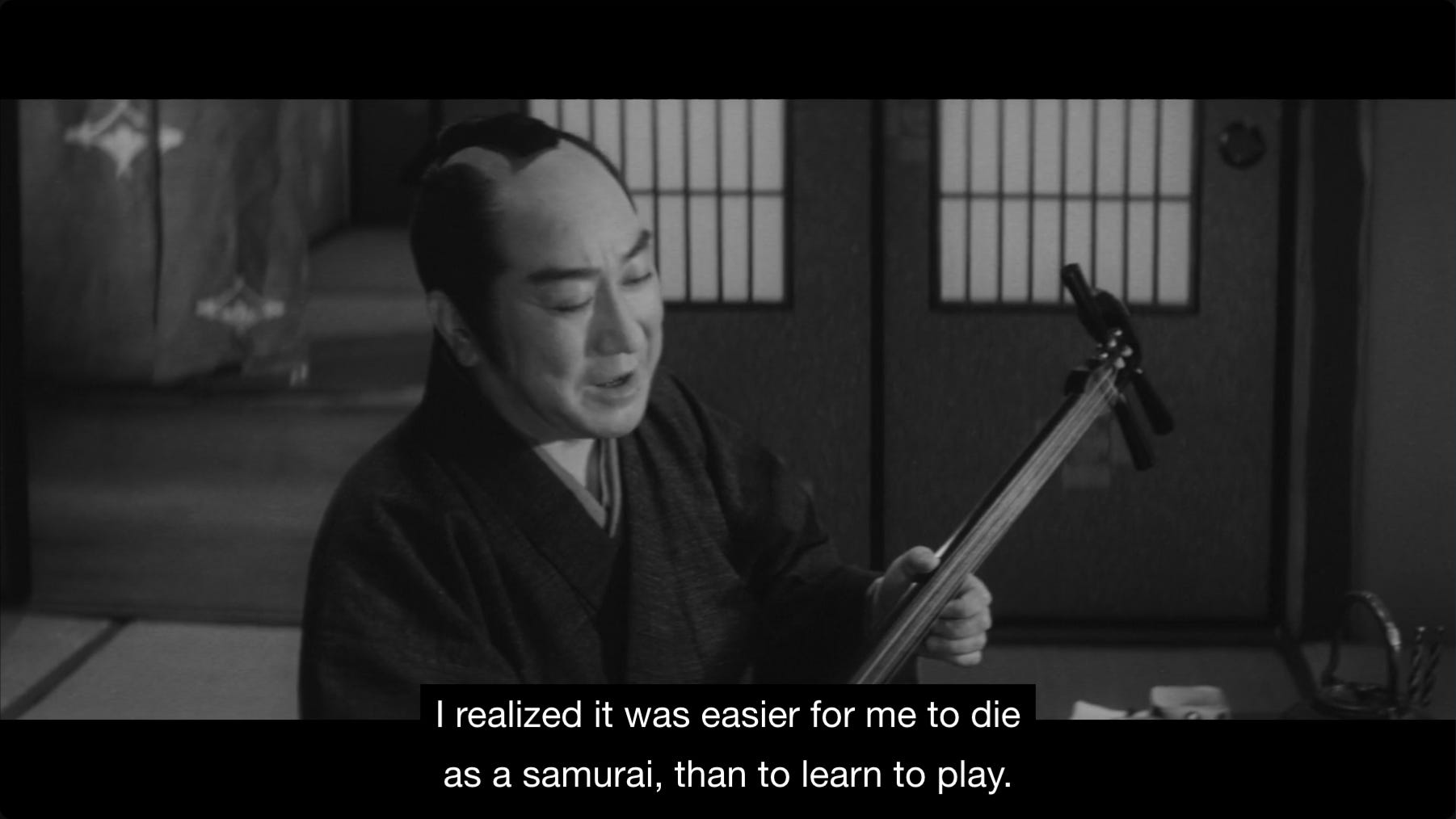
“I’ve heard it said that a samurai would choose death to avoid becoming a laughing stock”
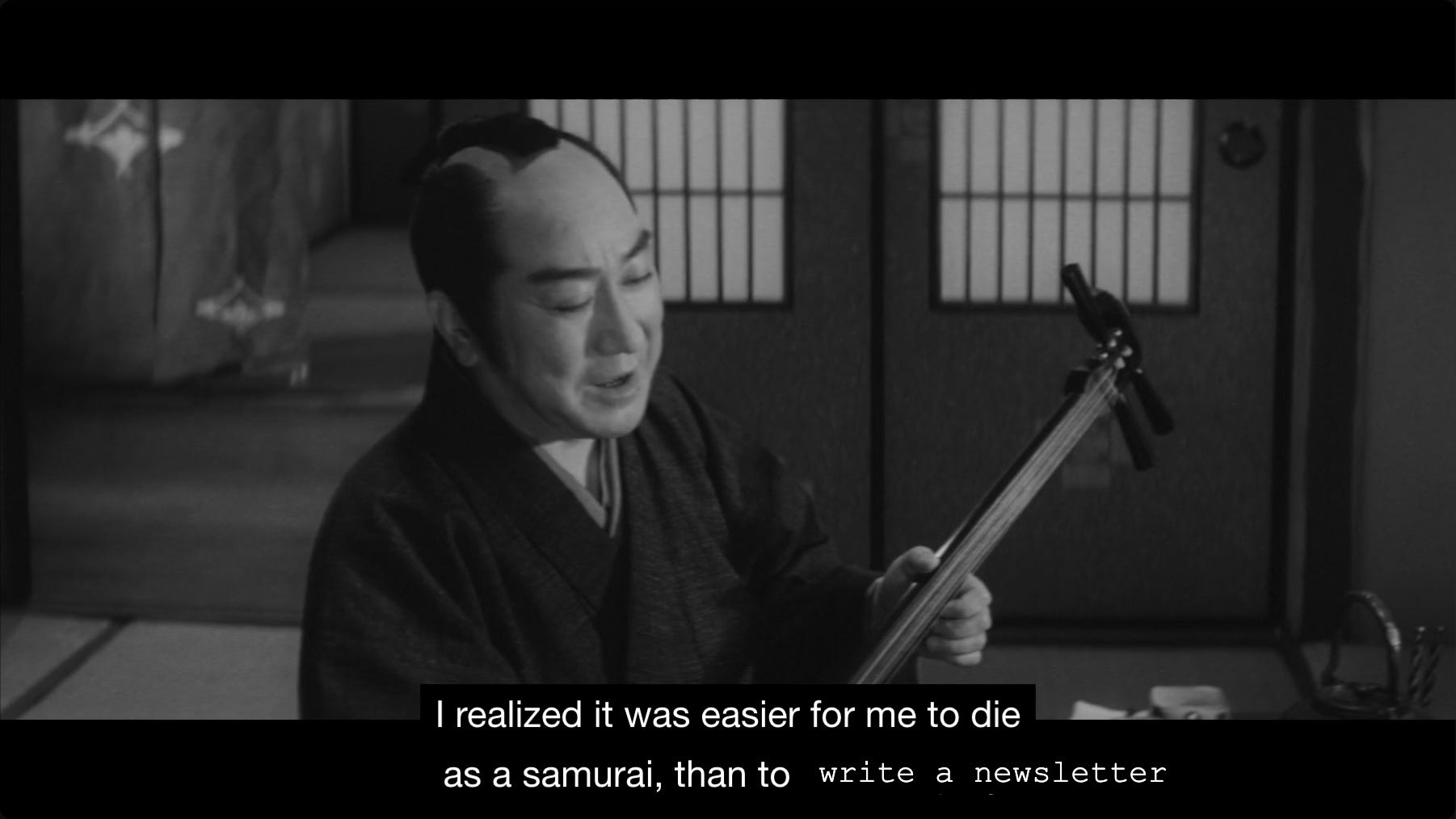
Much of the film revolves around the antagonism between one’s self-image and perception by others. Shinzaemon is seen as endlessly proficient, but Shinrokurō has a different read of him:
He gets deeply worried, thinking about what trouble he’s getting into. But, despite all his feelings, he just smiles and takes on the job. He takes on jobs that seem impossible, and achieves success. And that’s the really great thing about him.
Shinzaemon is externally self-assured and admired by even those who recognize his internal anxiety. Both Yukie Makino (Ryūnosuke Tsukigata) and Naritsugu concern themselves with the idea of being ‘laughing stocks’ in the English translation — though it’s worth noting their Japanese phrasing is different (guchi to o-warai kudasare and tenka no monowarai respectively). Even the different Japanese phrasing lends itself to reading this juxtaposition. Makino is unable to protect his son and daughter-in-law from Naritsugu, “as a living witness, I don’t feel free to die, so I must extend this life that I no longer care for.” Naritsugu’s obsession with how he is perceived by others (tenka, the world) is one of his many flaws.
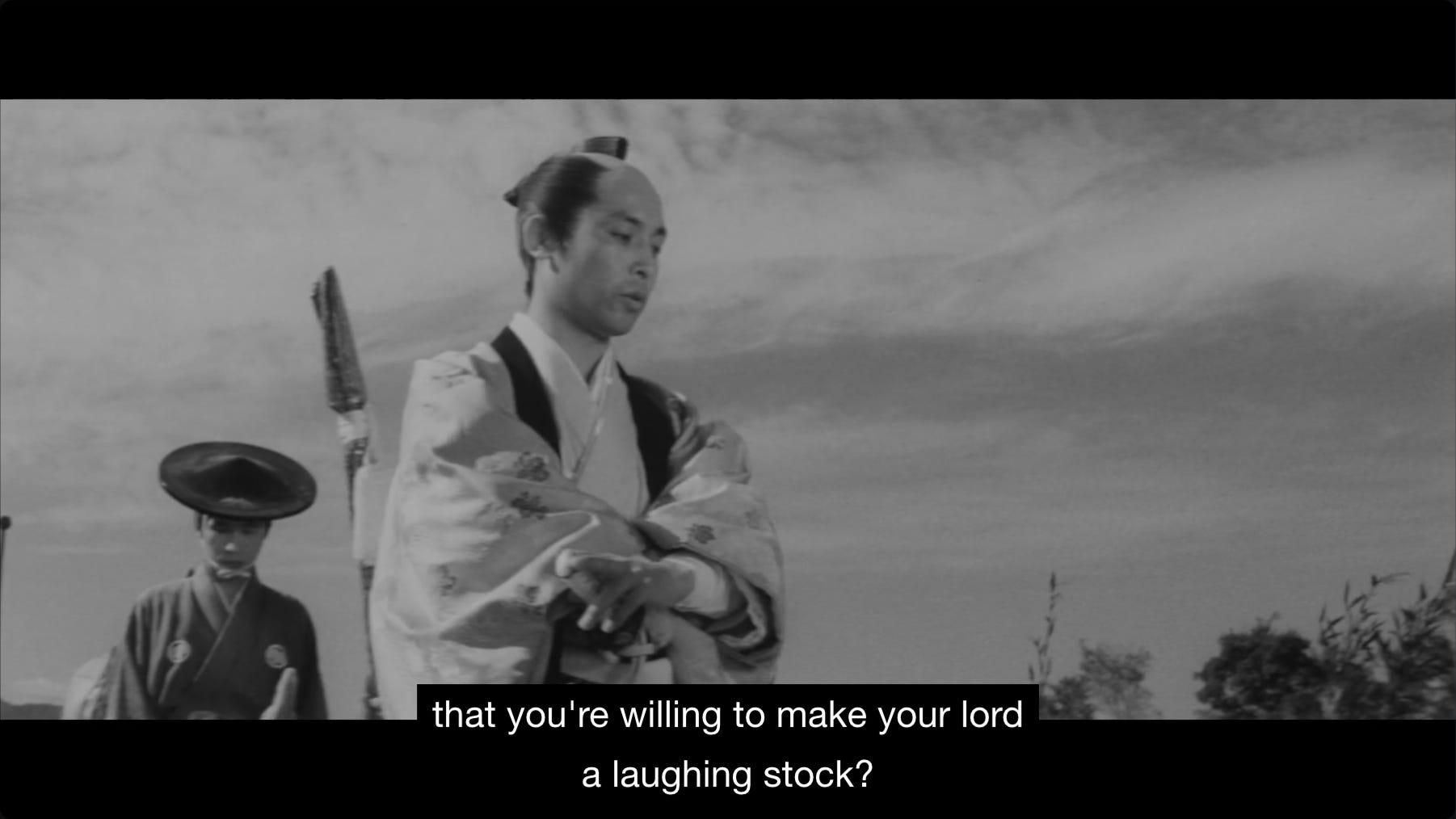
Ultimately Shinzaemon’s self-image is different from the calm exterior he shows. He looks at himself as having lived too long, and will confront death through Doi’s censure or in the course of assassinating Naritsugu.
“I’m telling myself now how truthful I’ve been to the Way of the Warrior”
There is no question that the failings of the samurai class’s structure cannot dampen the heroic character of Shinzaemon, Shinrokurō, Hirayama, and Heizō. Though Heizō has little screen time, his role is critical. He re-emphasizes the economic relations of the samurai. As a ronin, he demands payment for joining the plot against Naritsugu:
My sympathy with your cause has nothing to do with money. But I’m a ronin with no kind of relationship with you. I don’t think you should expect me to work for no payment.
Heizō then describes his plans for the 200 ryo payment he requests:
120 ryo for loans and debts that have accumulated over the years, plus buying something nice for my relatives. Then, 30 ryo for a tomb for my wife who died from the hardships I put her though. And 20 ryo for my own preparations. With the remaining 30 ryo, I plan to experience the kind of luxuries I never had in life … pleasing those around me ultimately satisfies my desire.
In the film’s penultimate scene, Shinrokurō finds Haizō’s dead body, 30 ryo left in his pocket.
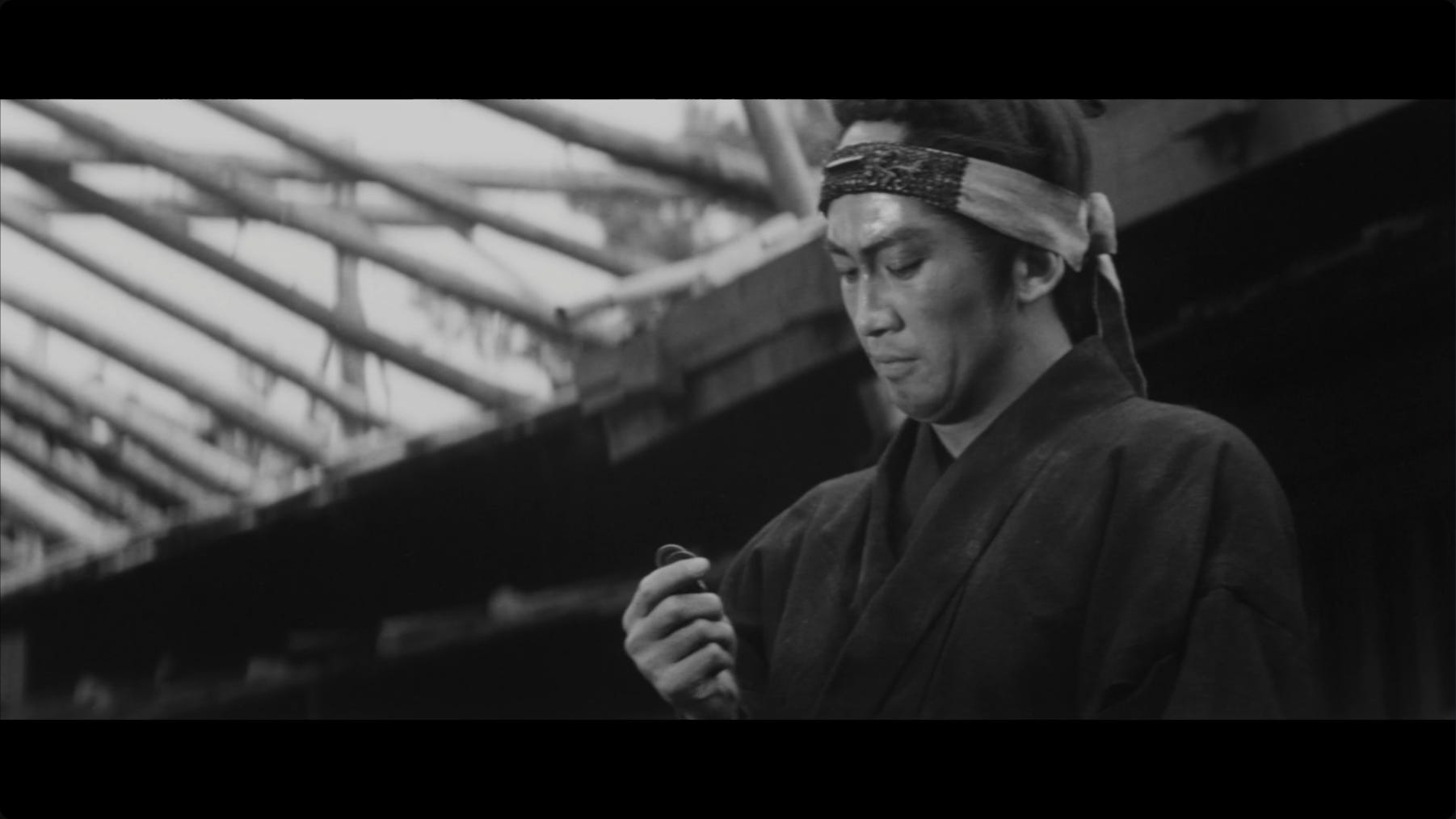
This unstated and unknown self-sacrifice encapsulates what is admirable about the samurai for Kudo.
Like Haizō, Shinzaemon is heroic for what he is willing to sacrifice. He exposes his doubt to Hirayama only through parable:
They say a man’s life is unpredictable, but not a warrior’s life. When he fights with the aim to die, he lives. When he fights with the aim to live, he dies. I’m telling myself now how truthful I’ve been to the Way of the Warrior.
Even as Shinzaemon is a paragon of the samurai (samurai no michi), he has fallen short only because he has not given his life. Not for nothing, this is a film whose action is initiated by harakiri: Zusho Mamiya, another chief Naritsugu retainer, kills himself in a plea to the government to censure Naritsugu and deprive him of his title. Hanbei takes a different path:
If Chief Retainer Lord Mamiya had to commit harakiri, I wish he’d done so in front of my lord. I feel we could’ve done something about it then. I’ve also thought of committing harakiri myself. But I kept seeing the face of the former Shogun, who asked me to protect his son Naritsugu, and the face of my foe Lord Shimada.
Hanbei is only a villain because he is trapped between the two obligations. But neither Hanbei nor Shinzaemon act without some sort of lawful authority, even if the record of that authority for Shinzaemon is erased and denied. Hanbei and Shinzaemon both die in the course of battle, Hanbei killing Shinzaemon without Shinzaemon raising his sword back. His dying words to Hanbei, “this is the right way. If I hadn’t killed your lord, I’d have lost my pride as a samurai. If you hadn’t killed me, you’d have lost your pride, too.” This is cut-and-dry heroic stuff. The critique the film levels, even in the face of these larger-than-life characters, looks at both the samurai’s rigidity and the permissiveness and favoritism of the Tokugawa Shogunate.
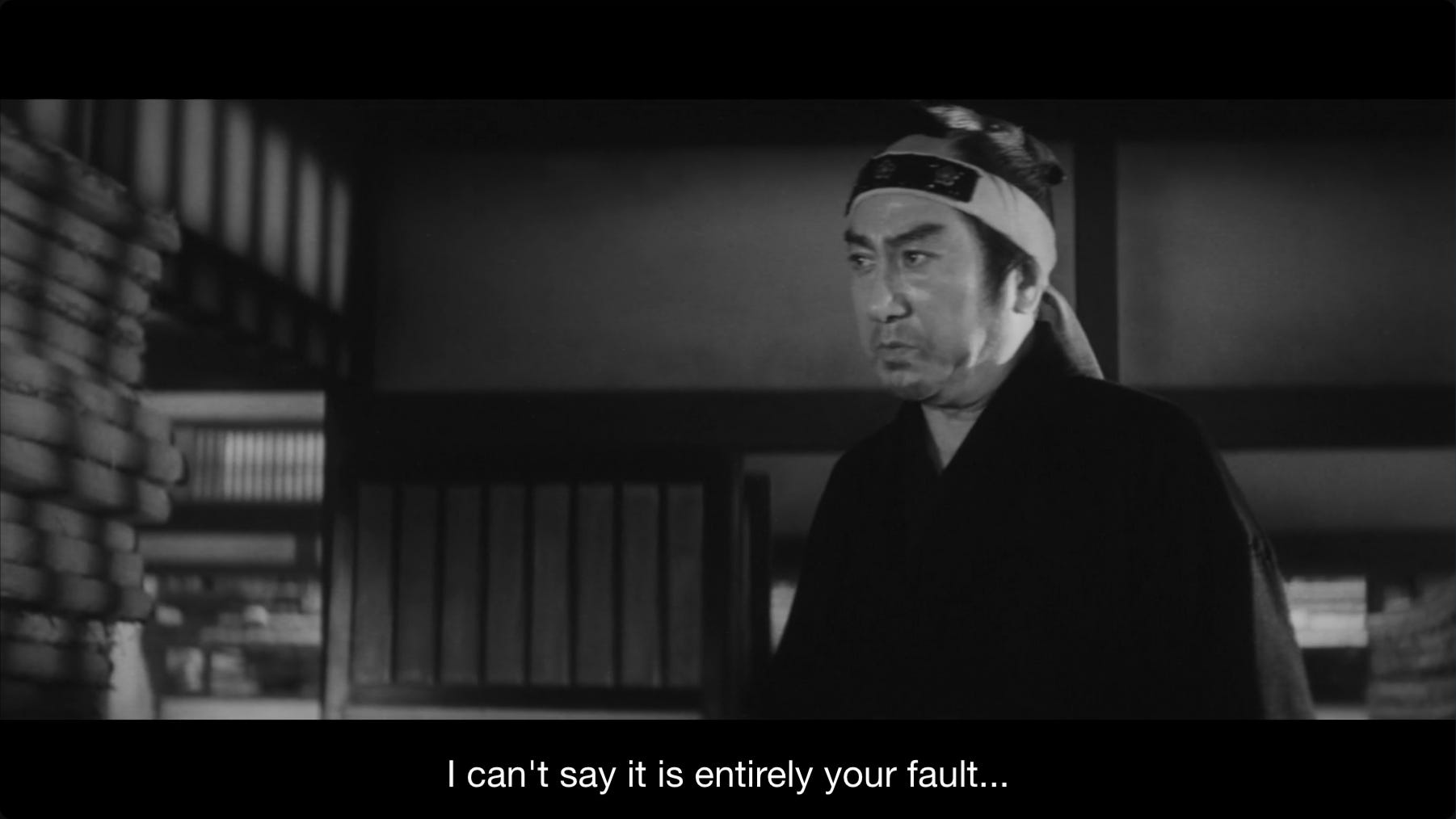
Shinzaemon tells his comrades after killing Naritsugu, “end this meaningless fight.” It is meaningless not just because Naritsugu has been killed, but because the confrontation itself occurs only because of the governments inability to object to the Shogun’s nepotism. Kudo seems to acknowledge that the samurai façade can produce perverse incentives. Hanbei ignores his ethical convictions in favor of personal enrichment and status. Shinzaemon cannot, nor does he even want to, pursue the life of an artist despite his prodigious shamisen skill.
Even understanding those shortcomings, 13 Assassins is a much more favorable, romantic view of the samurai than its contemporaries. The outlook is almost naive, with much of the characters plight coming from the machinations of daimyo like Doi and Naritsugu, the truly shiftless and corrupt compared to the committed, duty-bound samurai heroes.
Above all else, Shinzaemon is a hell of a cool character on screen. And this is a movie that’s full of them. For the scathing critique of samurai hypocrisy, look to Harakiri. 13 Assassins is a Shakespearean tale of those more heroic than flawed and inspiring than deconstructed. Nonetheless, Kudo’s work is at the peak of the genre.
Weekly Reading List
Music this week.
Also this.
Event Calendar: Gundam is Back in Theaters
Mobile Suit Gundam Hathaway: The Sorcery of Nymph Circe (2026) is gearing up for a full theatrical run starting on Thursday. There are at least seven days of showings nationwide, usually around 7pm at your local AMC. This is the second film of a planned trilogy, the first of which is available on Netflix. And, what do you know, I’ve written about it.

Until next time.