

Issue #432: Kiyoshi Kurosawa vs. Spike Lee for the Paradox Newsletter Lifetime Achievement Award

There are a lot of songs about nukes. More than I thought. This week’s Music League theme: “songs with lyrics about nuclear apocalypse or anxiety about nuclear weapons.” I was critical of this theme, thinking it might be generically homogenous. It was only after the playlist came out that one of my generous volunteer administrators for this season of Music League reminded me: I’m the one who came up with it. I forgor.
If you are a Music League spectator and are only going to listen to one playlist this go around, let it be this one. I would’ve happily taken the blame if the playlist sucked or was boring, but I’m even happier to take the credit knowing it is probably the best playlist we’ve ever had. The hits don’t stop: Sun Ra, Discharge, Kraftwerk, The Smiths, Prince, Bolt Thrower, Doom, and Watchtower.
There were also songs from bands and artists I’m not too familiar with, who I will now listen to a lot like Barry McGuire, Tom Lehrer, Orchestral Manoeuvres In The Dark, and Television Personalities. I have to give some special attention to a song that moved me particularly: “誰にも見えない匂いもない2012” by Rankin Taxi.
The title translates to “You Can’t See It, You Can’t Smell It,” an upbeat dance hall tune with lyrics like “radioactivity is horrible, radioactivity is cruel, radioactivity hurts.” This is the second version of the song by Rankin Taxi, opposing the use of nuclear power in Japan in a post-Fukushima climate: “if there’s an accident it’ll be a huge panic, one small mistake and everyone will die.” Taxi takes aim at corporate greed, the environmental costs of nuclear power, and the military-industrial complex in a radically incongruent musical mode.
Someone else submitted the Integrity cover of “Cease to Exist” which blew my mind. I like the lyrics of the Earth Crisis version, but the song is not good.
This is an incalculable improvement. Dwid even changes some of Karl’s lyrics, from “Mercy of madmen whose commands will cast us into World War Three. If the keys turn from the press of a switch all life as we know it will cease to exist” to “welcome to World War Three. Flip the switch, turn the key. Cease to exist.” Integrity strips down the lyrics at every opportunity to great effect.
I underestimated the scope of cautionary nuclear fables, and even more so just how fantastic the songs would be. What’s the common thread here? This is a subjectWorld War Three for the great songwriters of the past two generations.
This week I wrote about the three Kiyoshi Kurosawa films that have been screening around the country. This is the second time I’ll be writing about Chime (2024).

The 2024 essay is really good. Reading it felt like seeing it for the first time and I didn’t re-tread the same territory this week. If you don’t have it in your inbox, you’ll have to cop a paid subscription to read. I’m not just giving you a sales pitch saying that I’d be happy to have spent $5 to read it.
“I don’t know what possessed me”: Kiyoshi Kurosawa’s Troika of Chime, Serpent’s Path, and Eyes of the Spider
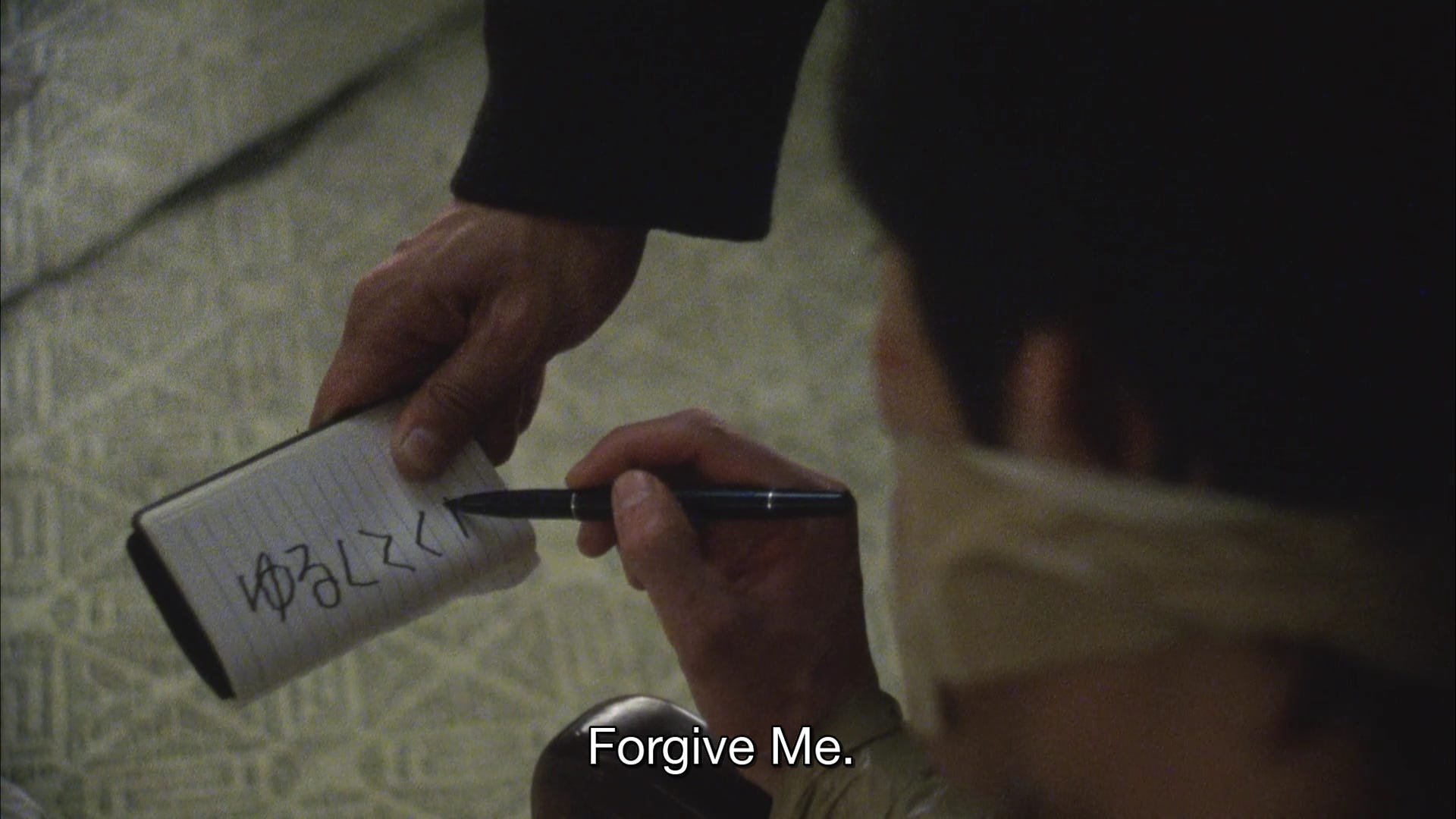
“Sensory knowing ceases, while spirit-urges proceed”
Without question, the most popular of Zhuangzi’s writings is the ‘butterfly passage.’ Lacan explores it in The Four Fundamental Concepts of Psychoanalysis (1973), Westworld (2016) evokes it in the fifth episode of the fourth season.

But I also like the fable of “Butcher Ding,” “The Dextrous Butcher,” or, as translated here, “Cook Ding”:
Cook Dīng was carving up an ox for Lord Wén-huì. Every touch of his hand, every move of his shoulders, every step of his feet, every bend of his knees—Swish! Thwack! The sounds rang out as he waved the knife with a swoosh, all perfectly in tune, as though performing the Mulberry Grove dance to the rhythm of the Jīng-Shǒu symphony.
Lord Wén-huì said, ‘Ah! Wonderful! How can skill reach this level?’
Cook Dīng put down his knife and replied, ‘What I care about is the Way. It’s beyond skill. When I first began carving oxen, what I saw was always the whole ox. After three years, I never saw the whole ox. Now I meet it with my spirit, rather than looking with my eyes. Sensory knowing ceases, while spirit-urges proceed. I go along with the natural patterns, strike in the main gaps, and guide the knife along the major seams, working according to the inherent structure. So I never hit the smallest ligament or tendon, much less a main joint.
A good cook changes knives annually—this is cutting. A poor cook changes knives monthly—this is hacking. Now this knife of mine I’ve used for nineteen years, carving thousands of oxen, and yet the blade is like it’s fresh from the grindstone. The joints have spaces in them, and the blade has no thickness. When what has no thickness enters what has space—whoo!—there’s surely more than enough room for the blade to wander about. This is why after nineteen years the blade is still like it’s fresh from the grindstone.
Still, whenever I come to an intricate place, I see it will be difficult and cautiously take care. I keep my eyes on it, work slowly, and move the knife delicately, until suddenly it has already come apart, like a clump of earth falling to the ground. I stand there holding the knife, looking all around, feeling completely satisfied and fulfilled, and then I wipe the knife off and put it away’.
Lord Wén-huì said, ‘Excellent! From hearing the words of Cook Dīng, I’ve learned how to nurture life’. (57-58, Fraser trans.)
Like all of Zhuangzi’s work, there’s a lot to read closely. The simple, presentist contradiction is between the realm of butchery and the idea of “nurturing life,” a contradiction that is smoothed over by the ideas of life’s circularity that romanticize human needs and wants in their subjection of the so-called ‘natural’ world. There’s also the realm in which Dīng works — one might “hack” or “cook,” but there’s not a name for what Dīng does. He cares about “the Way” as opposed to cultivating skill. “Spirit-urges” supersede “sensory knowing.” Then there’s the description of the knife’s relation to the joints, “the joints have spaces in them, and the blade has no thickness … there’s surely more than enough room for the blade to wander about.” Dīng reasons here from a first principle, that a knife moving through empty space should never dull. But it is only his precision, or rather, his adherence to “natural patterns” that allows him to insert his knife into a space which is otherwise invisible. The most conventional of his advice is, “whenever I come to an intricate place, I see it will be difficult and cautiously take care. I keep my eyes on it, work slowly … until suddenly it has already come apart.” His slowness is not a question of efficiency, or even time. Before he knows it, the job is done. My dad gave me this same advice, “when in a rush, slow down.” And Ding takes pride in his work, “feeling completely satisfied and fulfilled.”
Reading Zhuangzi’s parable against the grain, more in line with the contradiction between “to butcher” and “to nurture life,” is what Kiyoshi Kurosawa’s Chime (2024) allows.
Rewatching Chime with Serpent’s Path (1998) and Eyes of the Spider (1998) this weekend, I couldn’t help but think of Takuji Matsuoka (Mutsuo Yoshioka) as a Butcher Ding-like figure. If some other agency, “spirit-urges,” inhabits Ding to the end of virtuosic ox carving, those same “spirit-urges” take the form of the chime that drives Matsuoka to kill others and Ichiro Tashiro (Seiichi Kohinata) to kill himself. Though Matsuoka tells detective Makoto Otsuki (Ikkei Watanabe):
People come here to calm their negative emotions. Looking at the ingredients, touching them, and savoring the taste calms you down. So we feel fine even with dangerous things lying around.
One can imagine Matsuoka sitting in an interrogation room much like the one where Kenichi Takabe (Kōji Yakusho) interrogates Kunio Mamiya (Masato Hagiwara), looking at Otsuki as confused as he is in his first job interview, “I don’t know what possessed me to say that.”
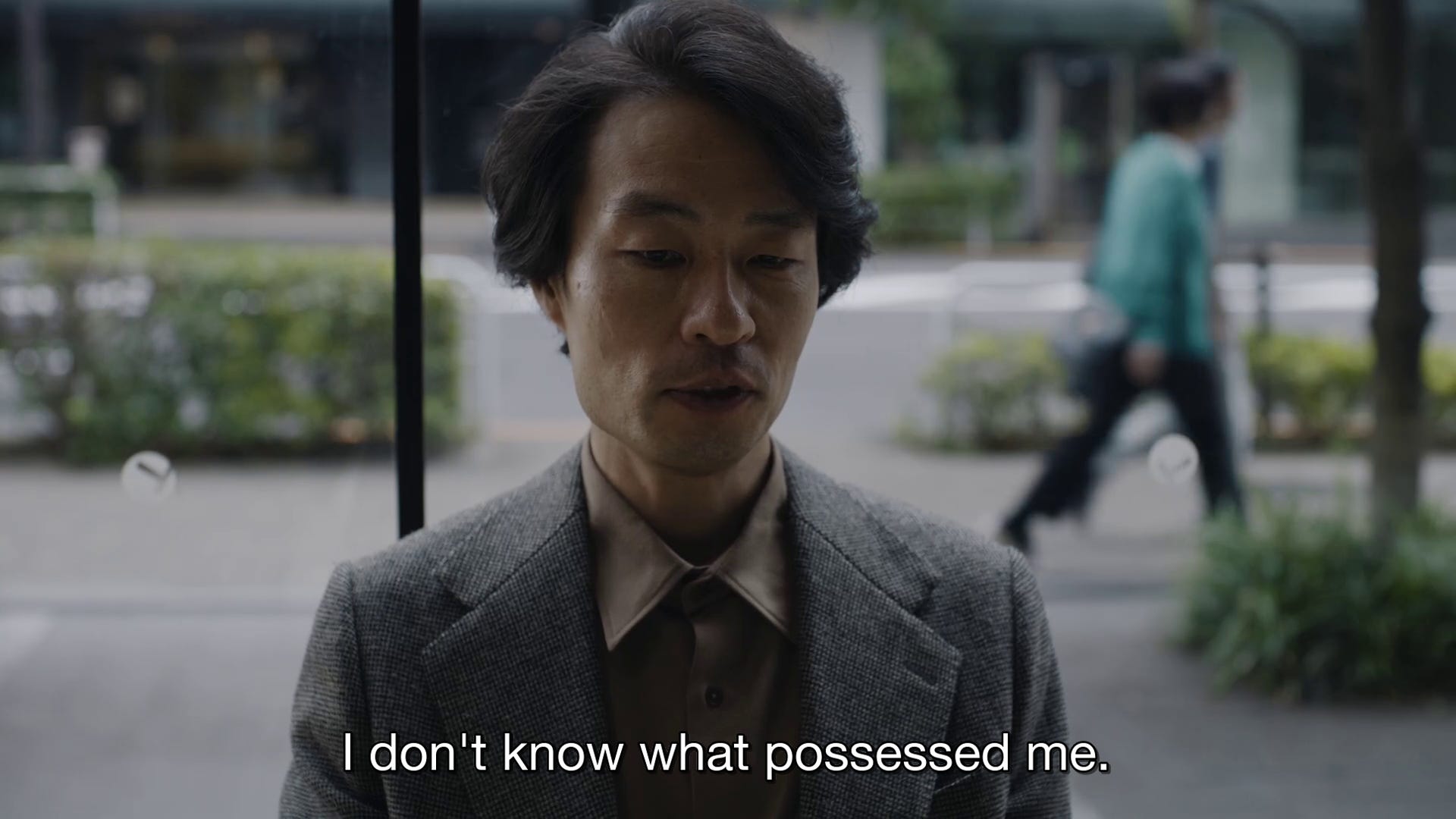
Something radical, and radically against one’s own self-interest, repeats in Chime. There’s the chime itself, Matsuoka’s repeated reference to himself for which he is castigated, his wife’s disposal of cans, the stabbing and cutting of onions, chickens, and human bodies. Freud writes in Beyond the Pleasure Principle (1920):
It is clear that the greater part of what is re-experienced under the compulsion to repeat must cause the ego unpleasure, since it brings to light activities of repressed instinctual impulses … the compulsion to repeat also recalls from the past experiences which include no possibility of pleasure, and which can never, even long ago, have brought satisfaction even to instinctual impulses which have since been repressed. (Norton Standard Edition 21)
In the simplest possible Freudian terms, these repetitions are a manifestation of something repressed. While Butcher Dīng may turn over his body to his “spirit-urges,” one cannot control what those urges motivate someone to do. Not all are so lucky. And Matsuoka kills with the wu wei of “effortless action” or “absence of self-initiated action” (Zhuangzhi: Ways of Wandering… 182). He is possessed by desire.
The repetitions that characterize desire in Chime generally entail some encounter between or among subjects. Elaborating Freudian Wiederholungszwang (’repetition compulsion,’ usually, in the Stardard Edition) as “repetition automatism” in “Seminar on ‘The Purloined Letter’,” Lacan writes:
It is not only the subject, but the subjects, caught in their intersubjectivity, who line up—in other words, they are our ostriches, to whom we thus return here, and who, more docile than sheep, model their very being on the moment of the signifying chain that runs through them.
If what Freud discovered, and rediscovers even more abruptly, has a meaning, it is that the signifier’s displacement determines subjects’ acts, destiny, refusals, blindnesses, success, and fate, regardless of their innate gifts and instruction, and irregardless [sic] of their character or sex; and that everything pertaining to the psychological pregiven follows willy-nilly the signifier’s train, like weapons and baggage. (Écrits 21)
Following this logic, Lacan chooses “automatism” over “compulsion” because the unconscious intervention into human action has several requirements. First, a pre-precondition, the subject must be the subject of the signifier, enmeshed in a signifying network that requires multiple subjectivities. Second, the subject’s desire is not the agent of their action, but rather the Lacanian view suggests the subject’s representation initiates the automatism of repetition. The signifier is displaced by itself in the course of representation.1 This, too, is a repetition.
Kurosawa, in some sense or another, is not ignorant of this labyrinthine Lacanian formulation. Chime hinges on the assertion of Matsuoka’s “I” in an intersubjective setting. Matsuoka’s excesses, along with those of his wife Haruko (Tomoko Tabata) and his son Kenichi (Koki Ishige) chafe against their ego. This ego corresponds to an ideal imposed based on a ideology of domestic obligation. None of them, however, can fulfill the roles into which they are cast precisely because they are displaced in the course of their casting with the movement of the signifier.
“If it’s the wrong guy, they’re all involved anyway”
If representation-as-repetition is critical across Kurosawa’s oeuvre, the most evident meta-repetition is across Serpent’s Path/Hebi no Michi and Eyes of the Spider/Spider’s Eyes/Kumo no Hitomi.2 Both films star Shô Aikawa as a man named Nijima Naomi. Though Nijima’s biography is different between the films, he is an enigmatic killer partially involved in a revenge plot in both. Serpent’s Path is my favorite among the two, where Nijima initially appears to be the Faustian tempter to Teruyuki Kagawa’s Miyashita — sharing a character archetype with Mamiya from Cure or Sano (Daiken Okudaira) from Cloud (2024). As it turns out, however, it is Nijima who is seeking revenge rather than thrills and his ultimate target is Miyashita.
Both Miyashita and, it is revealed toward the end of the film, Nijima have daughters who have been tortured and killed by an unnamed criminal organization. This organization sells tapes of the abuse. Miyashita, a former salesman of these tapes, is looking for the specific killer. Nijima faults the organization as a whole, and directs Miyashita to expose more and more members. Thus, the relationship between Nijima and Miyashita is less Sano and Ryōsuke (Masaki Suda) and more Teddy (Joe Pantoliano) and Leonard (Guy Pearce) in Christopher Nolan’s Memento (2000).

Following the discussion of Hannah Arendt’s “Personal Responsibility Under Dictatorship” (1964) two weeks ago, Nijima’s ostensible revenge quest follows the logic of her argument. She writes:
In every bureaucratic system the shifting of responsibilities is a matter of daily routine, and if one wishes to define bureaucracy in terms of political science, that is, as a form of government—the rule of offices, as contrasted to the rule of men, of one man, or of the few, or of the many—bureaucracy unhappily is the rule of nobody and for this very reason perhaps the least human and most cruel form of rulership. But in the courtroom, these definitions are of no avail. For to the answer: “Not I but the system did it in which I was a cog,” the court immediately raises the next question: “And why, if you please, did you become a cog or continue to be a cog under such circumstances?” (31)
Nijima, like Arendt, faults both the system and the so-called “cogs” in the system’s machinery — even as every supposed killer implicates someone else. He holds to account every person with even proximate participation in the act of torture or the self-enrichment resulting from that torture.
Serpent’s Path repeats, in part, out of necessity. It is a narrow film with only a few sets; including two of Kurosawa’s signature empty warehouses. Part of Nijima’s sinister quality comes from his activity in one of those sets, a classroom where he teaches gibberish.
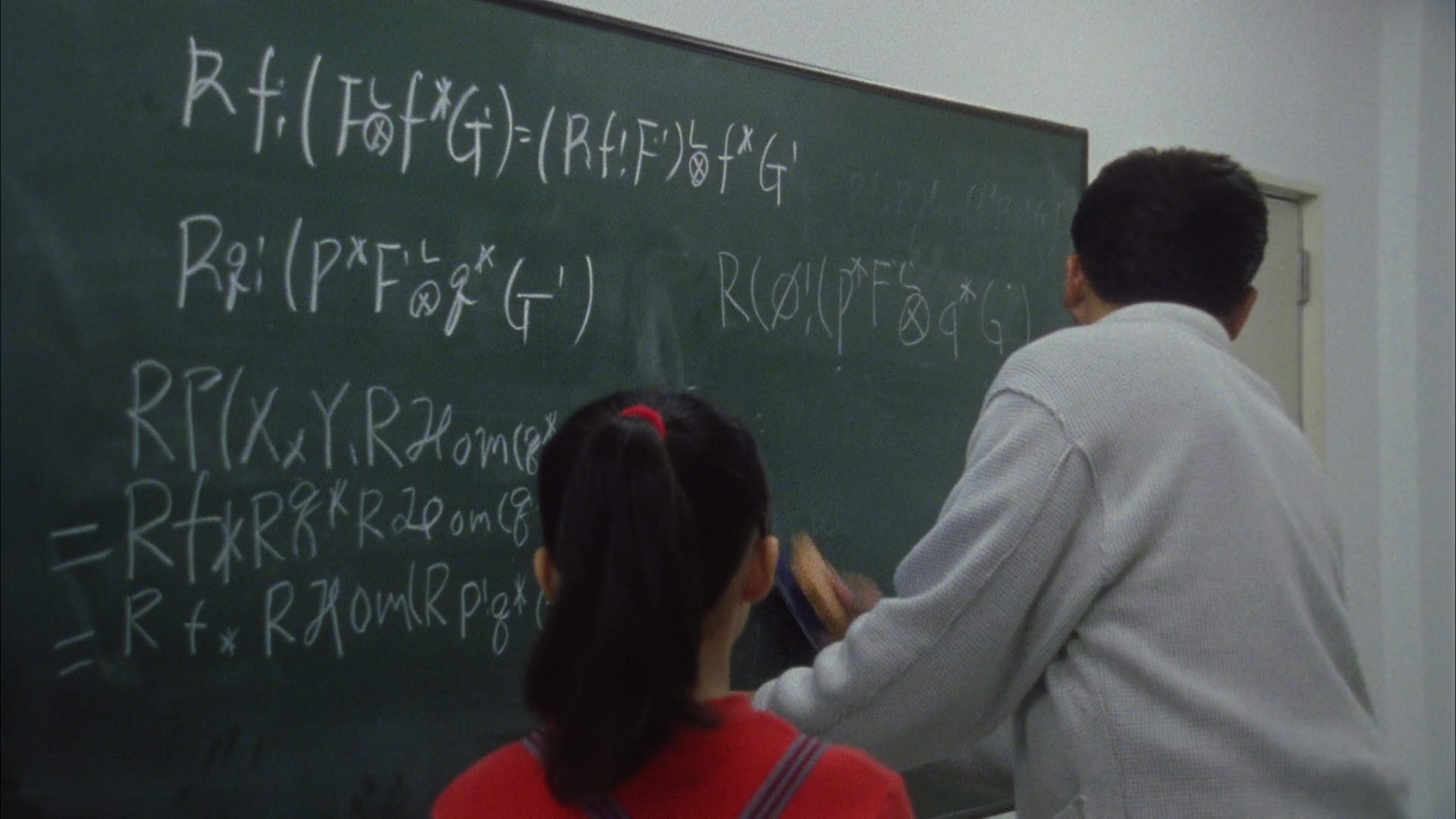
There’s something cultish about Nijima’s seminars where he cautions students of all ages that an incorrect result in these nonsensical equations could lead to “space turn[ing] inside out and time go[ing] backwards.” Knowledge is power for Nijima, both in the sense of his bizarre writing on the chalkboard and the truth of who committed the actual murder of the children. That power is also dangerous, with the power to turn around time or cause the world to “fall apart.” Nijima knows what Miyashita is looking to uncover through the entire film, positioning himself to achieve his own goal of killing the entire organization. He forces Miyashita to reckon with knowledge’s destructive quality.
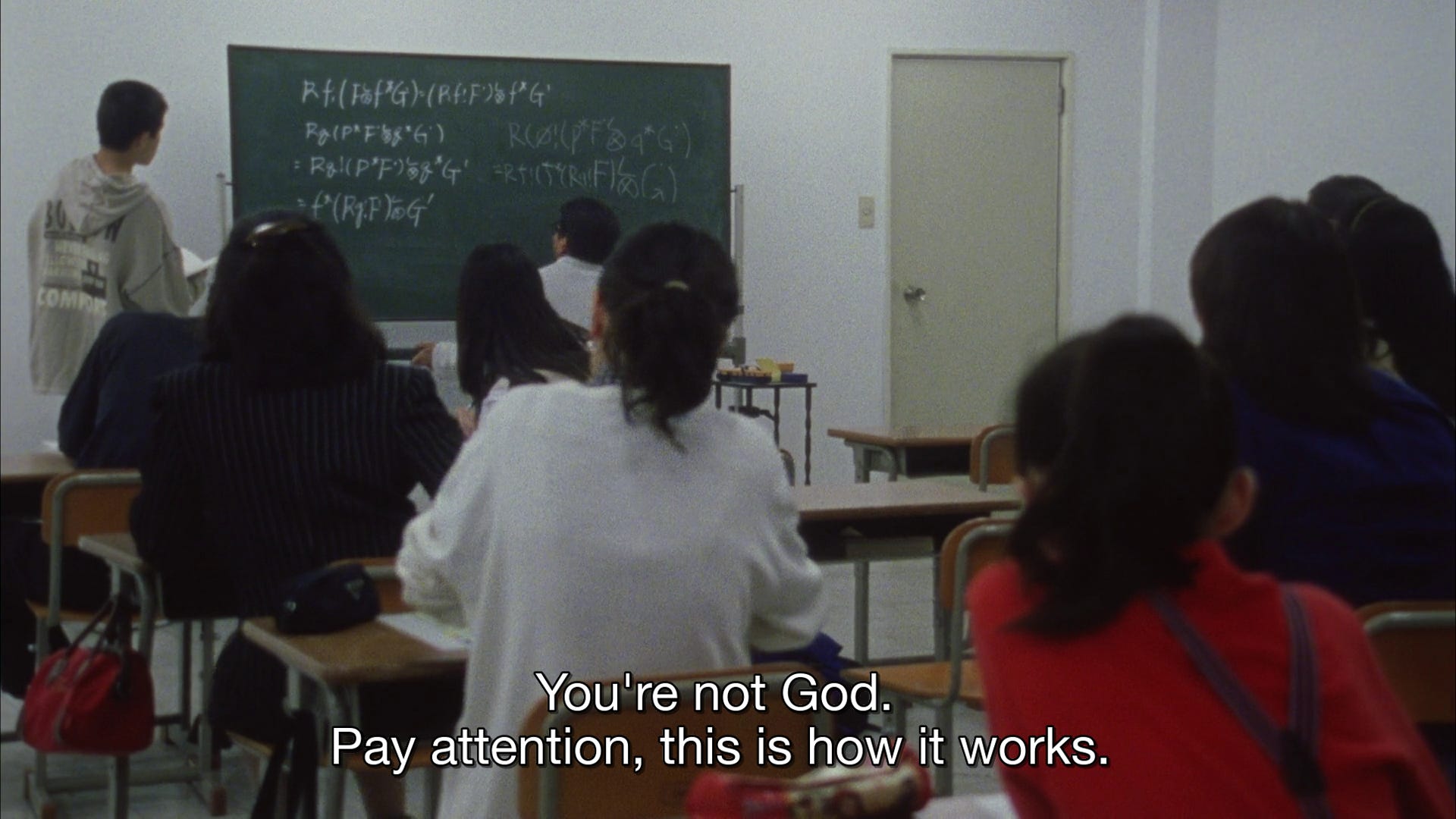
But Nijima’s true identity, or even his corporeal reality, is called into question. Miyashita may just as well be haunted by his own conscience within the circuitous dream logic of Serpent’s Path.
“Is there anything you’d sacrifice your life for?”
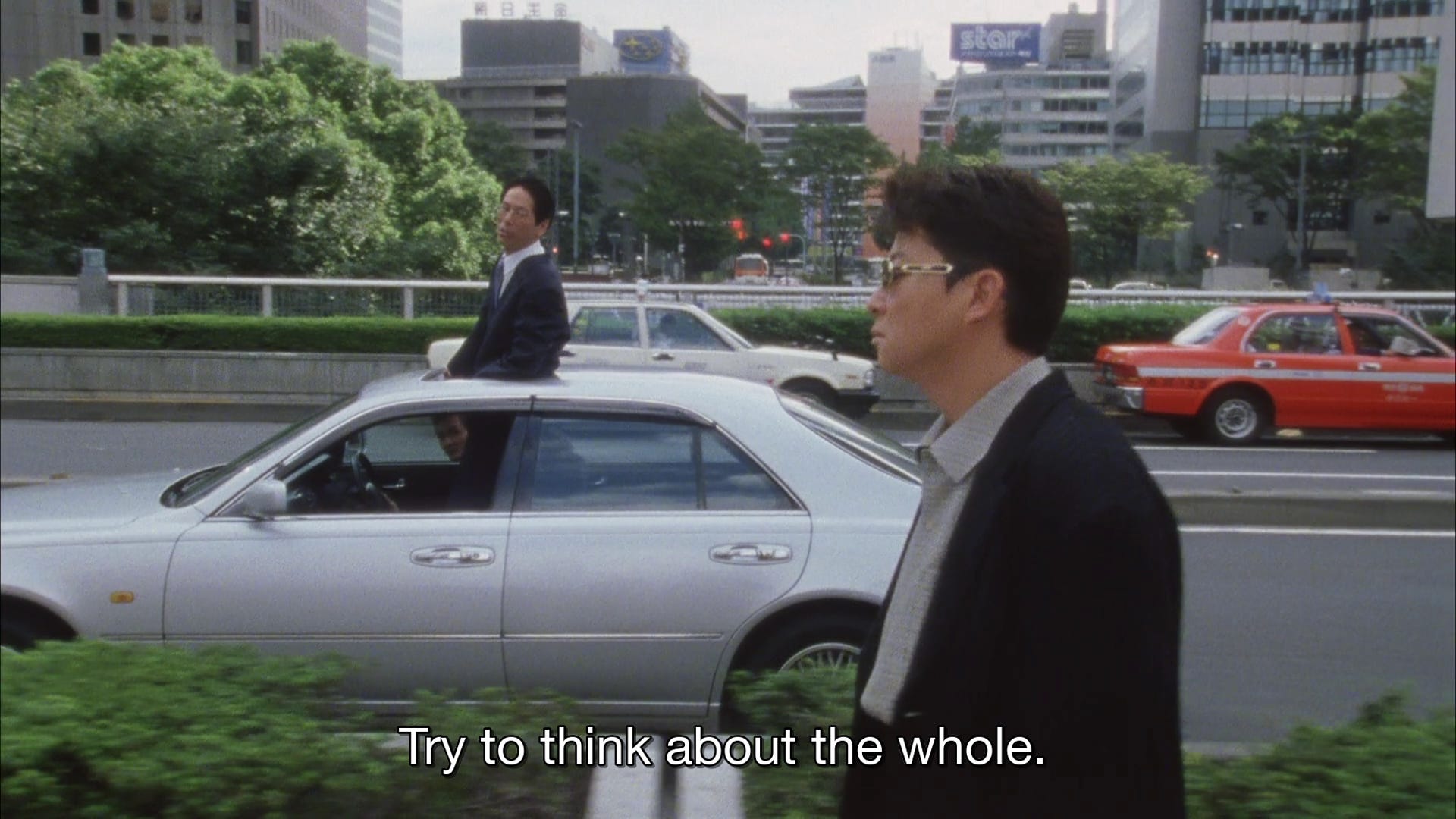
Eyes of the Spider is the more comedic of the two Nijima films, tying together the continuity of domestic anxieties from Cure to Chime and Cloud. This version of Nijima is not just a father, but a husband. The film is full of vignettes of a home life resembling Takabe’s or Matsuoka’s. Behind the facade, Nijima is a disaffected hitman working on behalf of a shady government organization with a group of yakuza aspirants including his high school friend Iwamatu (Dankan).
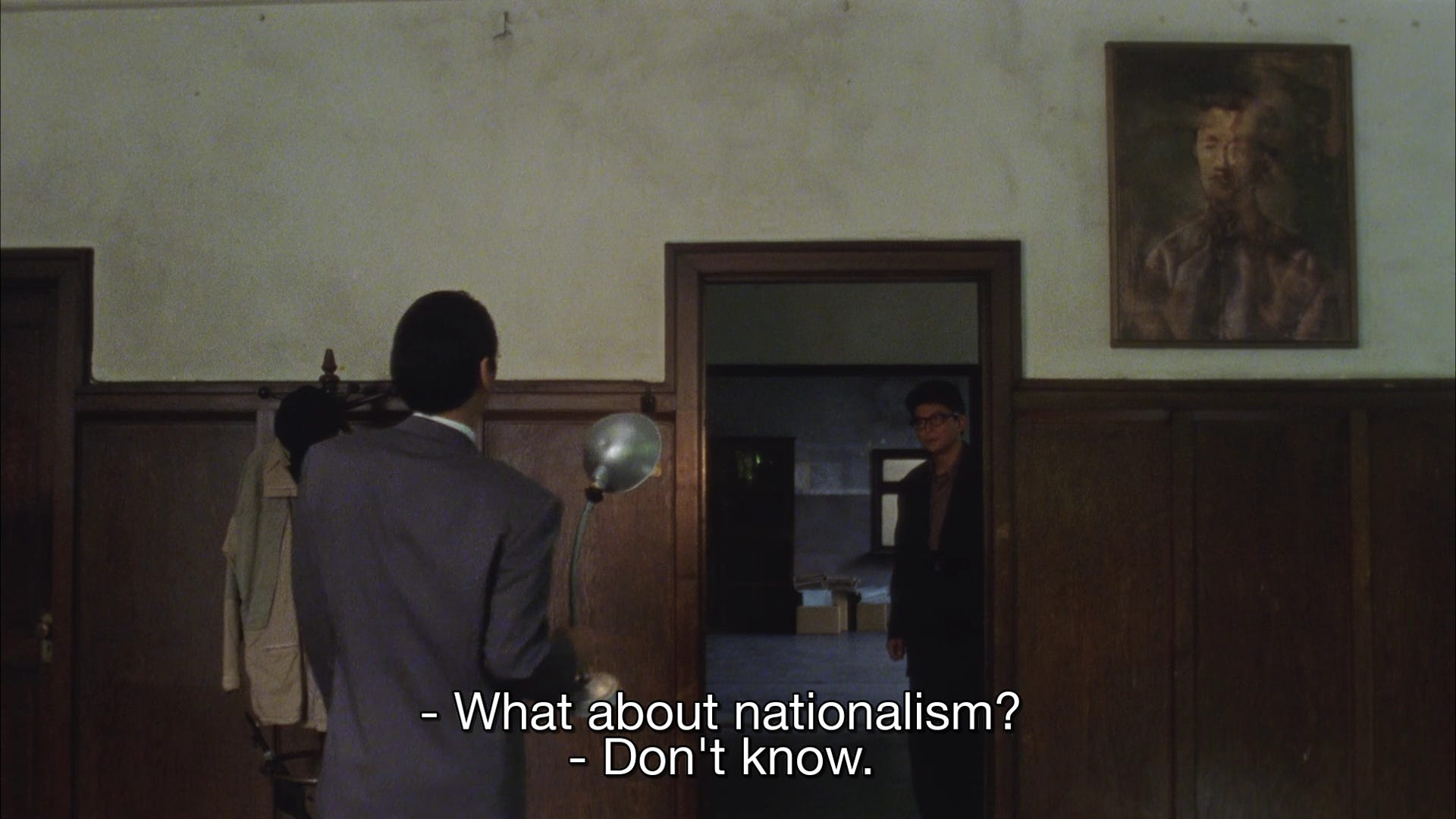
The film explores a number of Kurosawa preoccupations in addition to the ill-fit of domesticity for the ungovernable subject. Nijima kills effortlessly, inexplicably skilled as an assassin. There is a lingering, unexplored conspiracy behind the scenes of the film in which Nijima is caught. In the end, Nijima is a working stiff trying to pay his mortgage. This, too, forces subjectivity and desire into frames that cannot accommodate them.
This version of Nijima’s disaffection comes in the wake of an unsatisfying revenge that, rather than leaving Nijima unsatisfied, seems to render him too satisfied and unable to behave in accordance with demand or desire. Instead, he has become a cog, moving only when prompted through paths set out for him.
Again, Kurosawa shows a sinister side of a mastery that defies conscious thought. Nijima doesn’t need passion to kill. Instead, he kills because he can; and because there are worse ways to make a living.
Weekly Reading List

https://www.lrb.co.uk/the-paper/v48/n09/thomas-nagel/i-m-not-sorry — Thomas Nagel vs. T.M. Scanlon is a clash of philosophical titans. And Nagel empties the clip in his review of Scanlon’s Morality and Responsibility (2025). From my perspective, this is a fair and good faith critique of Scanlon’s work and some of its most ridiculous conciets. The subtext of Nagel’s analysis is a through line between Scanlon’s thinking and the moral universe of social media condemnation.

Michael Sugrue’s vintage lectures archived on youtube are absolute gold. I watched a few this week and am shocked to realize I’ve never posted them in the newsletter before.
Event Calendar: Gundam is in Theaters
Sparse updates this week — just added Mulholland Drive (2001) and Taxi Drive (1976) both at Brattle and both in 35mm this week. But really what you should do is watch Mobile Suit Gundam: Hathaway (2021) at your house and then go see The Sorcery of Nymph Circe (2026) so you know what the hell I am talking about when I write about it next week. There will be Plato.
Until next time.
You can read more about this in my upcoming essay on Cure for Studies in Gender and Sexuality.
I’m not sure if it is intended, but as a native English speaker there is an apparent homology between the romanization of ‘Hebi no Michi’ and ‘Kumo no Hitomi’ that is better conveyed in the localization of the latter as Spider’s Eyes. However, Eyes of the Spider is the official English title in every source I can find. Brattle, however, screened it with the title Spider’s Eyes.