

Issue #435: Looping the Critical Discourses (in the Backrooms)
What’s in a name? In Music League, one name reigns supreme: John Jacob Jingleheimer Schmidt.
Even as an adult, I find this song profoundly confusing. Is its premise really that there are two people, the speaker and the subject of the gaze, named John Jacob Jingleheimer Schmidt? In the somewhat ostentatious name and its repetition, we also have a precursor of what is becoming known as a ‘vocal stim.’
The Lil Uzi Vert and Nav song on the playlist was my contribution. I took it as an opportunity to share some beautiful music with the world more than angle for points. Earnestness is sometimes rewarded.
Catastrophes of Racial Signification in Backrooms
The target of the discourse machine will always be the tele-visual object ostensibly making a corporation a lot of money. Twitter still doesn’t quite have Heated Rivalry (2025) out of its system. There have been no shortage of things between its air date, I am sure, to command a lot of attention. Obsession (2026) has been a routine target of analysis, critique (non-moralizing), and criticism (moralistic). It is unlikely very many good ideas have come up around the film other than relating it to Vertigo (1958).

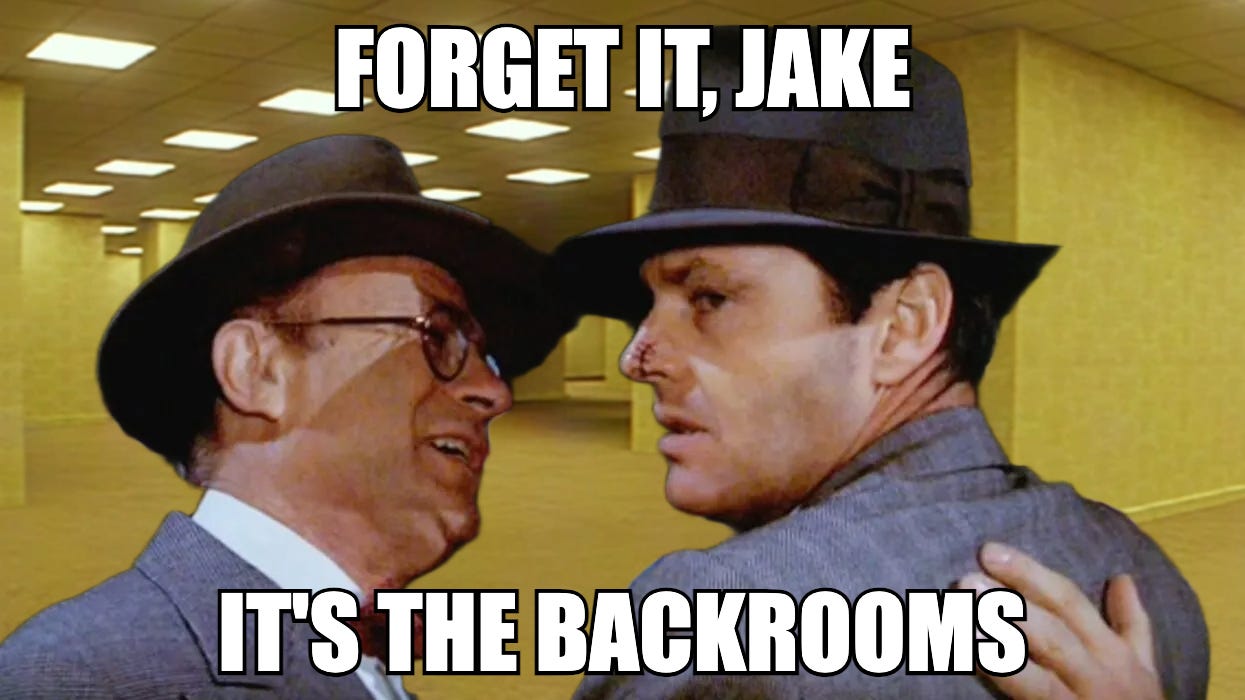
What’s the next target? You don’t need a map: it’s Backrooms (2026). I’m not going to degrade myself by talking about the financial returns of these films. For all I care, Obsession made six quadrillion dollars and Backrooms made a gazillion. And all on a shoe string budget! How impressive. What is more impressive to me is when popular taste overlaps with mine. This is the case with Obsession: the movie is very good. Backrooms is also okay. But how okay, good, or bad it might be in a qualitative sense, part of the discussion of Backrooms has attempted to litigate where it sits in a moral continuum. Here we are again. If the Backrooms of the film were as labyrinthine as those of the creepypasta, I might argue their un-mappable territory is a metaphor for the repeated arrival at the same sorts of critical inquiry.
Backrooms as an object of scrutiny on the topic of social consciousness and, as you’ll see, racial politics, may not make sense on its face. It is a feature film adapted from a series of youtube short films in turn adapted from a post on the 4chan image board. Somewhere along the line, there are a few video games, including the popular Escape the Backrooms (2022). This is thin, but emergent subject matter. Ideas and interpretations of ‘The Backrooms’ as such have popped up widely across the internet. But Kane Parsons is now the de facto custodian of the lore and canon, with his large body of work across the youtube videos and now the corporate sponsored feature.
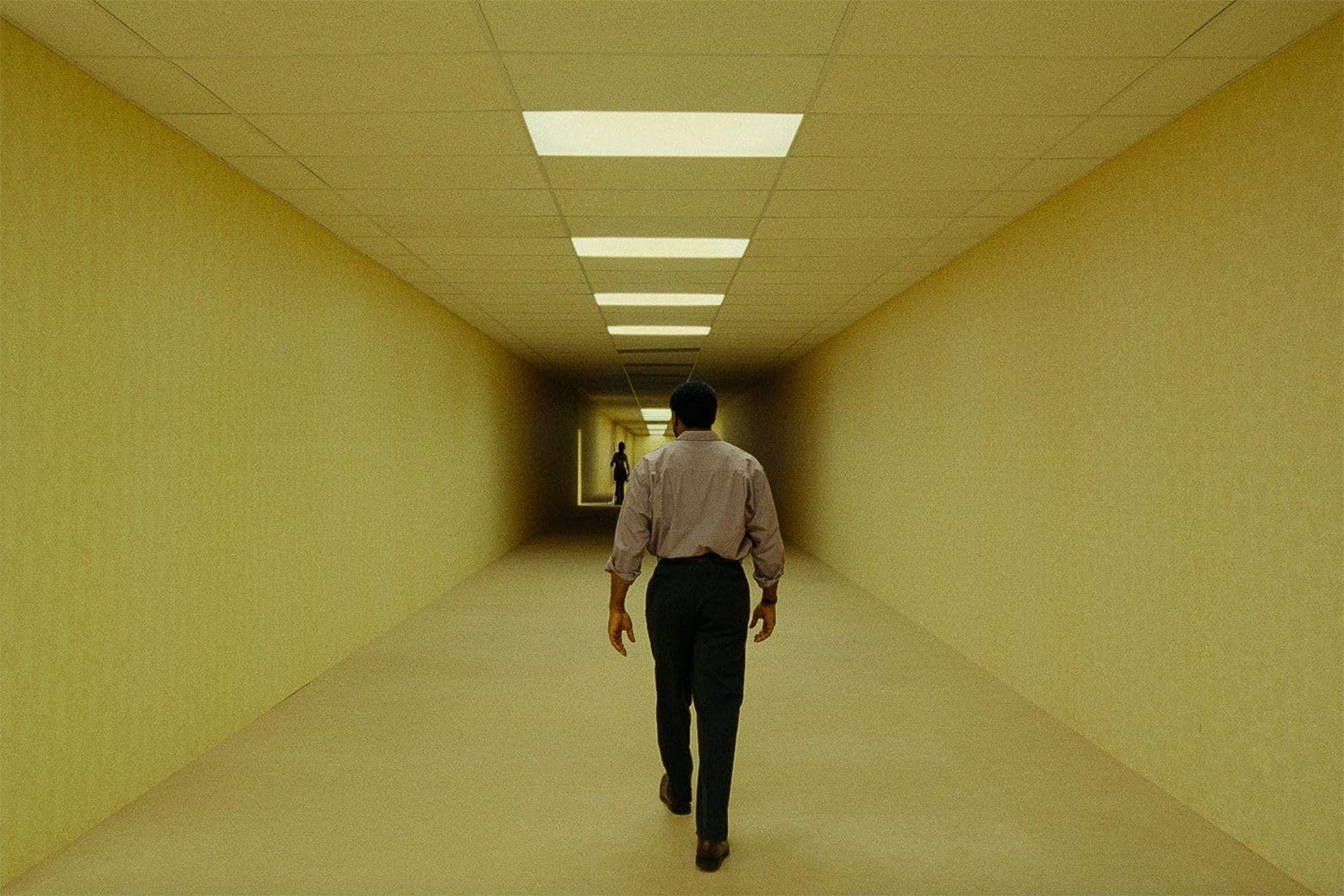
As for the film, which represents the concretized ‘The Backrooms’ canon, it follows a failed architect, Clark (Chiwetel Ejiofor) and his therapist Mary (Renate Reinsve) as the duo descend into the mysterious backrooms in parallel. The symbolism here should be obvious: the disciplines of architecture and talk therapy attend to the physical and mental components of the backrooms. Parsons pays his dues to the original backrooms image, taken in a furniture store, staging the entryway to his film’s backrooms through Cap’n Clark’s Ottoman Empire. Again, there’s symbolism riding the line between substantial and a bit too cute: any encounter with the backrooms seems to invite colonial aspirations.
One common refrain in criticism of Backrooms as an aesthetic object should sound familiar to horror fans: “nothing happens.” Despite the ostensible incongruity between the ‘weight’ of the source material and the seriousness of the feature film’s subject matter, not much has surprised me about its reception. This critique is no exception. One need look no further than Paranormal Activity (2007) for a critical antecedent to Parsons’ film. In Roger Ebert’s Paranormal Activity review he writes, “It illustrates one of my favorite points, that silence and waiting can be more entertaining than frantic fast-cutting and berserk f/x. For extended periods here, nothing at all is happening, and believe me, you won’t be bored.” Backrooms conveys its horror in the same way. Not much happens. It is unsettling. The disquieting space of the backrooms is brought to life in a way that will stick with you if you see your movies in one of the many megaplexes propping up otherwise abandoned malls.
Another criticism, far less common, indicts Backrooms for explicit or implicit racism. By casting Chiwetel Ejiofor as Clark, various parts of his character background and some of the imagery associated with the more horrifying elements of the film run up against anti-Blackness. That is, at least, my interpretation of the argument. I have not been particularly impressed or compelled by the close reading that has attempted to substantiate these claims, but these are fair and worthwhile avenues of exploration. However, any reading of Backrooms as anti-Black should not treat the film as an exception. It may or may not be part of a tapestry of how works signify in a society found on racism and with myriad observable outcomes resulting from systemic racism. This is true of any major U.S. motion picture.
Why should what Backrooms represents call for a moral condemnation of the film and its author? And, to the opposite point, why should a work with supposedly ‘low-brow’ subject matter be immune to rudimentary cultural criticism? Asking both of these questions is a re-litigation of asked-and-answered disputes of cultural studies. A work’s author is not on the hook for the social ills it represents. Sometimes those things will enter the film without any agency on the author’s part. To the second question, a work is worthy of study to the degree the critic can make a case for its substance by enacting the critique. My reading is the backrooms, big B, little b, italics, or otherwise, has many worthwhile angles of entry for serious analysis.
When it comes to Backrooms and racism, what is most interesting to me is the difference between Clark on the page and Clark as an embodied character played by Ejiofor. Clark’s race is never explicitly addressed in the film. There is virtually nothing, other than his embodiment, to make a determination about his racial identity. This, in itself, might be a point of contention. However, what it suggests to me is that this role could’ve gone to any man, of any race, and the incidental racial embodiment of the characters — both Clark and Mary — makes this reading possible.
Reading Backrooms and the racial-political problematics that emerge from it alongside the film Suture (1993) is productive in getting to the core of what I think is interesting here. In Desiring Whiteness (2002), Kalpana Seshadri-Crooks writes about Suture:
But the sense of bewilderment that this film generates turns on that point where the traditional narrative would demand an absolute suspension of our disbelief: the physical resemblance of the two brothers. In this film, however, it is not our disbelief that we are called to suspend, it is our credulity. We as spectators know what no one else in the film seems to know, recognize, realize, or care about, and this is that not only are the two men nothing alike (there is not the remotest resemblance, physical or otherwise, between them) but that Clay and Vincent are of different races. Vincent is white, and Clay is black. Like Magritte’s famous painting Ceci N’est pas une Pipe, this film asks us to consider the relation between signifies and visual images. (104)
She goes on to explicate the connection between the Lacanian notion of suture and the title of the film:
In other words, suture names the process by which the subject comes to find a place for itself in a signifying chain by inserting itself in what is perceived as a gap, a place-holder for it. The subject appears in the chain as a signifier, thus making a subjective meaning possible. (105)
To this end, it is not the case that Ejiofor is cast in a ‘white’ character playing the role of Clark. Clark, as a plot function written in a script, can only exist as a gap that is partially filled in the act of performance. Ejiofor’s performance brings Clark to life on the screen, regardless of what was consciously or unconsciously ‘intended’ by Parsons regarding the character’s race.
There is something to be said for the chaos generated when racial signifiers run amok. Backrooms is far from the most extreme example. Only a narrow set of close readers seem to be concerned with any racial-political subtext. Fewer still have made such considerations about films like The Purge (2013) and The Bye Bye Man (2017). Whatever Parsons culpability in representing stereotypes — racial or gendered — the fruit of what he inserts into the signifying chain is precisely the critical discourse we have in front of us. We need not deny it. Rather, we should think about it.
Weekly Reading List
Apparently Quentin Tarantino said something flattering about The Rip (2026) in Sight & Sound. Joe Carnahan’s remarkable thriller is one of the best things I’ve seen this year. I highly recommend it.
Event Calendar: Support Your Local Drive-In
No updates this week, but I’m near the Wellfleet Drive-In Theatre. Maybe I’ll go this week? If you have a drive-in theater near you this summer, pay them a visit.
Until next time.